Clear Sky Science · en
Non-invasive determination of disease activity in Crohn’s disease by serum luminex profiling
Why this research matters to patients
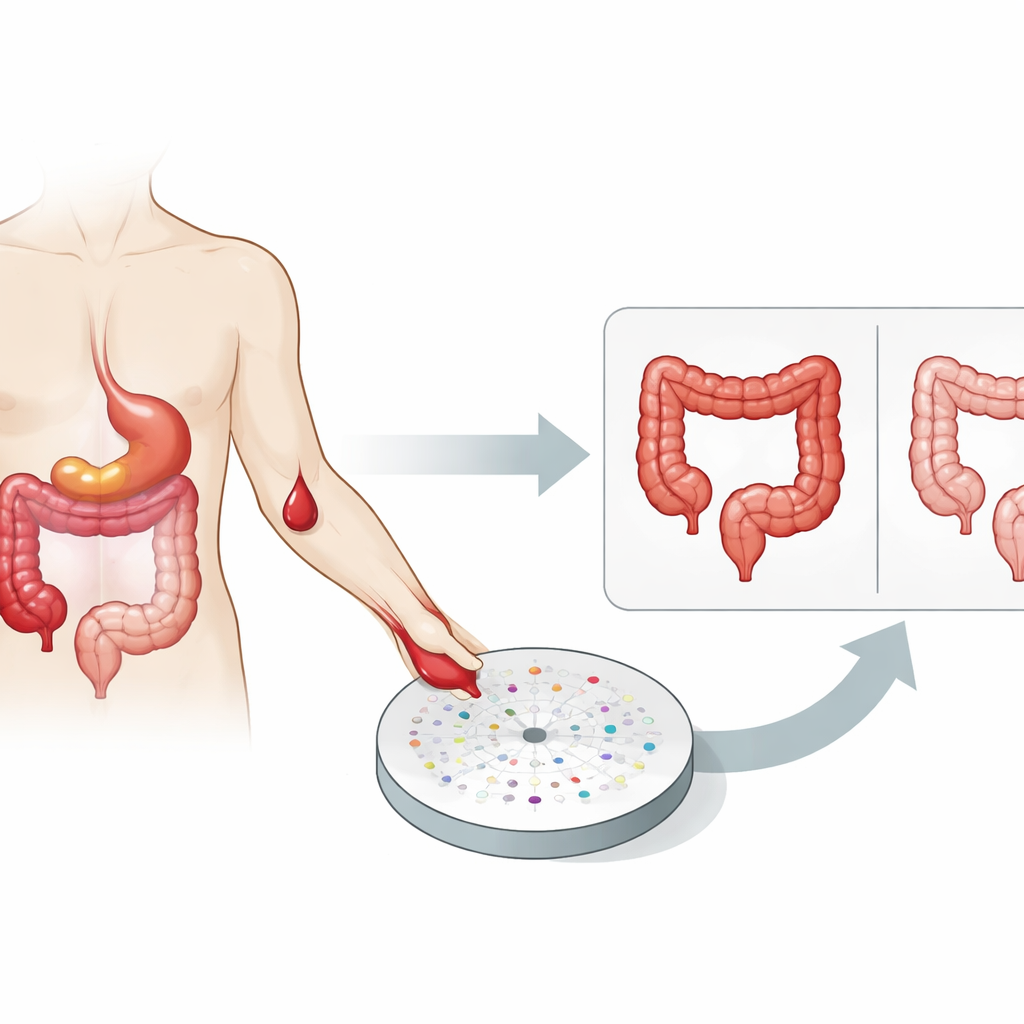
Crohn’s disease is a long-lasting inflammation of the digestive tract that often strikes people in the prime of life. To see how active the disease is, doctors usually rely on colonoscopy and tissue biopsies—procedures that are uncomfortable, time‑consuming, and expensive. This study asks a simple but powerful question: could an ordinary blood draw tell us just as much about what is happening inside the gut, helping patients avoid so many scopes?
Looking for answers in the blood
The researchers followed 103 people with Crohn’s disease and compared them with 40 people undergoing colonoscopies for routine reasons but who did not have inflammatory bowel disease. At the time of colonoscopy, everyone gave a blood sample, filled out symptom questionnaires, and had small pieces of tissue collected from the intestine. The team then used a technology called Luminex profiling, which can measure dozens of immune‑related proteins in a tiny amount of blood, to map each person’s “inflammation fingerprint.”
Comparing symptoms, scopes, and tissue
In Crohn’s disease, symptoms like pain and diarrhea do not always match what doctors see on a scope or under the microscope. To capture all angles, the team graded disease activity in three ways: a symptom score (CDAI), an endoscopic score based on what the camera showed in the bowel (SES), and a histologic score describing how inflamed the tissue looked under the microscope. They then asked which blood proteins differed between people without Crohn’s and those with Crohn’s, and which of those proteins tracked with active versus quiet disease by each of these three measures.
Many signals change, but one stands out
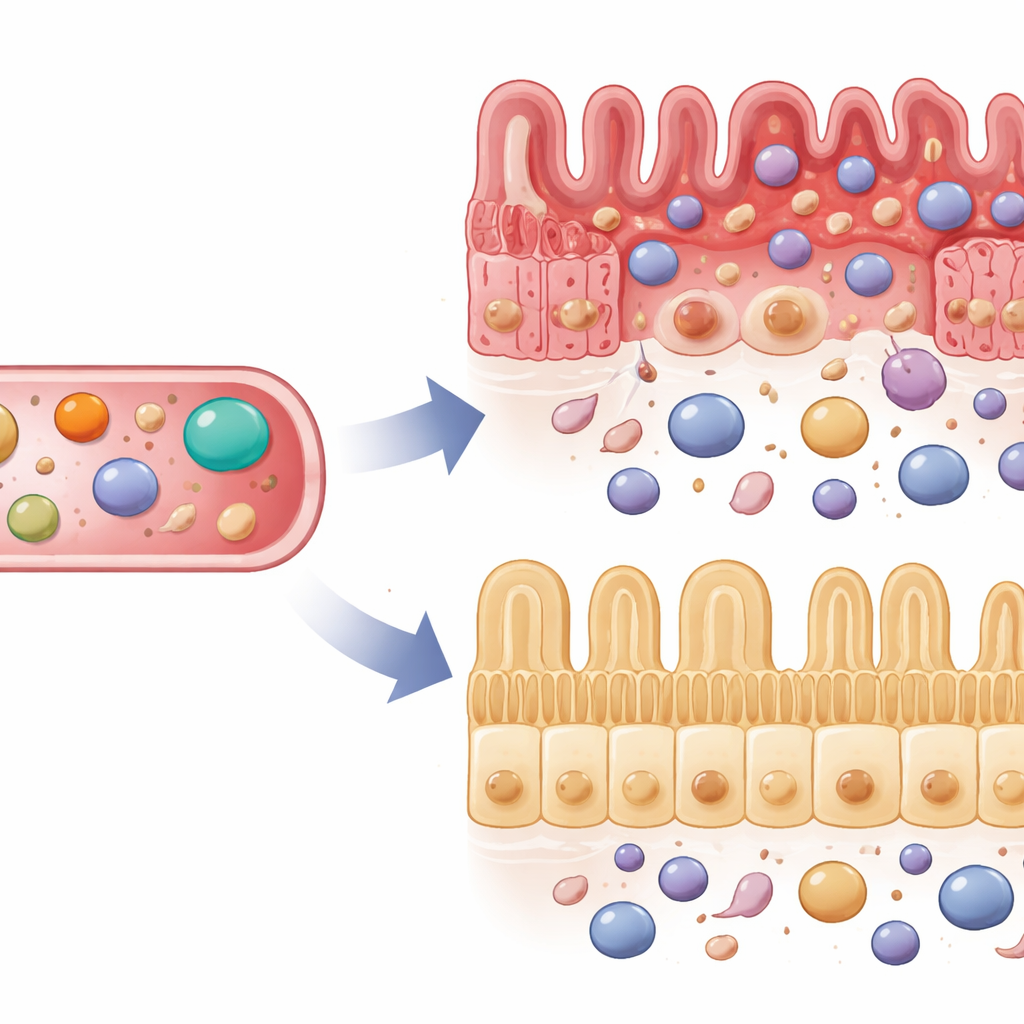
Dozens of immune messengers were higher in people with Crohn’s disease than in controls, highlighting the broad immune disturbance in this illness. Several of these markers rose when the bowel looked inflamed on endoscopy or by tissue examination. Yet only one protein, a chemokine called CXCL9, consistently separated active from inactive Crohn’s disease when judged by what doctors saw during the scope and in the biopsy slides. Higher levels of CXCL9 went hand‑in‑hand with more severe damage in the gut lining, while common blood and stool tests used today—C‑reactive protein and fecal calprotectin—were less tightly linked to these direct measures of inflammation.
From a complex pattern to a simple blood marker
Statistical analyses showed that CXCL9 levels correlated strongly with the endoscopic score and with microscopic severity, but not with symptom scores alone. In other words, CXCL9 captured what was happening in the gut wall more reliably than how sick patients felt. When the team tested how well CXCL9 could distinguish active from inactive disease, the results were encouraging: its performance was better than that of C‑reactive protein, a standard blood test widely used in clinics today. These findings held up even when accounting for the fact that many patients were taking powerful medications such as biologic drugs, which themselves can alter immune signals.
What this could mean for daily care
This work suggests that a focused blood test—especially one measuring CXCL9—could someday help doctors tell whether Crohn’s disease is truly inflamed or in quiet remission, without always needing to look directly inside the intestine. While larger and more diverse studies are needed before such a test becomes part of routine care, the study provides a clear proof of concept: carefully reading the immune messages circulating in the bloodstream may offer a non‑invasive window into the gut, guiding treatment decisions and potentially reducing the number of invasive procedures patients must endure.
Citation: Raffa, G.A., Tyree, R.N., Carson, K. et al. Non-invasive determination of disease activity in Crohn’s disease by serum luminex profiling. Sci Rep 16, 8867 (2026). https://doi.org/10.1038/s41598-026-42925-x
Keywords: Crohn’s disease, non-invasive biomarkers, CXCL9, gut inflammation, serum cytokines