Clear Sky Science · en
Thermo-hydro-mechanical response of energy-piled walls under varying wall configurations, pipe layouts, and seepage conditions
Turning Basement Walls into Clean Energy Sources
Most city buildings need both strong underground walls to hold back soil and steady supplies of heating and cooling. This study explores a technology that lets one piece of infrastructure do both jobs at once: energy-piled walls. By carefully studying how these walls behave when they heat up, cool down, and interact with groundwater, the researchers show how engineers can safely tap the ground as a renewable energy source while still keeping excavations and basements stable.
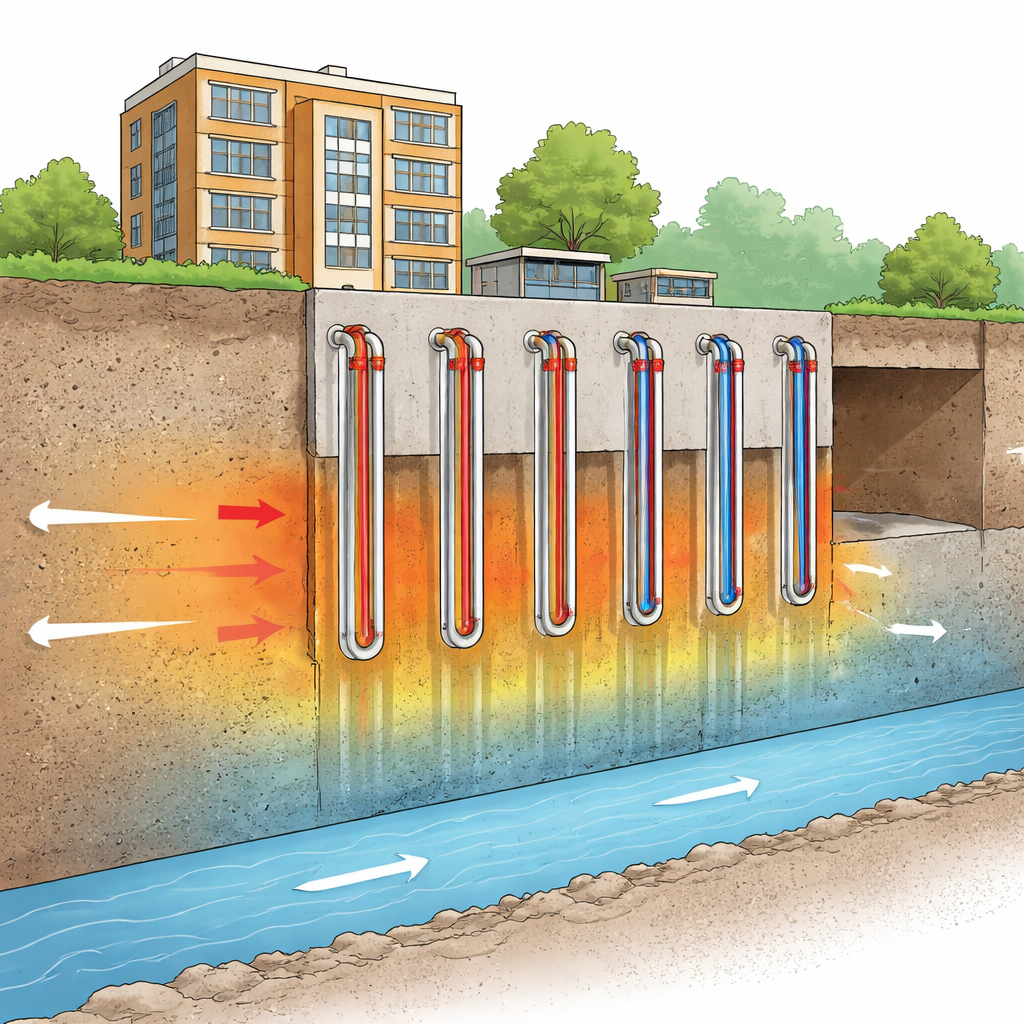
Walls That Store and Share Heat
Energy-piled walls are rows of concrete piles that both support the ground and act as underground heat exchangers. Plastic pipes run inside each pile, carrying water that either absorbs excess heat from a building in summer or brings stored warmth back in winter through a heat pump. Because the ground temperature a few meters below the surface stays fairly constant through the year, these walls can move large amounts of heat with far less electricity than traditional air conditioners or heaters. The catch is that repeatedly warming and cooling the piles also makes them expand and contract, which can subtly push and bend the wall and the surrounding soil.
Virtual Experiments Beneath the City
To understand these hidden movements, the team built detailed three-dimensional computer models of typical retaining walls for excavations up to 12 meters deep. They ran the models for six months of continuous heat rejection, mimicking a cooling season in which the building above is dumping heat into the ground. The simulations tracked heat flow in the pipes, temperature changes in the concrete and soil, groundwater movement, and the resulting stresses and tiny shifts in the wall. The researchers compared different wall types (a simple cantilever, a wall supported by two thick slabs, and a wall braced by many thinner slabs), two pipe layouts (4U-shaped loops and a spiral), and a wide range of soil stiffness and permeability, from loose sands to hard rocks and clays.
Small Movements, Local Stresses, and the Role of Water
The models show that, even under strong heating, overall sideways movements of the walls remain very small—less than about two millimeters—so service performance is not the main concern. However, the pattern of bending and internal stress changes with wall type, ground stiffness, and how the wall exchanges heat with its surroundings. Walls in stiffer ground or in contact with surfaces held at a constant cool temperature develop higher bending moments, especially near the ground surface and at the bottom of the excavation. The layout of the pipes also matters: although the spiral and 4U-shaped designs move similar amounts of heat, the spiral layout produces slightly larger peaks in thermally induced stress. In critical spots such as the junction between piles and supporting slabs, these tensile stresses can exceed the cracking strength of concrete, suggesting that extra reinforcement or crack-control measures are needed there.
Groundwater as Helper and Troublemaker
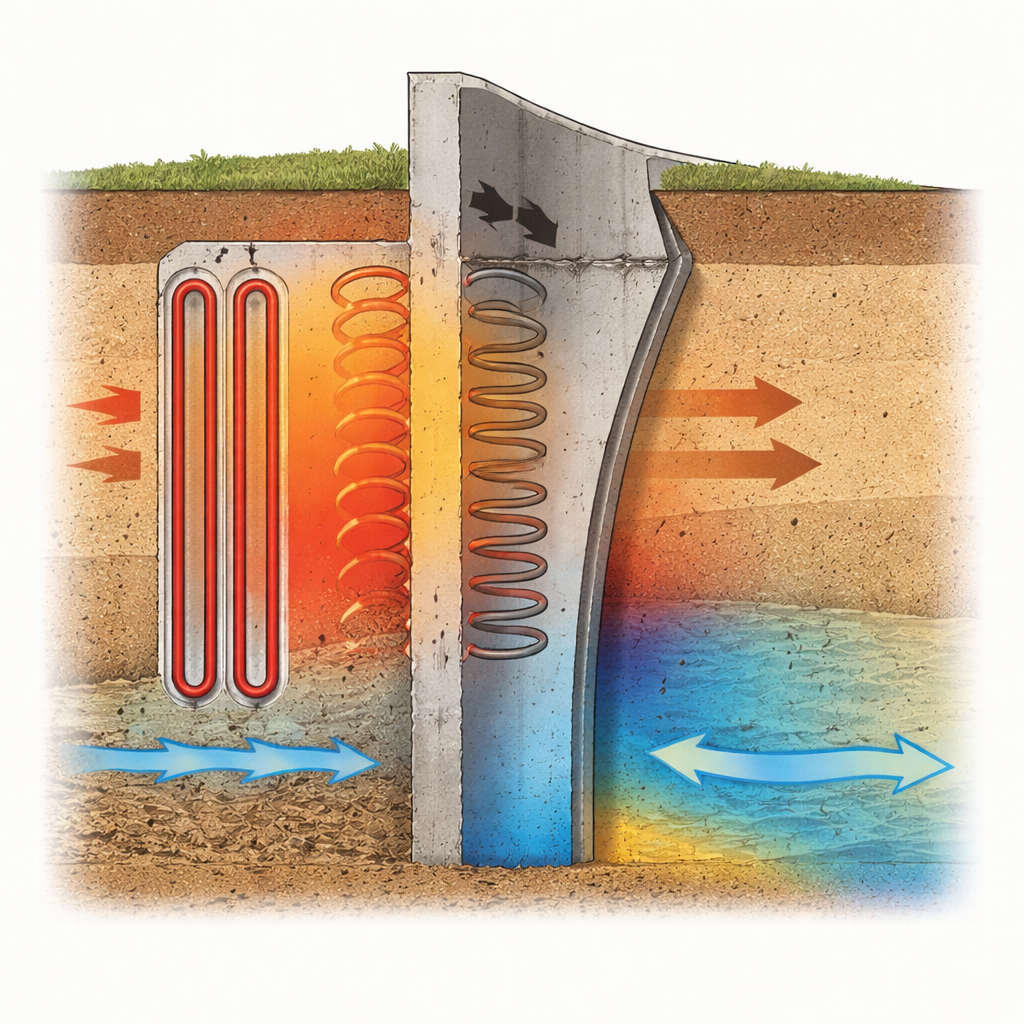
Groundwater flow turns out to be a double-edged sword. When water seeps through the soil near the wall, it carries away heat, boosting the thermal output of the system—sometimes by more than 50 percent compared to still water conditions. Yet this same movement of warm water can alter how the wall bends and where forces concentrate, especially at the bottom slab level. In highly permeable soils, seepage dominates: heat is swept along by moving water, reshaping temperature patterns and increasing both wall deflection and internal forces. In very tight, low-permeability soils, the water cannot move easily, so heating creates pockets of excess pore pressure instead. These trapped pressures do not greatly change sideways movements, but they can nearly double bending moments and shear forces in multi-propped walls, again at key structural locations.
A Design Map for Safer, Smarter Energy Walls
By sweeping across a wide range of soil and construction conditions, the authors identify practical thresholds that tell engineers which physical effect will dominate for a given site: above a certain permeability, seepage-driven heat transport controls the response; below a much lower threshold, trapped pore pressures become critical. Within these regimes, the study recommends favoring 4U-shaped pipe layouts and paying special attention to reinforcement near slab connections and at excavation depth. In everyday terms, the work shows that turning retaining walls into underground radiators is both feasible and efficient, provided designers account for how heat, water, and structure interplay beneath our feet. With the right checks, energy-piled walls can quietly strengthen urban basements while helping decarbonize building heating and cooling.
Citation: Villegas, L., Narsilio, G. & Fuentes, R. Thermo-hydro-mechanical response of energy-piled walls under varying wall configurations, pipe layouts, and seepage conditions. Sci Rep 16, 9198 (2026). https://doi.org/10.1038/s41598-026-42923-z
Keywords: geothermal energy, ground source heat pumps, energy piles, retaining walls, groundwater seepage