Clear Sky Science · en
Effects of compression legwear on knee biomechanics and inter-joint coordination during depth jumps: a randomized cross-over study
Why Tight Sportswear Matters for Your Knees
Many athletes and fitness enthusiasts swear by tight compression shorts or leggings, claiming they feel more stable, jump higher, and stay safer from injury. But do these garments actually change how your body moves, or are they just a comfortable trend? This study looked inside the motion of the knees and legs during demanding jump landings to see how different types of compression legwear affect joint movement, coordination, and potential injury risk.
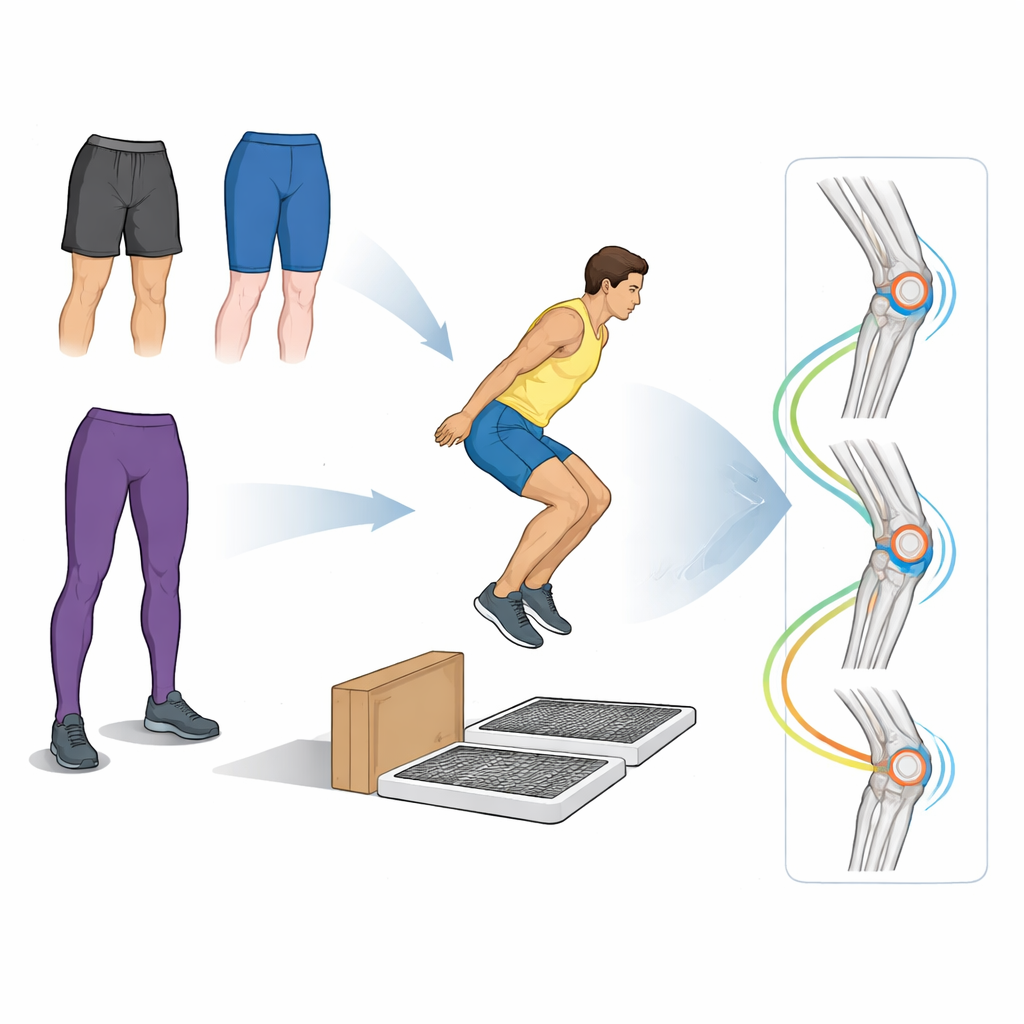
Three Types of Shorts, One Demanding Jump
The researchers recruited twelve healthy young men who regularly played sports like basketball or badminton. Each participant performed depth jumps from a 40-centimeter platform, stepping off and landing on both feet before rebounding into another jump. They repeated this while wearing three outfits in random order: ordinary loose sports shorts (the control condition), tight compression shorts that stopped above the knee, and full-length compression tights that extended from the hips to the ankles. High-speed cameras and force-sensing plates under the feet captured how the hip, knee, and ankle moved and how hard the ground pushed back during landing.
How the Knees Bend, Twist, and Steady Themselves
Instead of focusing only on jump height, the team examined how much the knee bent, tilted inward or outward, and rotated during the landings and the following stabilization phase. The full-length tights encouraged slightly deeper knee bending and a greater range of motion in the front-to-back plane right after the first landing, particularly on the less skilled, non-dominant leg. At the same time, they reduced unwanted sideways and twisting movements compared with ordinary shorts. During the later stabilization phase, the above-knee compression shorts led to larger, more controlled knee bending and less side-to-side wobble than regular shorts, suggesting that targeted pressure around the thigh can help guide the knee into safer positions.
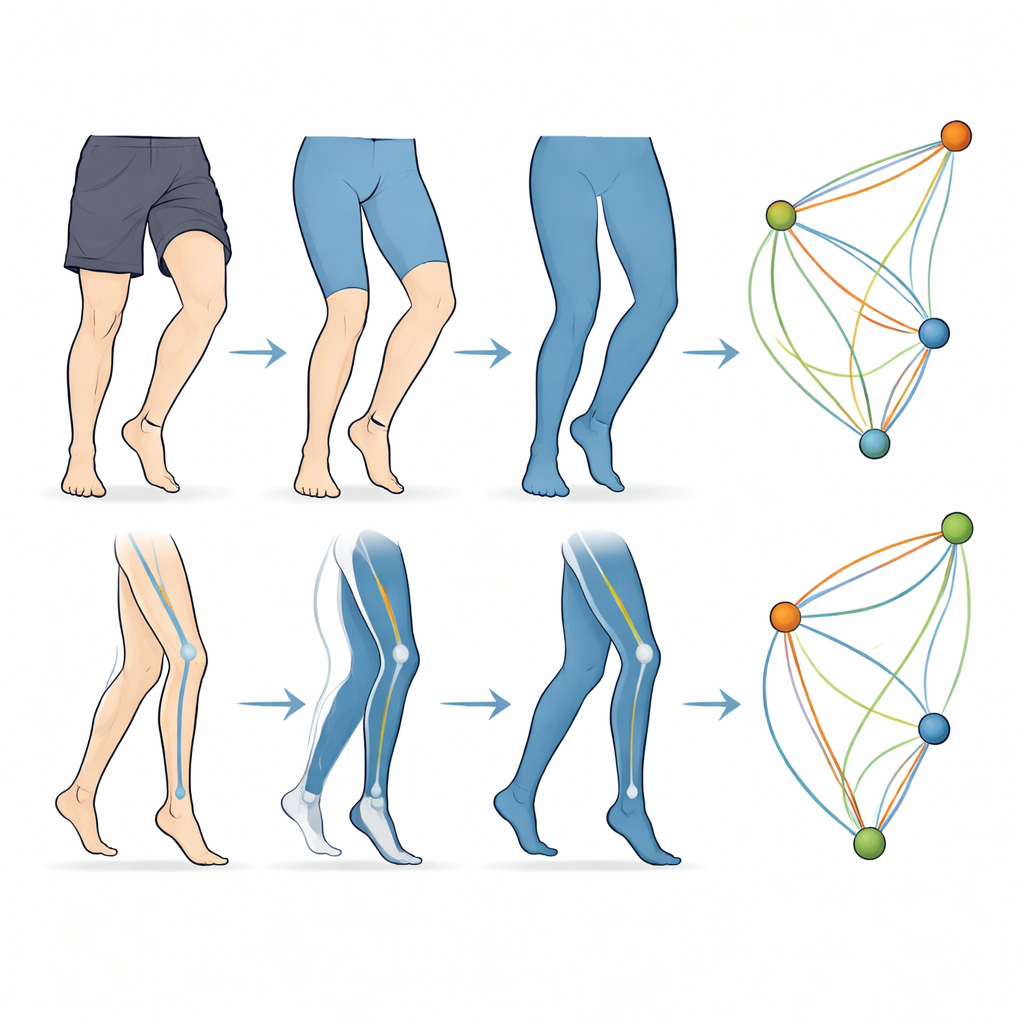
Hidden Forces and Teamwork Between Joints
Interestingly, the overall impact forces hitting the body—how hard the feet struck the ground—did not change much between outfits. What changed was how those forces were handled at the knee. Loose shorts tended to be linked with higher sideways loading at the knee, which is thought to be more stressful for joint tissues. Compression outfits, especially the tights, generally reduced this sideways strain but sometimes shifted load toward the inner side of the knee, which could be problematic if overdone. To understand how the leg worked as a system, the researchers also examined how the hip, knee, and ankle moved together over time. They found that different garments reshaped this “teamwork”: full-length tights often improved coordination between the knee and ankle and seemed to steady the leg in the side-to-side direction, while compression shorts offered better control of forward-and-back knee motion, particularly when both legs landed together.
Finding the Right Balance for Performance and Safety
The study’s big message is that compression legwear does not magically boost jump height, but it does meaningfully reshape how the legs move and share loads during landings. Full-length compression tights appear most helpful for improving coordination between the knee and ankle and for calming side-to-side knee motion, which may support stability during hard landings. Above-knee compression shorts seem to sharpen control of bending and straightening, potentially helping the knee absorb forces more safely. Regular loose shorts, meanwhile, preserve the body’s natural movement patterns but may require more muscular effort and allow more wobbly motions linked to injury risk. For everyday athletes, this suggests that choosing compression shorts or tights tailored to specific sports tasks—whether quick stabilizing landings or repeated vertical jumps—could modestly improve movement efficiency and help protect the knees over time.
Citation: Liu, L., Shi, Qq., Yick, Kl. et al. Effects of compression legwear on knee biomechanics and inter-joint coordination during depth jumps: a randomized cross-over study. Sci Rep 16, 8710 (2026). https://doi.org/10.1038/s41598-026-42890-5
Keywords: compression legwear, jump landing, knee stability, sports injury prevention, lower limb biomechanics