Clear Sky Science · en
Analysis of rainfall response and graded warning for landslides
Why rain on distant hills matters to everyday life
In many mountain towns, a spell of heavy rain can quietly set hillsides in motion, threatening homes, roads, and power lines days later. This study looks at a subtle but dangerous kind of slope movement, called creeping landslides, in a county near China’s Three Gorges Reservoir. Instead of sudden collapses, these slopes inch forward in small steps, speeding up briefly after storms. The authors ask a practical question: can we turn simple rainfall measurements into clear, graded warnings that help local officials evacuate people in time, without drowning them in false alarms?
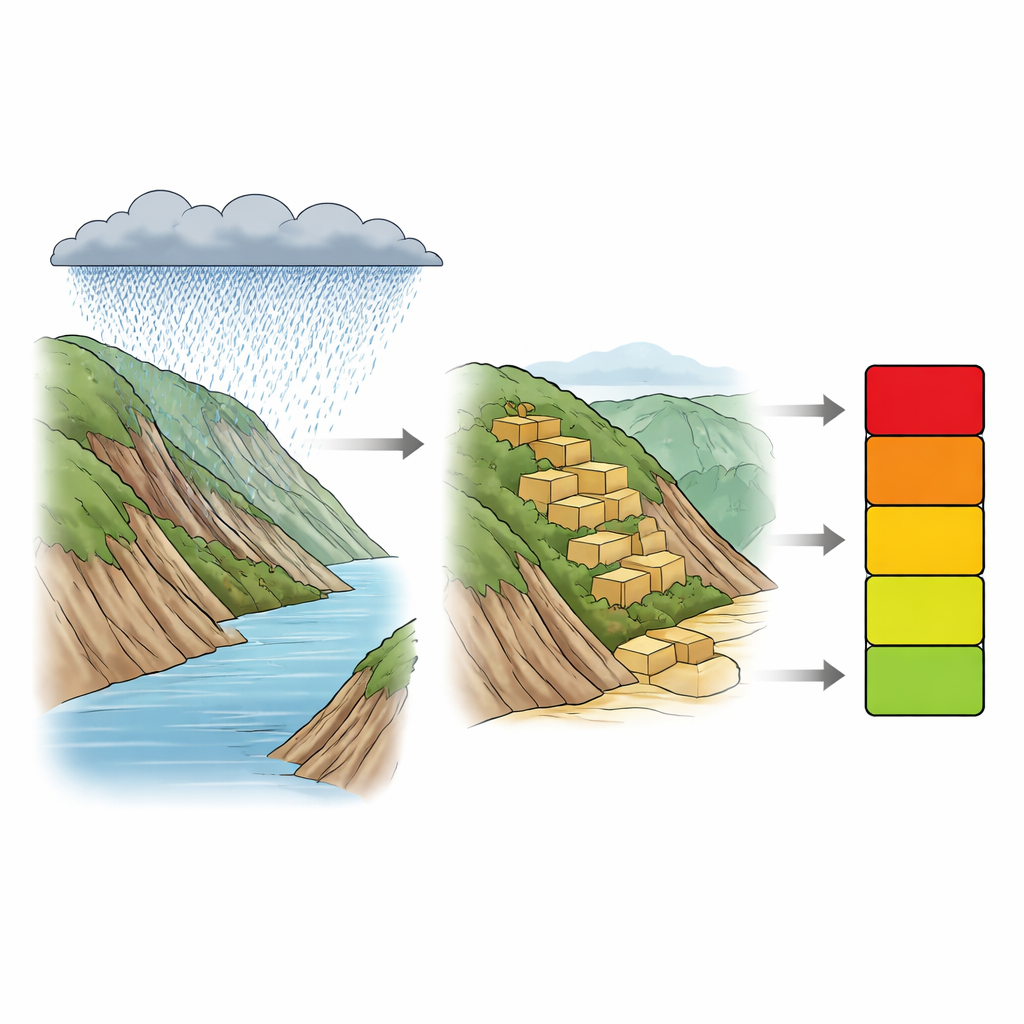
A slow-moving hazard on steep river banks
Zigui County sits along a deep river gorge where steep valleys, heavy monsoon rains, and large water-level changes from the Three Gorges Reservoir combine to make landslides a constant concern. Many slopes here do not fail all at once. Instead, they creep slowly—millimeters to centimeters per year—and then jump forward in short bursts when strong rain or rapid water-level shifts weaken the ground. These step-like movements may not grab headlines, but they can crack houses, damage roads, and force emergency evacuations. Because people live and farm on these slopes, local authorities need a way to judge when incoming rain has pushed conditions from routine concern to imminent danger.
Turning scattered measurements into a simple yardstick
The researchers collected more than a decade of data from dozens of GPS stations anchored into creeping slopes, alongside daily rainfall records from a nearby weather station. One challenge was that slopes differ in size: a few centimeters of movement on a short hillside may signal the same level of concern as much larger motion on a long one. To make fair comparisons, the team introduced a “displacement ratio,” which divides how far a slope has moved by its total length. This simple yardstick strips out the influence of slope size, allowing the same warning rules to apply to many different hillsides across the region.
Finding how much rain tips slopes into motion
Another puzzle was deciding which slice of rainfall history matters most. Rather than look only at single downpour days, the team tested cumulative rain over one to ten days before known landslide movements. They found that the total rain over four or five days, depending on the month, had the strongest link with slope motion. Using computer simulations of a “typical” creeping slope, they also showed that storms smaller than 30 millimeters barely register in the GPS data. Focusing only on more substantial rain events, they fitted a simple curve that connects cumulative rain to the displacement ratio. While this one-factor model cannot explain everything that happens inside a hillside, it consistently captured about one third of the observed variation—enough, the authors argue, for a practical early warning tool.
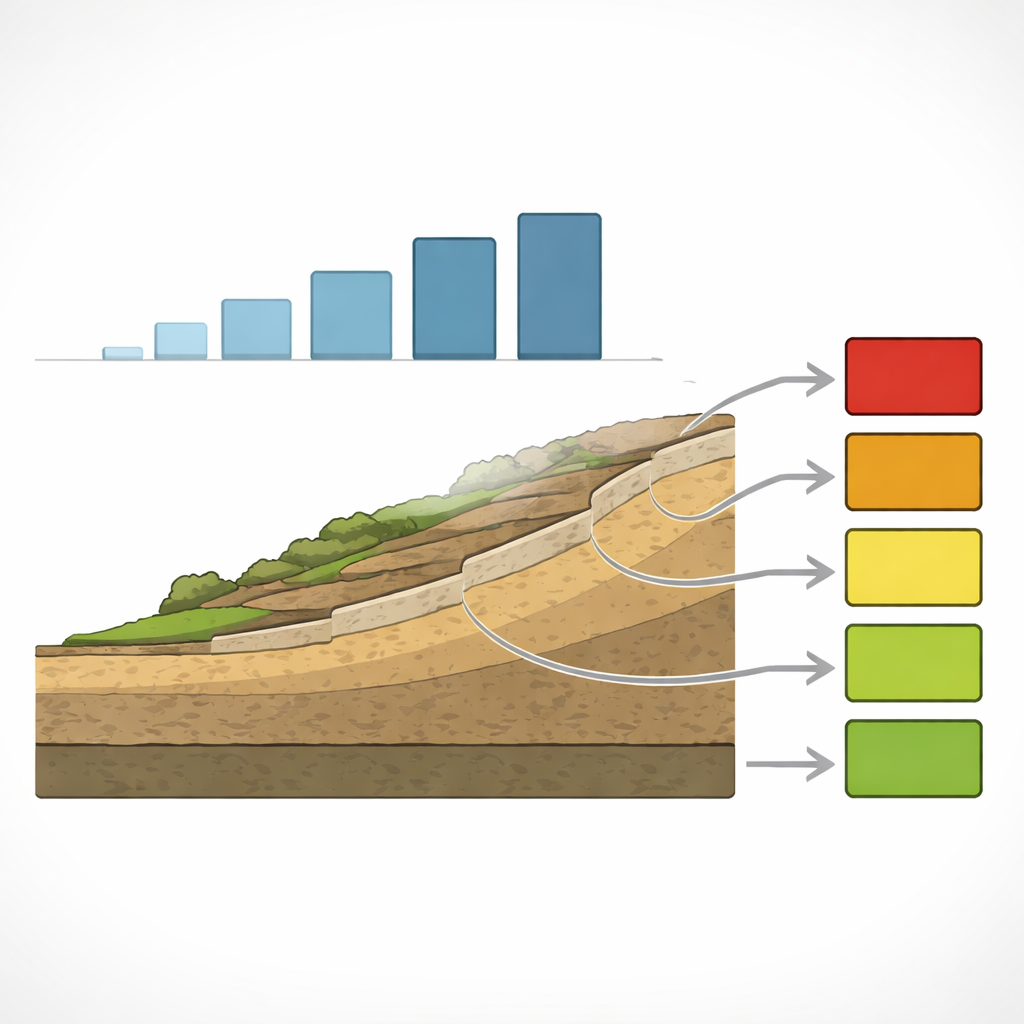
From rainfall amounts to colored warning levels
With this relationship in hand, the team worked backward: they chose a characteristic displacement ratio that marks a shift from very slow to clearly noticeable movement, based on well-studied local landslides. Then they calculated how much rain would typically be needed to reach that point in different parts of the rainy season. These values—around 78, 160, and 197 millimeters of rain over several days—became turning points in a five-level warning scale, from routine monitoring to urgent evacuation. When they tested the system on three sizable slope incidents in 2021, it raised the alarm before every one, and also would have called for the highest alert during a past extreme storm that triggered hundreds of landslides. The trade-off is an 8 percent false alarm rate: some days receive high warnings even though no landslide occurs.
What this means for people living below steep slopes
For residents and officials in landslide-prone areas, this work offers a clear, usable rule of thumb: keep a close watch not just on how hard it rains today, but on how much rain has soaked the hills over several days. Once those amounts cross certain thresholds, slopes that usually creep quietly are much more likely to lurch forward. The proposed system turns that insight into a stepwise warning scale that favors safety, accepting some extra alarms in exchange for catching all serious events in the test period. While the method still needs adjustment for other regions and more complex local geology, it shows how simple measurements—rainfall totals and basic slope motion—can be combined into a practical tool to reduce risk before disaster strikes.
Citation: Xing, Y., Wang, P. & Huang, S. Analysis of rainfall response and graded warning for landslides. Sci Rep 16, 8661 (2026). https://doi.org/10.1038/s41598-026-42802-7
Keywords: rainfall-induced landslides, early warning systems, Three Gorges Reservoir, creeping slopes, disaster risk reduction