Clear Sky Science · en
Multiparametric robust sensing via readout of characteristic magnetization loops
Measuring More with One Tiny Sensor
Modern devices—from power electronics to medical instruments—often need to monitor several things at once, such as temperature and magnetic field. Normally this requires multiple sensors and careful calibration that can drift over time. This paper presents a new way to read out both temperature and magnetic field simultaneously from a single tiny magnetic film, while staying reliable even when the electronics around it change.
How a Magnetic Film Becomes a Thermometer and Field Meter
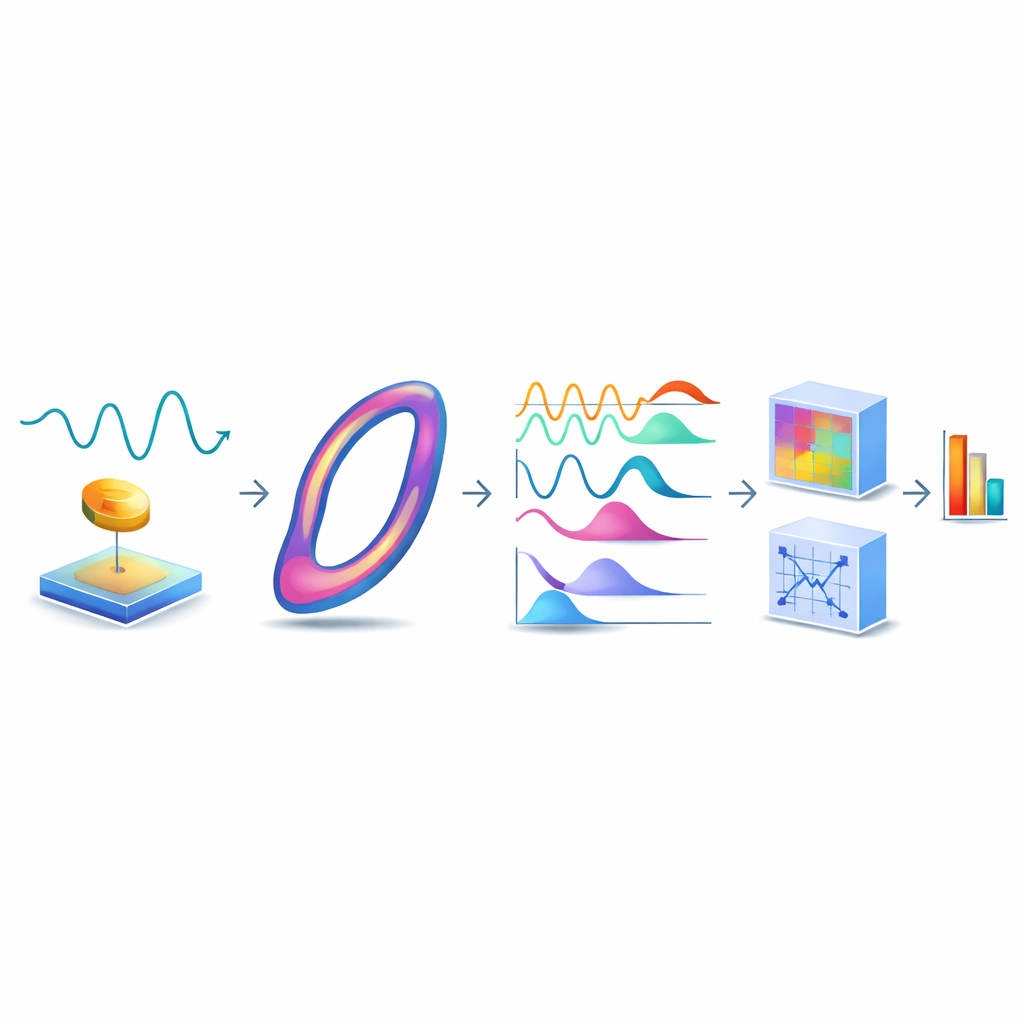
The heart of the approach is a special transparent magnetic film that rotates the polarization of light when it is magnetized. The researchers shine polarized light through this film and bounce it off a mirror on the back side. As an alternating magnetic field is applied, the magnetization in the film swings back and forth in a loop rather than following a simple straight line. This loop depends on both the temperature and any extra static magnetic field present. By watching how the light intensity changes over time with a balanced photodetector, the team records these loops without touching the sample, keeping the system electrically isolated.

Hidden Patterns in Wiggly Signals
The recorded loop is not analyzed point by point. Instead, the signal is broken down into a small set of building blocks called harmonics—simple sinusoids at multiples of the driving frequency. Each harmonic has a size (amplitude) and a timing shift (phase). Different physical effects in the magnetic film, such as how domains appear, move, and disappear as the field changes, leave distinct fingerprints in these amplitudes and phases. Some harmonics reflect how strongly the material responds, others capture how delayed or asymmetric the response is. Taken together, they describe the overall loop shape in a compact way.
Shape Numbers that Ignore Electronics Drift
In practice, raw amplitudes and phases are easily distorted by changes in amplifier gain, cable length, or delays in the electronics—problems that usually force frequent recalibration. To avoid this, the authors do not use the harmonics directly. Instead, they form ratios of amplitudes and differences of phases between harmonics, always referencing them to the main (fundamental) harmonic. These derived "shape parameters" describe only the geometry of the loop, not the absolute size or timing of the setup. The result is a set of material-specific numbers that remain stable even if the signal chain gets a little louder, quieter, or slower.
Mapping Conditions and Letting Algorithms Invert Them
To turn these shape parameters into actual readings of temperature and magnetic field, the team first performs a detailed calibration. They systematically vary temperature and applied bias field and record how each shape parameter responds, building up smooth two-dimensional maps. Some parameters mainly follow temperature, others mainly track the magnetic field, and many show more complex ridges and valleys that encode both. Using these maps, they then test two ways of solving the inverse problem: a lookup-table method that searches the maps numerically, and a machine-learning model based on a random forest regressor trained on noisy synthetic data derived from the calibration.
How Accurate and Why It Matters
Both approaches can recover temperature and magnetic field from new measurements with high precision. The study reports typical uncertainties of about 0.17 kelvin and 6 microtesla over the full tested ranges when using the machine-learning model. The main limiting factor is not the electronics, but random variations in how magnetic domains nucleate in the film—a kind of intrinsic magnetic noise. Because the method is based on gain- and delay-invariant shape parameters, the sensor does not need to be recalibrated when the readout electronics age or change slightly. The concept can also be adapted to other readout schemes and even to different types of non-linear materials, offering a general route to compact, robust multiparameter sensing in future technologies.
Citation: Path, M.P., Vogel, M. & McCord, J. Multiparametric robust sensing via readout of characteristic magnetization loops. Sci Rep 16, 8148 (2026). https://doi.org/10.1038/s41598-026-42763-x
Keywords: magneto-optical sensing, multifunctional sensors, magnetic hysteresis, temperature measurement, machine learning readout