Clear Sky Science · en
Another piece of the puzzle: analysis of Acanthocheilonema spirocauda larvae from its presumed intermediate host the seal louse (Echinophthirius horridus)
Why Tiny Parasites in Seals Matter
Wild seals share their ocean home with an unseen cast of parasites that can quietly undermine their health. One of the most important is the “seal heartworm,” a long, thread-like worm that lives in the heart and major blood vessels of seals and can weaken them or even contribute to their death. For decades, scientists suspected that a blood-sucking insect called the seal louse played a key role in spreading this heartworm, but the details were fuzzy. This study zooms in on the heartworm’s baby stages inside the louse, adding an important missing piece to the puzzle of how this disease moves through seal populations.
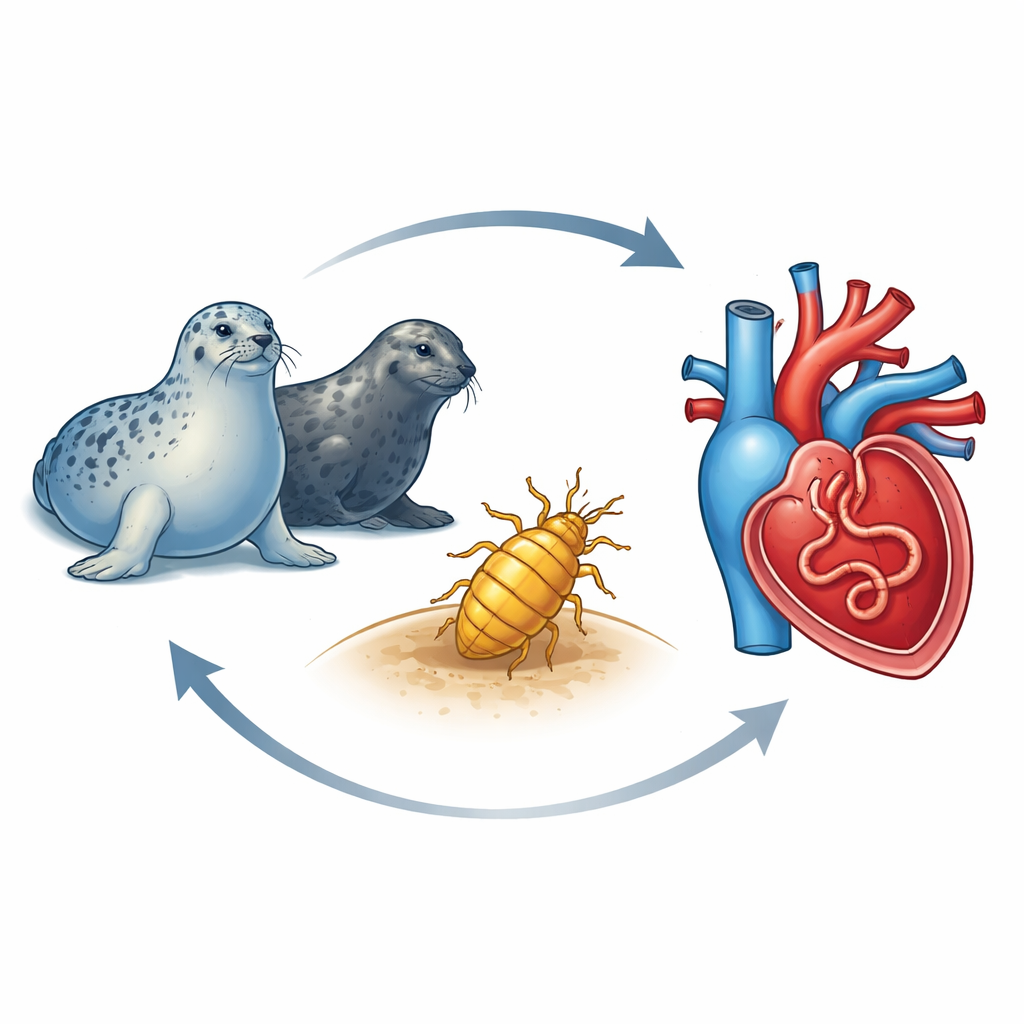
A Hidden Partnership Between Worm, Louse, and Seal
Heartworms do not travel directly from one seal to another. Instead, like similar parasites in dogs and cats, they rely on a “middleman” blood-feeding insect. Adult heartworms live in the heart and large blood vessels of seals and release tiny larvae into the bloodstream. When a seal louse takes a blood meal, it likely sucks up these early larvae. Over time, the larvae develop into more advanced, infectious stages inside the louse. When that louse bites another seal, the infectious larvae can be passed on, starting the cycle again. The seal louse is perfectly positioned for this role because it spends its entire life on seals, feeds on their blood, and infests the same species and age classes that are most affected by heartworm.
Careful Dissections of Seal Lice
To test the long-standing idea that the seal louse truly serves as the heartworm’s go-between, the researchers collected 151 lice from naturally infested harbor and grey seals cared for at rehabilitation centers along the North Sea. The lice were removed non‑invasively during routine health checks and preserved in alcohol. Under a powerful stereomicroscope, each louse was opened with fine needles and forceps. The team separated the head, thorax, abdomen, gut, and soft internal fat tissue, then examined each part under high‑resolution light microscopes to search for worm larvae. They measured the length and width of any larvae they found and noted exactly where in the louse’s body those larvae were hiding.
Tracking Larvae Through the Louse’s Body
The researchers found that more than a quarter of the lice (26.5%) carried seal heartworm larvae, for a total of 186 larvae across all infected lice. By comparing sizes, shapes, and locations, they could place most larvae into three stages of development, from earliest to latest. The overwhelming majority were early stages curled up in the louse’s fat tissue, just under the outer shell, suggesting this is where the heartworm does most of its growing. A smaller number of more developed larvae were found free in the body cavity, in the flight muscles, or near the mouth region, hinting that they were migrating toward the biting mouthparts, ready to be transferred into a new seal during feeding. Advanced imaging methods, including confocal laser microscopy and scanning electron microscopy, revealed the internal structure of these larvae in fine detail, such as the gut, muscles, and developing reproductive organs.
Fitting the Pieces Into a Larger Disease Story
This detailed snapshot of larvae inside the seal louse meshes with earlier evidence: previous work had already shown a strong link between lice and heartworm infections in seals, detected heartworm DNA in lice, and even visualized larvae inside louse tissues using 3D X‑ray scans. The new study strengthens the case by documenting all three larval stages inside the same insect host and mapping how their position in the louse changes as they mature. Together, these findings strongly support the idea that the seal louse is not just a bystander but a necessary part of the heartworm’s life cycle in the wild.
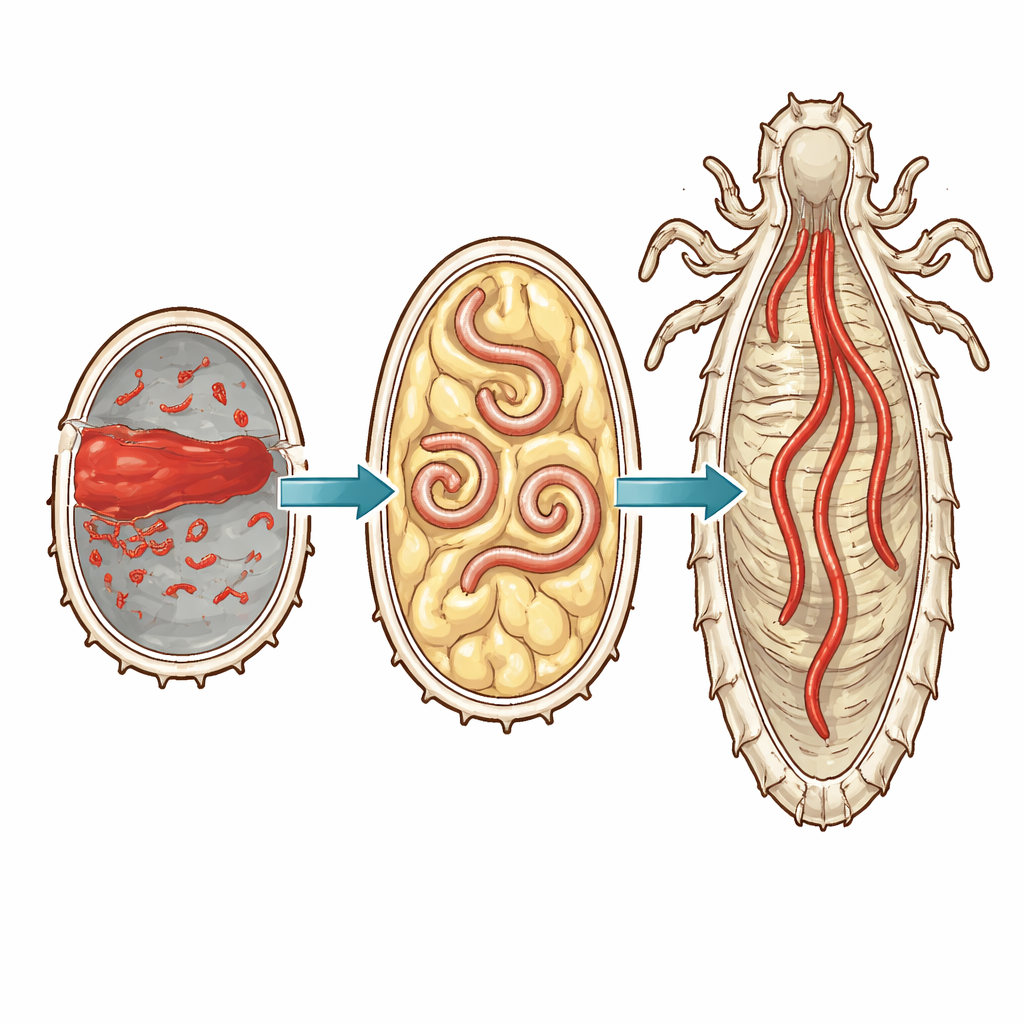
What This Means for Seal Health
For a non‑specialist, the take‑home message is that a tiny insect on a seal’s skin can determine whether a 20‑centimeter worm ends up in that seal’s heart. By confirming the seal louse as the likely key carrier of seal heartworm, this study helps scientists understand how the parasite spreads through seal colonies and why young, vulnerable animals may be at particular risk. That knowledge is vital for wildlife veterinarians and conservationists who monitor the health of seal populations and look for early signs of emerging disease threats. Knowing the full route—from seal to louse and back to seal—opens the door to targeted surveillance and, in the future, better strategies to limit the impact of heartworm infection on marine mammals.
Citation: Wilhelm, C., Schwaha, T., Rubio-García, A. et al. Another piece of the puzzle: analysis of Acanthocheilonema spirocauda larvae from its presumed intermediate host the seal louse (Echinophthirius horridus). Sci Rep 16, 9656 (2026). https://doi.org/10.1038/s41598-026-42760-0
Keywords: seal heartworm, marine parasites, seal louse, pinniped health, vector-borne disease