Clear Sky Science · en
Real-time eructation event prediction in livestock using head vibrations and machine-learning in an IoT wearable device
Why Cow Burps Matter for the Climate
Most people don’t think twice about a cow’s burp, but these small puffs of gas quietly add up to a big climate problem. Cows and other grazing animals release large amounts of methane, a heat‑trapping gas far more powerful than carbon dioxide in the short term. Yet today’s best tools for measuring this methane are costly, bulky, and often require taking animals out of their normal pastures. This study presents a new way to watch methane‑linked burps in real time using a lightweight head halter and smart algorithms, pointing toward cheaper, more humane climate monitoring on farms.
A Smart Halter for Grazing Cows
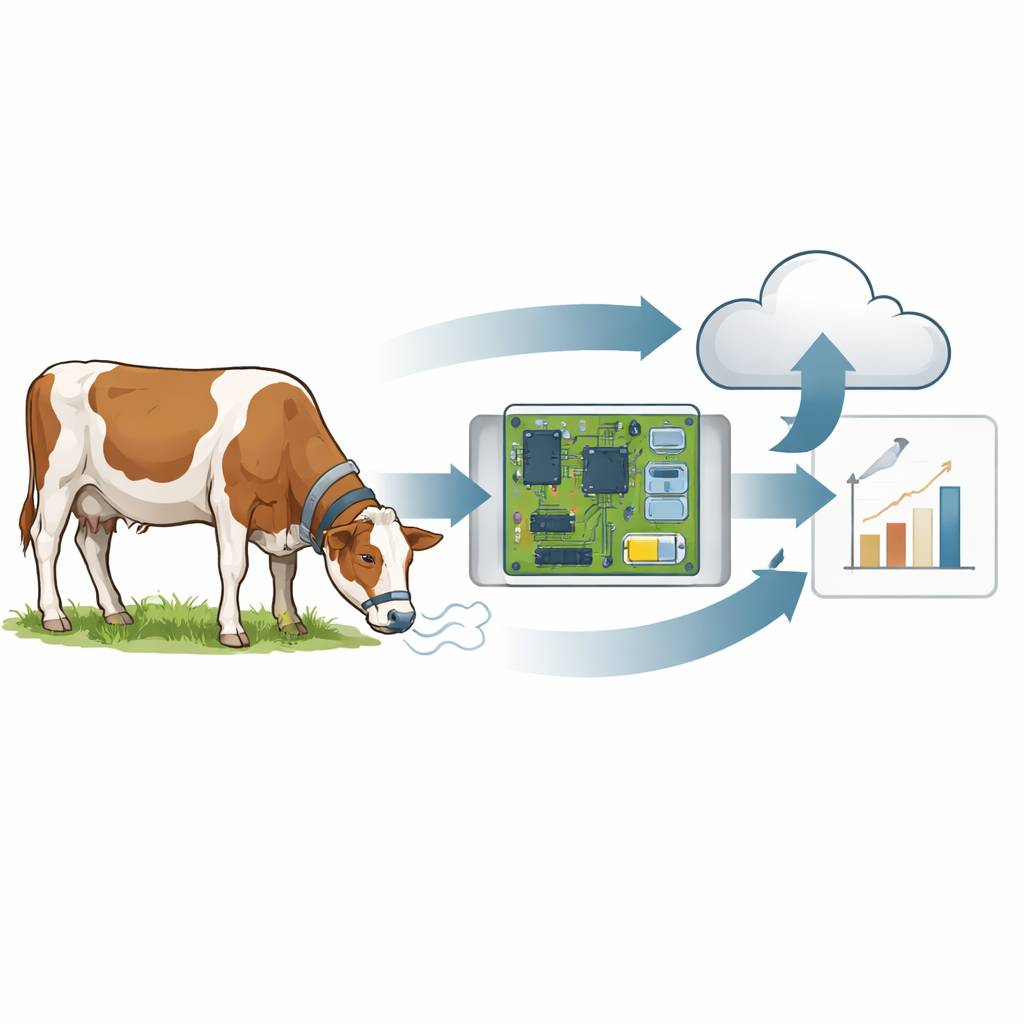
The researchers designed a special halter that a cow can wear while roaming and feeding as usual. Built into the straps over the muzzle, neck, and nape are tiny motion sensors that feel subtle vibrations in the animal’s head. A small gas sensor can be placed in front of the nose to sniff methane, and all of the electronics sit on a compact circuit board powered by a small battery. The system sends data wirelessly to a phone or tablet, where a custom app shows the incoming signals and stores them for later analysis. The whole setup weighs about as much as a light collar, so the cows can move and graze naturally.
Turning Burps into Data
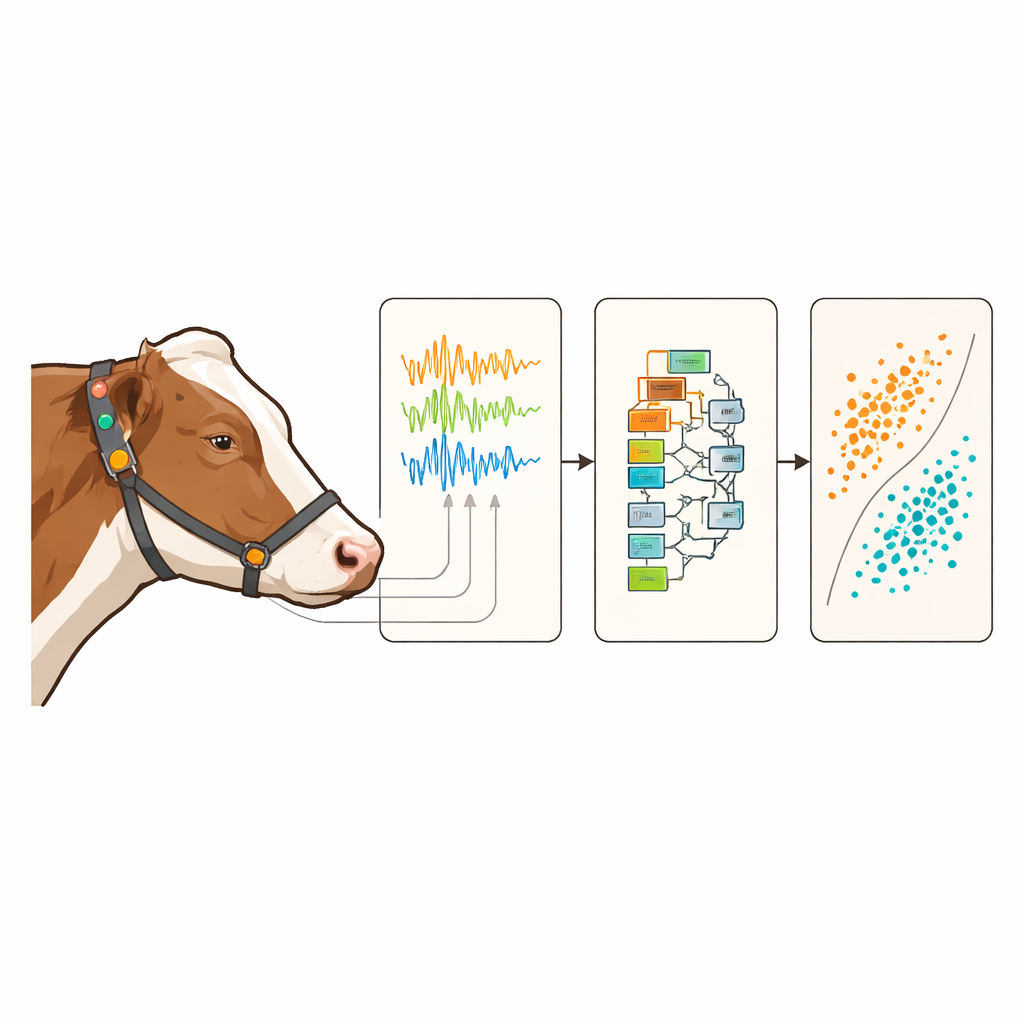
To teach the system what a burp looks like in data form, the team first needed reliable examples. They used the methane sensor to flag moments when gas levels at the cow’s nose rose sharply above background values. Each of these spikes marked a likely belching episode. At the same time, the motion sensors recorded how the cow’s head moved and vibrated. The scientists then chopped these motion records into short time windows around each methane spike and calculated simple summaries of the movements—such as how large, how variable, and how long the vibrations were in each direction. These summaries became the ingredients fed into computer models to separate “burp” windows from normal behavior.
Teaching Machines to Spot Burps
With this labeled data in hand, the team tried a suite of machine‑learning methods, including decision trees, random forests, boosting methods, and neural networks. In their first round of tests on two cows and three sensor locations, models that used data from all three head sensors performed best, correctly identifying burp‑linked windows about three‑quarters of the time. Later, the researchers expanded their tests to seven cows and focused on a single, well‑placed sensor, which made the problem harder because animals differ in how they move. Even then, a compact neural‑network model still performed better than chance and correctly detected many events in new data. Importantly, the final models were compressed enough to run directly on tiny low‑power chips, allowing the halter to make predictions on the spot without constant internet access.
Real‑World Challenges in the Field
Detecting burps in a pasture is trickier than it sounds. Burping is relatively rare compared to all the moments when a cow is simply standing, lying, walking, or chewing. That means the data are heavily imbalanced: for every true burp, there are many non‑events. The team addressed this by carefully selecting and overlapping time windows during training so that the models saw enough positive examples. They also checked how well the system worked under natural conditions where non‑events greatly outnumber burps. In that tougher setting, their best model still picked out far more true events than a random guess would, at the cost of some false alarms. Tests across individual cows showed that some animals were easier to classify than others, highlighting the need for larger and more varied datasets in future work.
What This Means for Cleaner Farming
In simple terms, this study shows that you can listen to a cow’s head movements instead of directly measuring gas all the time and still get a useful picture of when methane‑rich burps occur. The current system does not yet replace gold‑standard instruments, and it detects events that are defined by methane spikes rather than directly proving the exact amount of gas released. But it offers a promising, low‑cost way to wake up more energy‑hungry methane sensors only during likely burps, extend battery life, and monitor animals without confining them to chambers. With more animals, longer trials, and tighter links to established measurement methods, this kind of smart halter could become part of practical, animal‑friendly tools that help farmers and scientists track and ultimately cut methane from livestock.
Citation: Moncayo, J., Velasquez, M.L., Riveros, P.E. et al. Real-time eructation event prediction in livestock using head vibrations and machine-learning in an IoT wearable device. Sci Rep 16, 9099 (2026). https://doi.org/10.1038/s41598-026-42728-0
Keywords: livestock methane, wearable sensors, machine learning, precision farming, greenhouse gases