Clear Sky Science · en
Enhancing solar PV efficiency in mining operations through optimized cleaning intervals and automated dust mitigation
Why Dusty Solar Panels in Mines Matter
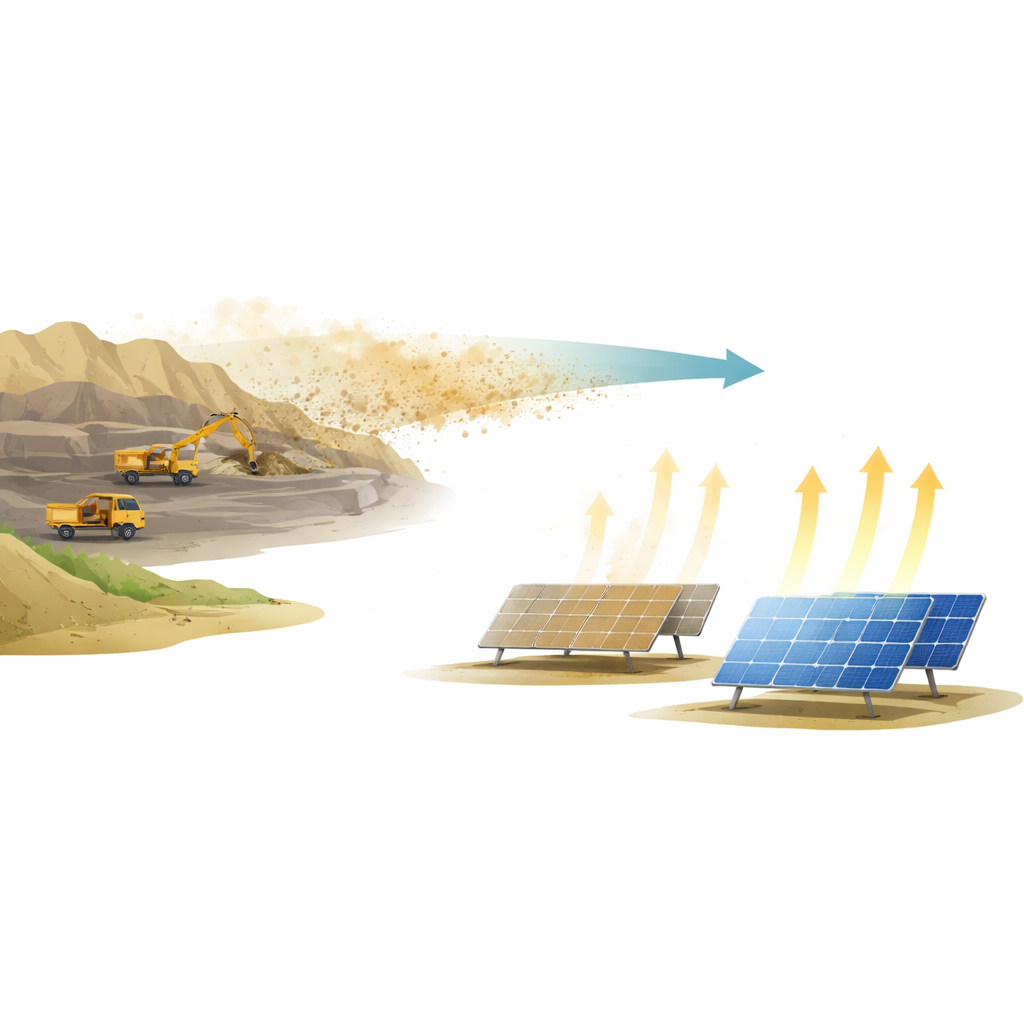
Solar power is often promoted as a clean, low-maintenance way to run energy-hungry industries. But in open-pit mines, where heavy machines constantly grind, blast, and haul rock, the air can be thick with dust that quietly robs solar panels of much of their output. This study asks a very practical question: how badly does that dust hurt solar power in a working iron ore mine, and how often do panels really need to be cleaned to keep electricity flowing efficiently without wasting water, money, or labor?
Watching Panels Fade Under Real-World Dust
To move beyond lab tests, the researchers installed two identical solar panels side by side at a mechanized iron mine in southern India and observed them for six months. One panel was cleaned every day, while the other was left to gather whatever dust the mine produced. By tracking sunlight levels, dust buildup on a nearby filter, and electrical output from both panels each week, they could see how real mining seasons—dry winter, scorching pre-summer, and early monsoon—changed the amount of dust landing on the glass and the electricity lost as a result. This field approach captured the true mix of blasting, truck traffic, wind, and occasional rain that panels must survive in everyday mining operations.
How Much Power Dust Really Steals
The numbers turned out to be stark. Over the study, dust loading on the panel surface ranged from about 2 to nearly 6 grams per square meter, with the heaviest buildup in the pre-summer weeks when mining was most intense and the weather driest. In that period, the output of the dusty panel fell by more than 60 percent compared with the clean one, even though sunlight was strong. Most of the damage showed up as a drop in current—the flow of electrical charge driven by incoming light—while voltage changed only slightly. In the early and late parts of the season, when dust levels and mining activity were lower or rain occasionally rinsed surfaces, losses were still substantial but closer to 30–40 percent. The result is a clear picture: in mines, dust is not a minor nuisance but a major drain on solar performance.
Finding the Right Cleaning Rhythm
Simply cleaning panels as often as possible is not the answer; frequent washing can be costly, use scarce water, and cause wear on the glass. By following how power loss grew with each passing week, the team identified cleaning schedules that keep most of the energy while avoiding unnecessary work. In the dustiest pre-summer weeks, power dropped quickly toward a plateau of heavy soiling, so cleaning every three to four days was needed to keep panels above roughly 70 percent of their potential. In dryer winter and early monsoon periods, dust built up more slowly, so cleaning every six to seven days was enough. This season-dependent approach turns cleaning from guesswork into a data-based strategy, tailored to local mining activity and weather.
A Waterless Robot for Tough Conditions
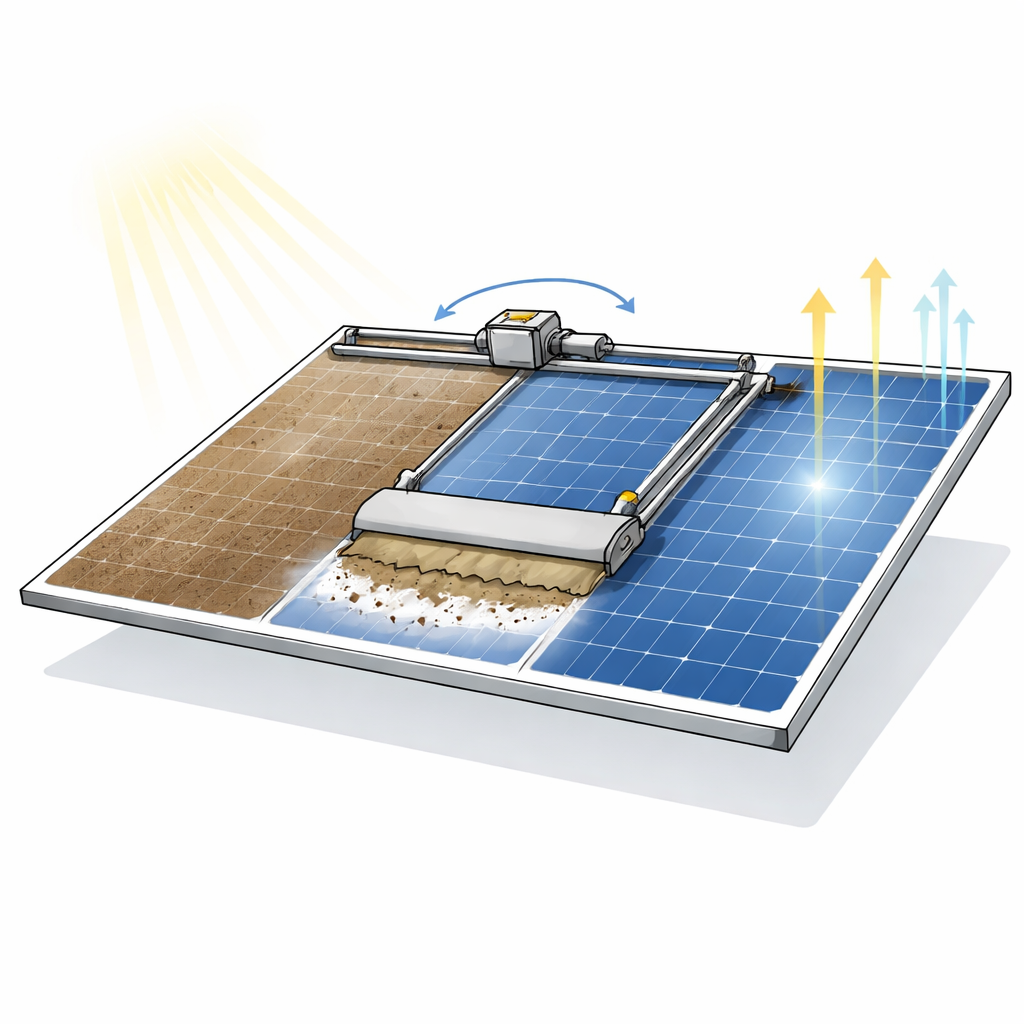
To make that strategy practical, the researchers built and tested a small automatic dry-cleaning device mounted directly on a panel. Guided by a simple microcontroller and a real-time clock, a lightweight wiper made of soft sponge material travels back and forth along rails on the panel frame, brushing dust away without using water. Trials in the same mine, under three contrasting seasonal conditions, showed that a single cleaning pass could restore roughly 30–45 percent of the power lost to dust, averaging about 40 percent recovery. Because the system uses only a small electric motor, draws little power, and does not rely on detergents or hoses, it is well suited for remote, water-scarce sites and can operate with minimal human attention.
What This Means for Cleaner Mining
To a non-specialist, the message is straightforward: in dusty mines, solar panels can lose well over half their output if left uncleaned, but smart schedules and simple automation can win much of that power back. By matching cleaning frequency to the seasons and using a low-cost, waterless wiper rather than manual washing, mines can generate more clean electricity, reduce diesel use, and avoid unnecessary wear on panels. The study shows that with careful measurement and a bit of engineering, solar farms in some of the harshest industrial settings can move much closer to their full potential.
Citation: Tripathi, A.K., Aruna, M., Prakash, E. et al. Enhancing solar PV efficiency in mining operations through optimized cleaning intervals and automated dust mitigation. Sci Rep 16, 8718 (2026). https://doi.org/10.1038/s41598-026-42709-3
Keywords: solar panels, mining, dust, cleaning robots, energy efficiency