Clear Sky Science · en
Age-dependent perception of floral emissions and the role of CO2 in regulating nectar-seeking in mosquitoes
Why flower smells matter to mosquitoes
Mosquitoes are infamous for their thirst for blood, but for most of their lives they run on sugar. Both males and females visit flowers for nectar, which fuels flight, survival and, ultimately, disease transmission. This study asks a deceptively simple question with big implications: how do malaria mosquitoes find the best flowers, and does this ability change as they age? By looking closely at one common plant, Lantana camara, the researchers reveal how flower scents and carbon dioxide (the same gas we exhale) guide hungry mosquitoes to nectar at just the right time.
Flowers, gas, and hungry insects
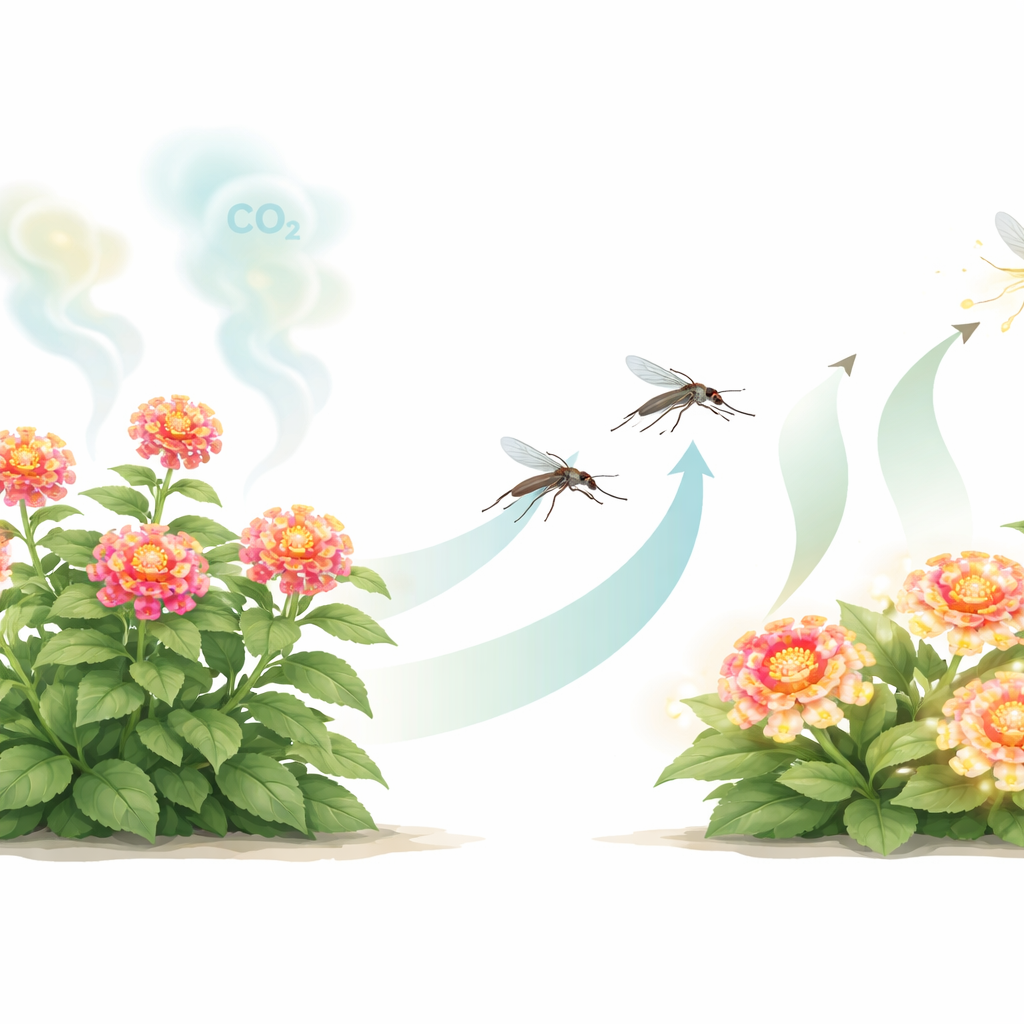
Flowering plants release complex blends of airborne chemicals, many of which humans experience as scent. Mosquitoes use these blends, along with visual cues, to locate nectar sources. Lantana camara, an attractive but invasive ornamental shrub, is especially important because its nectar boosts mosquito survival and egg-laying. The team focused on two African malaria vectors, Anopheles coluzzii and Anopheles arabiensis, and asked how these species detect Lantana odours and the carbon dioxide (CO2) that seeps from its flowers at night—when mosquitoes are most active.
Decoding the sugar smell
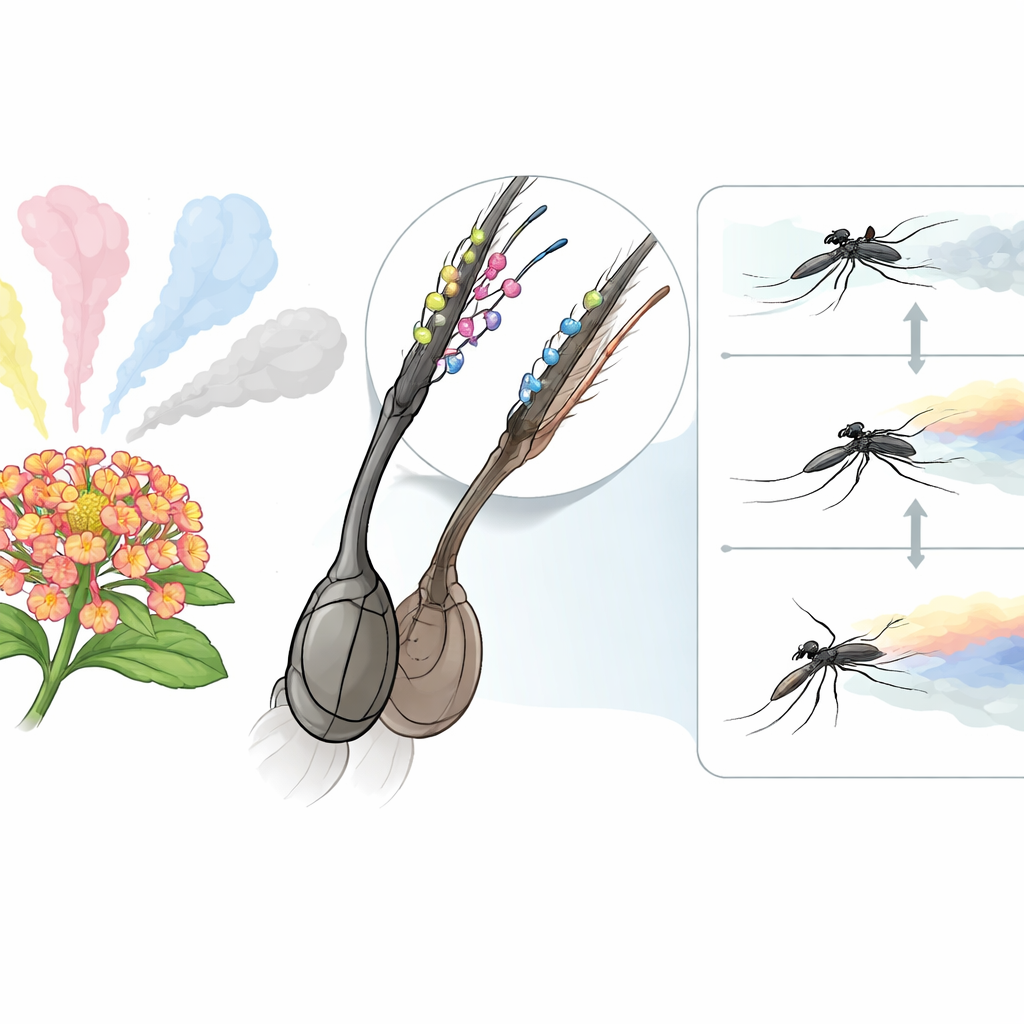
To understand which parts of Lantana’s perfume matter to mosquitoes, the researchers used a clever approach: they expressed the mosquitoes’ odour receptors one by one in fruit flies and exposed them to the plant’s scent. This allowed them to map which specific volatile organic compounds—15 in total—activated which receptors. Most belonged to a group of plant-derived molecules common in floral scents. When these 15 compounds were mixed back together in the same ratios and released at controlled rates, both mosquito species were strongly influenced by the blend. Young females, just one day after emerging, were attracted to low doses but repelled by high doses, while slightly older four-day-old females showed the opposite pattern, revealing that the same flower smell can mean different things at different ages.
Breath of nectar: the role of carbon dioxide
The study also tracked how much CO2 Lantana inflorescences released throughout the night and how this related to the nectar they contained. Individual flower clusters emitted CO2 in fluctuating pulses, reaching levels modestly above the surrounding air. Importantly, the more nectar a flower produced, the higher its CO2 output. Behavioural tests showed that a realistic extra 100 parts per million of CO2 alone caused slight avoidance in very young females and no clear effect in older ones. Yet when the same CO2 pulses were added on top of the synthetic floral blend, they changed the mosquitoes’ choices: the combination shifted which odour strengths were most attractive, in a way that depended on age and testing context. CO2, in other words, did not simply lure mosquitoes from afar—it helped them decide which nearby flower was most rewarding.
Changing noses with age
Recordings from the mosquitoes’ antennae showed that their sensory equipment itself changes as they mature. Older females of both species responded more strongly, and to a wider range, of the key Lantana chemicals than newly emerged mosquitoes did. Some odours that went unnoticed by young females triggered clear responses in older ones, while at least one compound was sensed only by the younger group. These age-linked shifts in sensitivity likely track changes in the expression of odour receptor genes, tuning the insects’ “noses” to different cues as their nutritional and reproductive needs evolve.
What this means for mosquito control
Together, these findings show that malaria mosquitoes do not simply follow any sweet smell in the night. Instead, they selectively read complex flower odours and subtle CO2 signals in ways that depend on their age and context, allowing them to home in on nectar sources efficiently and with reduced risk. Understanding this fine-tuned system could help researchers design better sugar-based traps or lures that target mosquitoes at specific life stages. In practical terms, learning how mosquitoes sense and prefer certain flowers may offer new tools to reduce their survival and, ultimately, their capacity to spread disease.
Citation: Omondi, B.A., Wondwosen, B., Dawit, M. et al. Age-dependent perception of floral emissions and the role of CO2 in regulating nectar-seeking in mosquitoes. Sci Rep 16, 8484 (2026). https://doi.org/10.1038/s41598-026-42694-7
Keywords: mosquito nectar feeding, flower scent, carbon dioxide, Anopheles mosquitoes, chemical ecology