Clear Sky Science · en
Development and temporal validation of five year retinal arteriosclerosis risk prediction in high risk adults from an East China cohort
Why the Eyes Matter for Vascular Health
As people live longer, protecting both vision and heart health has become a central challenge of aging. The small blood vessels in the back of the eye offer a rare, direct view of the body’s circulation. When these vessels stiffen and narrow—a condition called retinal arteriosclerosis—it may signal broader problems in the arteries that supply the heart and brain. This study asked a practical question: can we use routine health check-up data to estimate who is most likely to develop retinal arteriosclerosis over the next five years, and intervene before serious damage occurs?
Looking at a Large Community Over Time
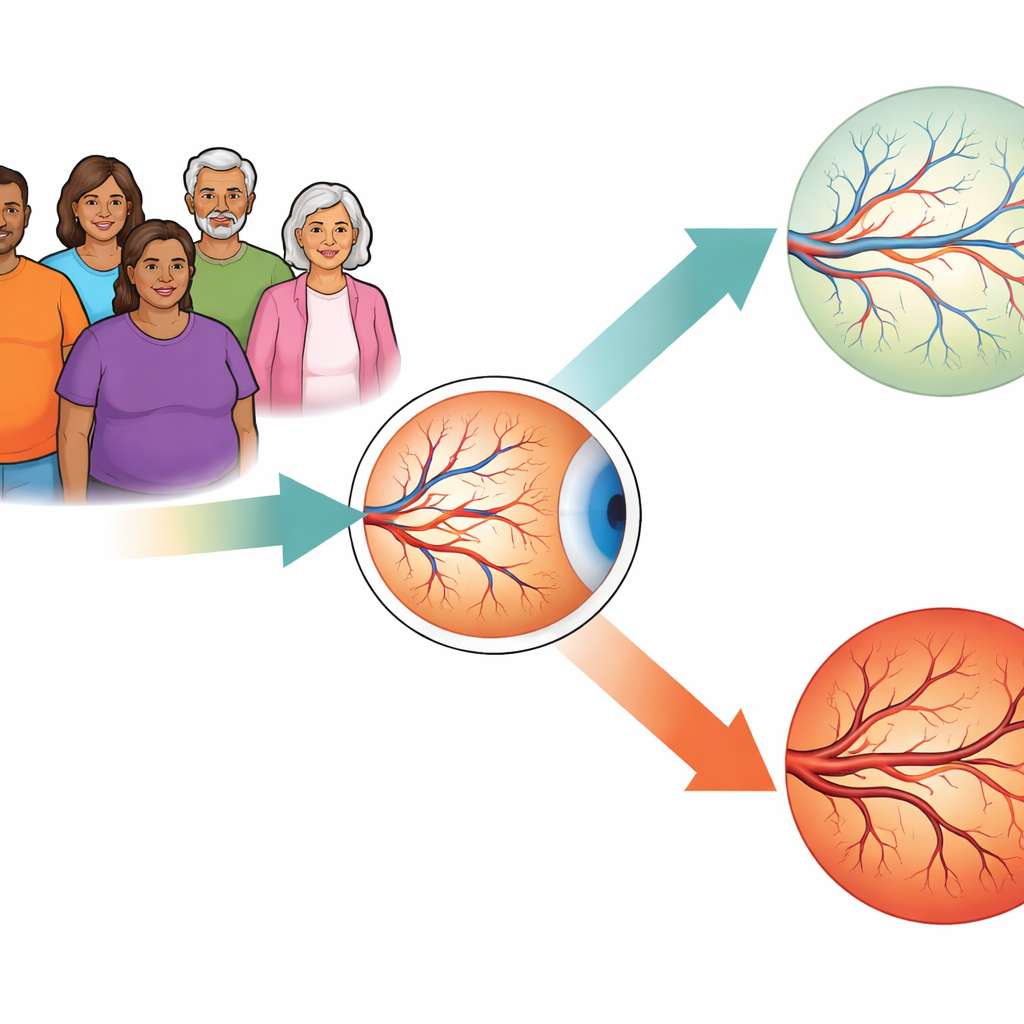
The researchers drew on records from more than 90,000 adults who regularly attended health examinations at a medical center in East China between 2015 and 2021. Most were office workers or retirees who had their eyes photographed and their blood pressure, body size, smoking habits, and standard blood tests measured every one to two years. At the start of the study, anyone who already had retinal arteriosclerosis or too little follow-up was excluded so that only new cases over time were counted.
How Often the Problem Appears
Over roughly three years of follow-up per person, more than 10,000 participants developed signs of retinal arteriosclerosis. This translated to about 36 new cases per 1,000 people each year. Men older than 40 and women older than 45 were found to be at especially high risk, so the team focused on building prediction tools separately for these two groups. The pattern fit with what doctors already see in clinics: older age, higher blood pressure, extra body weight around the waist, diabetes, and smoking were all common in people who later developed the disease.
Building a Five-Year Risk Score
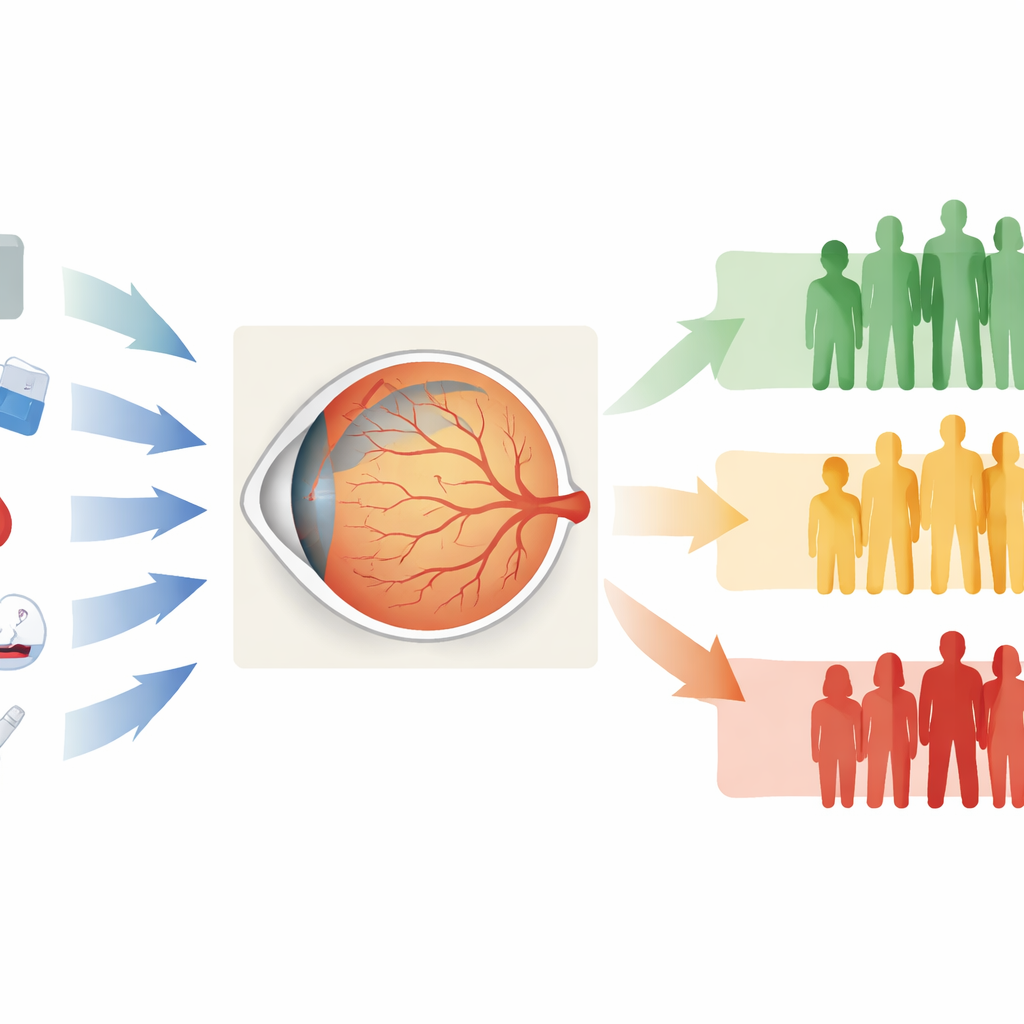
To turn these patterns into something usable, the researchers created mathematical models that estimate a person’s chance of remaining free of retinal arteriosclerosis over the next five years. For men, the model used age, body mass index, waist and hip size, blood pressure, smoking status, history of high blood pressure and diabetes, and a standard kidney-related blood measure called creatinine. For women, the model used a similar set of factors plus a cholesterol-related measure known as high-density lipoprotein. These models were developed in the newer 2015–2021 data, then checked against an earlier set of health records from 2005–2013 to see whether they still worked in a different time period.
Testing Accuracy and Adjusting for Change
When the models were tested, they proved good at ranking people from low to high risk: those with higher scores developed retinal arteriosclerosis much more often than those with lower scores. In statistical terms, their ability to distinguish high- from low-risk individuals was strong, with performance measures close to 0.8 on a scale where 1.0 is perfect and 0.5 is no better than chance. However, when applied to the older 2005–2013 data, the models initially overestimated the absolute risk, likely because the overall rate of disease was lower in that earlier period. By updating the baseline risk level to match the older data—essentially recalibrating the models—the researchers restored good agreement between predicted and observed outcomes. This step highlights that even well-designed prediction tools must be adjusted when used in populations or eras that differ from the one in which they were created.
Turning Predictions into Prevention
The final result is an online calculator that allows men over 40 and women over 45 to obtain an estimate of their five-year chance of avoiding retinal arteriosclerosis, using measurements that are already collected in routine check-ups. For people flagged as higher risk, doctors and patients can consider earlier and more frequent eye examinations and, more importantly, more aggressive control of modifiable factors such as blood pressure, blood sugar, body weight, and smoking. For the general reader, the takeaway is that the back of the eye offers a convenient window into overall vascular health, and that simple, measurable features of everyday health can help forecast future eye vessel damage. Used wisely and updated for new populations, such prediction tools may support earlier, more tailored prevention of both vision loss and cardiovascular disease.
Citation: Zhu, J., Xu, J., Gao, X. et al. Development and temporal validation of five year retinal arteriosclerosis risk prediction in high risk adults from an East China cohort. Sci Rep 16, 10835 (2026). https://doi.org/10.1038/s41598-026-42686-7
Keywords: retinal arteriosclerosis, eye blood vessels, cardiovascular risk, risk prediction model, population cohort