Clear Sky Science · en
Challenges associate with microbiome diversity, glucocorticoids, and condition in a wild songbird
Why this study matters for birds and beyond
Stress is a fact of life for wild animals, from fighting off rivals to dodging predators. This study asks a timely question: when a wild songbird is stressed, what happens to the tiny community of microbes living in its gut, and how might that ripple out to its overall health and even its bright beak color? By following wild male Northern cardinals in their natural habitat, the researchers connect stress hormones, body condition, ornamentation, and the gut microbiome in a way that sheds light on how modern challenges—from urban noise to captivity—might influence animal health.
Hidden helpers inside a songbird
Like humans, birds host vast communities of bacteria living in and on their bodies. These microbes can help with digestion, support the immune system, and may even interact with the brain and stress pathways. When that internal community becomes less varied or shifts in composition, animals may be more vulnerable to disease or less efficient at using nutrients. The Northern cardinal, a familiar red backyard bird, provided an ideal test case: males are territorial, easy to find and recapture, and display a bright red-orange beak whose color depends on diet and health. Earlier work in this same population had linked richer gut communities with better body condition and distinct beak coloration, hinting that the microbiome and visible health signals are intertwined.
Putting wild birds under pressure
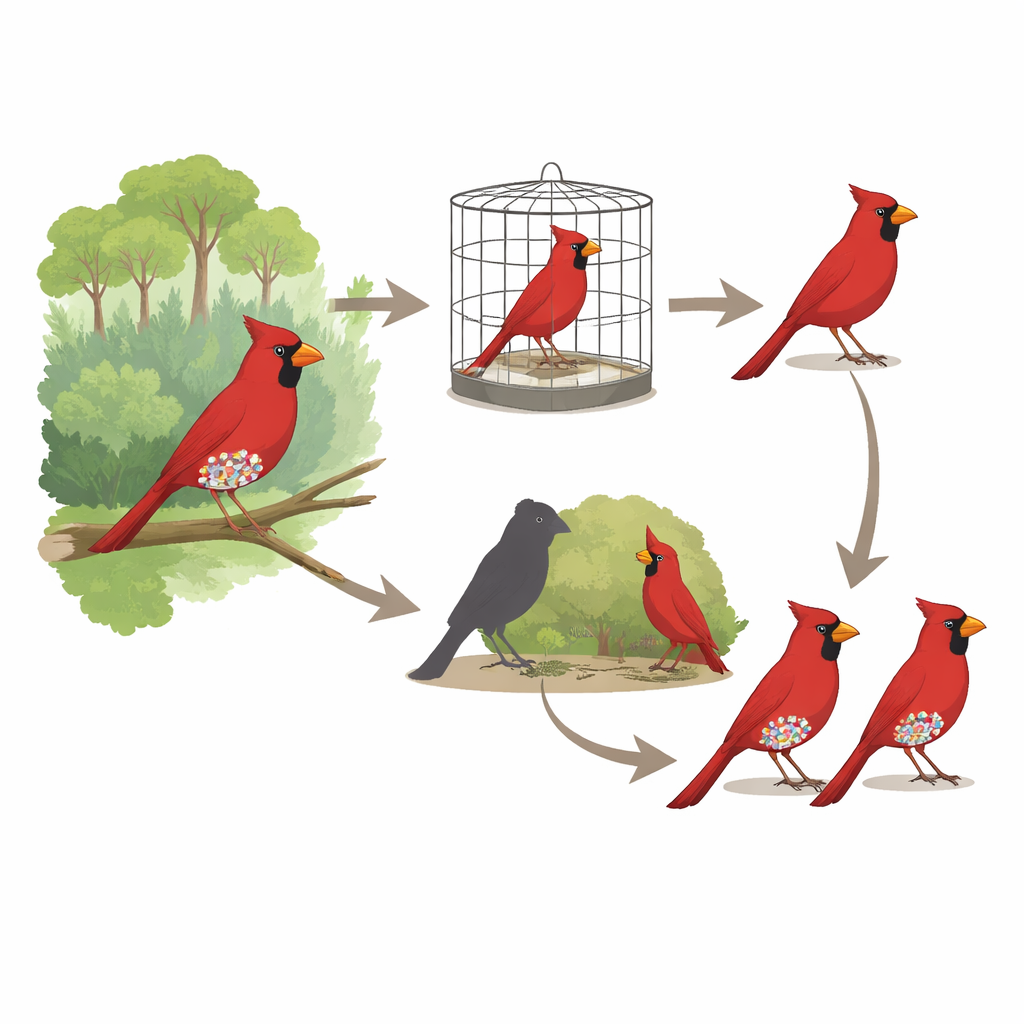
To explore how natural challenges reshape this inner ecosystem, the team captured free-living male cardinals in Florida and collected initial samples: a cloacal swab to profile gut bacteria, blood samples to measure the stress hormone corticosterone, body measurements to gauge condition, and standardized photos of beak color. Each bird was then randomly assigned to one of three paths before being recaptured about 11 days later. One group experienced a simulated territorial intrusion: repeated playbacks of a rival male’s song on their territory, a social stressor that mimics an ongoing threat. A second group underwent a temporary hold: an extra hour of confinement in a cage immediately after capture, approximating a brief but intense captivity event. A third control group was simply released and left undisturbed until the next capture. The same suite of samples was then collected again to track how each bird changed over time.
Stress, microbes, and outward signs
When the researchers compared microbiome samples before and after treatment, they focused on two aspects: alpha diversity (how many different kinds of bacteria and how evenly they are represented within a bird) and beta diversity (how much the community changed between the first and second sampling). The most striking shifts emerged in beta diversity. Birds that spent an extra hour confined showed the largest changes in gut community composition, those exposed to repeated territorial intrusions showed intermediate shifts, and controls changed the least. In other words, even a short stint of captivity disrupted the microbiome more than an ongoing social challenge, suggesting that brief, human-imposed confinement can be especially destabilizing to a wild bird’s internal ecosystem.
Linking inner changes to hormones, weight, and beak color
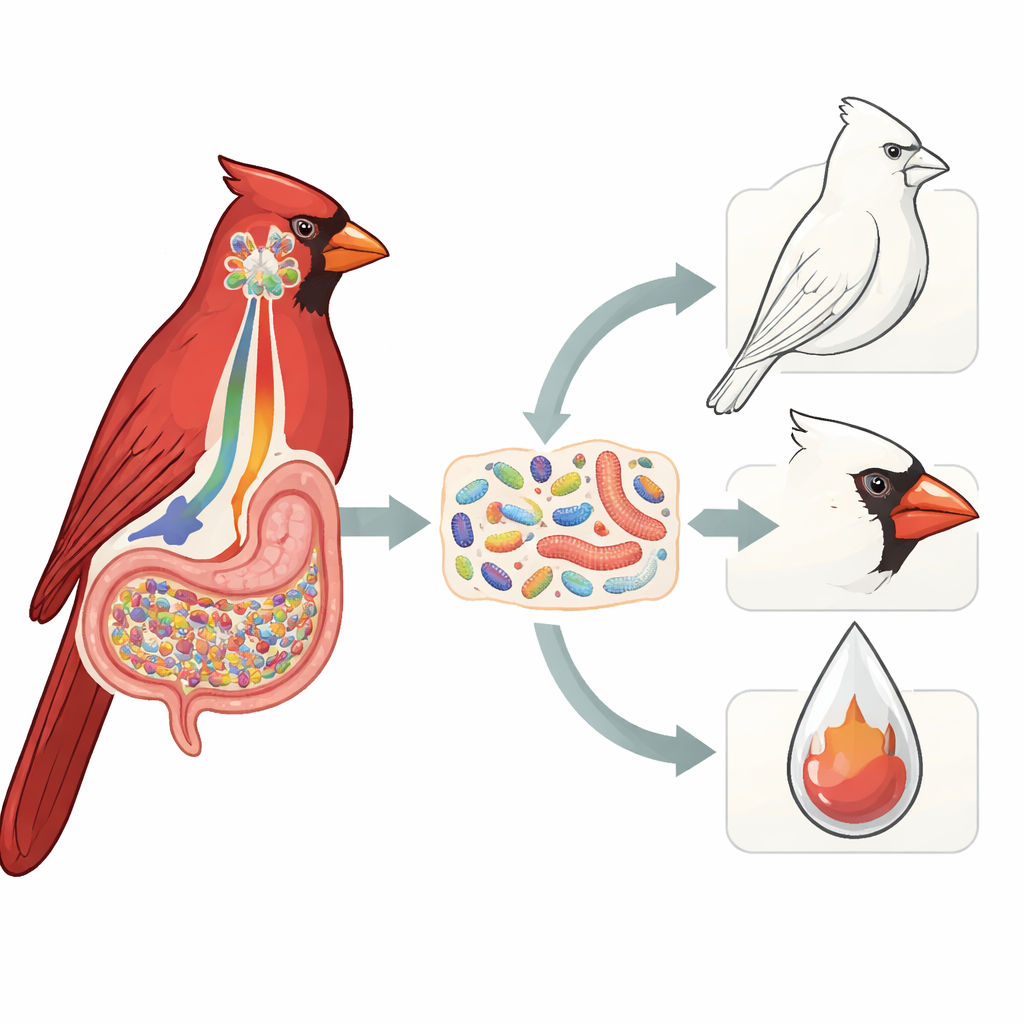
The story became richer when the team compared microbial shifts with changes in stress hormones, body condition, and beak ornamentation. Birds whose stress hormone response to handling grew stronger over time tended to lose microbial diversity, implying that mounting a bigger hormonal response may come at a cost to their inner community. Changes in body mass were also tied to how much the microbiome shifted, particularly in birds facing repeated territorial intrusions. Beak color—a carotenoid-based signal that depends on diet and health—tracked these changes as well: birds whose beaks shifted more in hue, saturation, or brightness tended to show greater changes in their gut bacteria. Finally, certain bacterial groups became more or less common under stress: potentially harmful genera such as Staphylococcus were enriched in temporarily confined birds, while typically beneficial groups like Bacillus declined in individuals whose baseline hormone levels rose, hinting that stress may favor less desirable microbes.
What this means for wildlife and conservation
Taken together, the findings show that real-world challenges—especially short bouts of captivity—can quickly reshape the gut microbiome of adult, free-living songbirds, in step with shifts in stress hormones, body condition, and visible ornaments like beak color. For field biologists, wildlife rehabilitators, and conservation programs, this suggests that standard practices such as capture, temporary housing, and repeated handling may quietly alter animals’ internal ecosystems in ways that matter for their health and survival. More broadly, the study underscores that stress does not just change behavior or hormone levels; it can reconfigure the microscopic world inside an animal, potentially influencing how well it copes with a changing environment.
Citation: Slevin, M.C., Houtz, J.L., Vitousek, M.N. et al. Challenges associate with microbiome diversity, glucocorticoids, and condition in a wild songbird. Sci Rep 16, 8511 (2026). https://doi.org/10.1038/s41598-026-42507-x
Keywords: gut microbiome, avian stress, wildlife health, Northern cardinal, captivity effects