Clear Sky Science · en
Effects of early inertial exercises on morphological and functional recovery after ACL reconstruction
Why this matters for injured knees
Serious knee injuries are all too common in sports and everyday life, and many people undergo surgery to repair a torn anterior cruciate ligament (ACL). Yet even with modern operations and careful physical therapy, patients often struggle to fully regain strength and confidence in the injured leg. This study asks a simple but important question: can adding a specific kind of resistance exercise, called inertial training, earlier in rehab help the operated leg rebuild muscle and catch up with the healthy leg more effectively?
Two different paths to getting back on your feet
The researchers followed 24 adults who had undergone ACL reconstruction using the same surgical technique and then started a 12‑week rehabilitation program. Everyone received a comprehensive standard program that included hands‑on therapy, swelling control, taping, and progressively more demanding exercises to bend and straighten the knee, strengthen the thigh muscles, and improve balance. Half of the participants stayed on this standard path. The other half performed the same program but, starting in week seven, also used a special device that provides inertial resistance for knee‑extension exercises in a seated, weight‑bearing position.
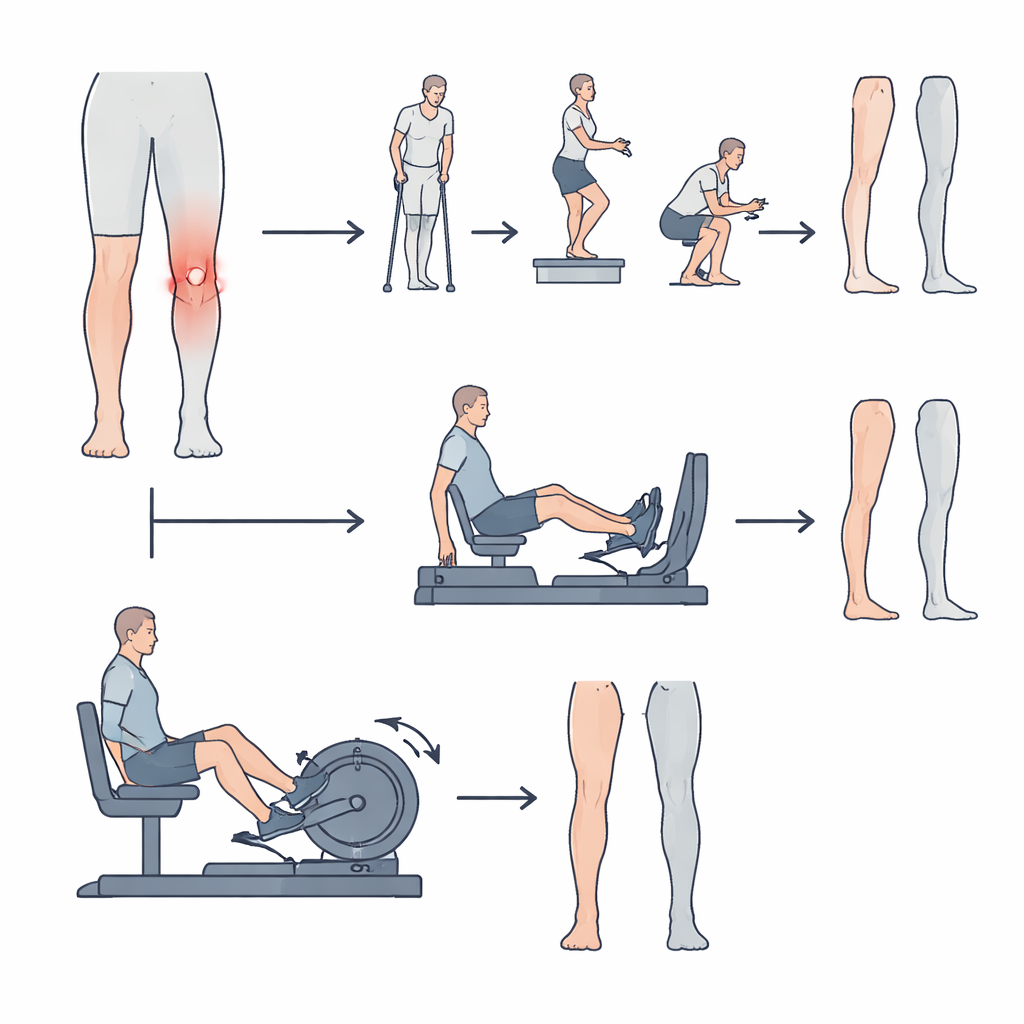
A new kind of resistance for the healing leg
Inertial training, often delivered through flywheel devices, resists movement differently from traditional weights. As you push to straighten your knee, you spin a wheel; as the wheel keeps turning, it pulls back on your leg, forcing the muscles to brake the motion. This “extra” work while the muscle is lengthening is thought to be a powerful trigger for rebuilding muscle size and strength. To keep things safe for recently operated knees, the team used a custom‑built InerKnee device that allows this type of loading while the foot stays in contact with a platform, reducing strain on the joint. From weeks seven to twelve, patients in the inertial group trained twice a week in short, intense bouts, with resistance gradually increased based on the strength of their healthy leg.
What changed in muscle size, strength, and balance
Before rehab began, both groups showed marked differences between their operated and healthy thighs: the injured side was slimmer and weaker. After 12 weeks, standard measures of strength using a motorized testing chair and measures of dynamic balance on a reach‑and‑touch test were similar in both groups. In other words, adding inertial exercises did not produce obvious advantages in peak strength or balance at this relatively early stage—and, importantly, it did not make outcomes worse or less safe. However, when the researchers looked more closely at how equal the two legs were, especially under inertial loading, a different pattern emerged.
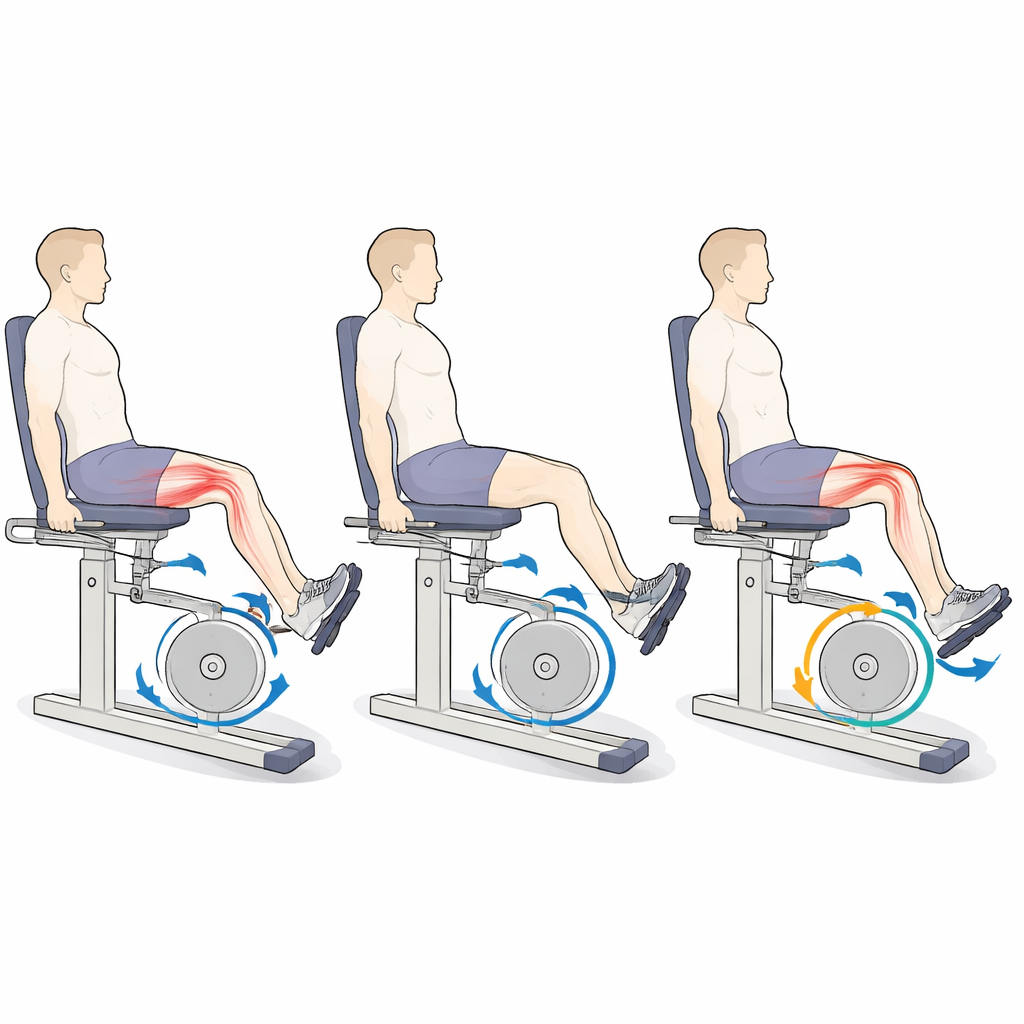
Better symmetry where it counts
People who performed the added inertial exercises showed a much greater reduction in differences between their injured and healthy limbs. Thigh circumference measured above the kneecap became more similar between legs, and body‑composition scans showed that only the inertial group gained measurable muscle mass in the operated limb. When strength was tested using the same inertial setup as in training, the ratio of operated‑to‑healthy leg strength moved closer to one in the inertial group than in the standard group, with a large statistical effect. By contrast, those who did only standard rehab still had clear side‑to‑side gaps in both size and strength at the end of the program, even though they could perform balance tasks just as well.
What this means for people recovering from ACL surgery
For patients and clinicians, the study suggests that carefully introduced inertial knee‑extension exercises, starting around seven weeks after surgery, can help the injured leg rebuild muscle and strength more evenly without jeopardizing joint safety or basic strength and balance gains. While both rehab programs produced similar overall performance at 12 weeks, the added inertial work led to a more symmetrical and muscular operated leg, which is considered important for reducing abnormal movement patterns and possibly lowering the risk of future problems. The authors note that this was a small, early‑stage trial, but their results support using closed‑chain inertial training as a promising complement—not a replacement—to standard ACL rehabilitation.
Citation: Naczk, A., Wieczorek, K., Kaczorowski, P. et al. Effects of early inertial exercises on morphological and functional recovery after ACL reconstruction. Sci Rep 16, 8644 (2026). https://doi.org/10.1038/s41598-026-42441-y
Keywords: ACL rehabilitation, inertial training, knee surgery recovery, quadriceps strength, flywheel exercise