Clear Sky Science · en
Floquet angular modulation for 6G systems
Why shaping future wireless signals matters
Today’s wireless networks already strain to keep up with streaming, cloud gaming, and billions of connected gadgets. The coming sixth generation, or 6G, will push even further, aiming for holographic calls, immersive virtual reality, and sensing abilities woven into the environment itself. To make that possible, engineers need new ways to shape and direct radio waves far more precisely than current antenna technology allows. This paper presents a fresh mathematical tool for doing exactly that, promising faster, more flexible control of signals bouncing off smart surfaces that can help power tomorrow’s ultra-connected world.
Smart walls that guide invisible waves
A key idea behind 6G is to turn ordinary walls, billboards, and building facades into reconfigurable intelligent surfaces, or RIS. These are ultra-thin panels patterned with tiny elements that can adjust how they reflect incoming waves, like a mirror that can instantly change its shape. By tuning these elements, a network can bend beams around obstacles, boost coverage in hard-to-reach spots, or send different data streams to different users using the same frequency band. All of this relies on what the authors call angular modulation: deliberately sculpting the angle and phase of waves so they interfere constructively in some directions and cancel in others.

Why old tools fall short for 6G
Traditional methods for analyzing such angular control were mostly developed for simpler, slower systems. Classic Fourier analysis assumes things do not change quickly with time, making it ill-suited for rapidly reconfigurable panels. The Jones-matrix approach excels at describing polarization—the orientation of the electric field—but does not naturally capture the many spectral sidebands that appear when surfaces are driven in complex ways. Bessel-series expansions, often used in laser spectroscopy, become painfully heavy to compute when engineers try to describe arbitrary, nonlinear modulation patterns across thousands of elements. Techniques using orbital angular momentum, which twist wavefronts into spirals to pack in more data channels, are very sensitive to misalignment and environmental disturbances. In short, none of these methods alone offers the needed mix of realism, speed, and flexibility.
A new way to see patterns inside patterns
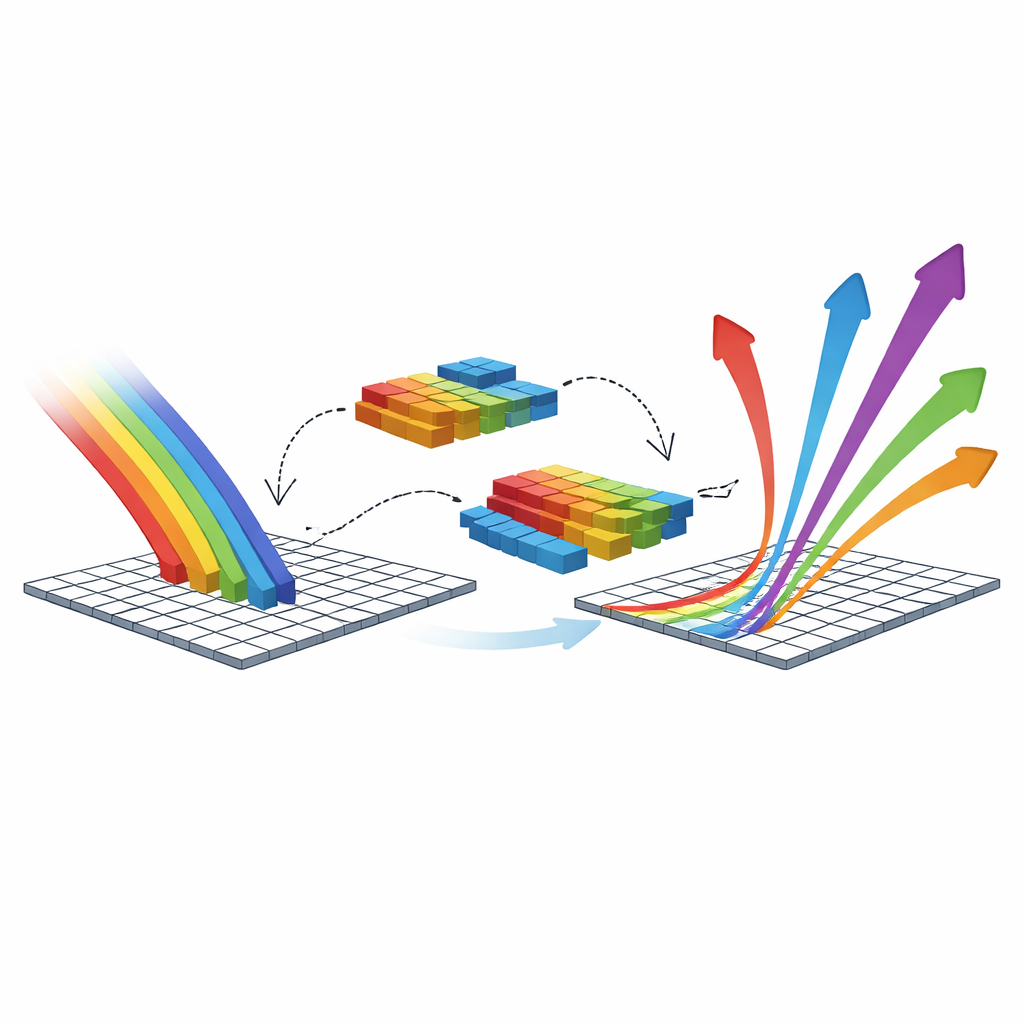
The authors build on a powerful idea from physics known as Floquet theory, which describes waves traveling through periodic structures, like light in a crystal or radio waves across a repeating antenna grid. In such systems, behavior in a vast array can be inferred from a single “unit cell” repeated many times, dramatically shrinking the computational problem. They combine this with a modified Fourier treatment to separate two ingredients: the basic, repeating structure of the surface, and the extra angular modulation that engineers apply electronically. Mathematically, the response of the array is written as a sum of spatial harmonics—simple building-block waves—while the additional phase pattern acts like a spectral filter that mixes these harmonics in a controlled way. This viewpoint turns a once static analysis tool into an active design framework: instead of just predicting what a given surface will do, it helps choose the modulation needed to achieve a desired wave shape.
From neat math to faster, smarter antennas
Putting this framework to the test, the authors show how it can describe two essential 6G tasks: steering a single beam and creating several beams at once. A simple linear phase ramp across the surface tilts the outgoing beam in a precise direction, echoing a “generalized Snell’s law” for engineered reflections. More complicated phase patterns split energy into multiple angles, supporting multi-user links or combined communication-and-sensing modes. Crucially, the Floquet–Fourier model handles both linear and nonlinear phase profiles and can incorporate time-varying modulation, so it extends naturally to panels whose behavior is rapidly pulsed or oscillated. By operating in the spectral domain, the method replaces slow double summations with fast transforms, cutting computational effort from scaling with the square of the number of elements to scaling roughly as that number times its logarithm.
Speed gains and real-world resilience
Numerical experiments underline the practical impact. For a large smart surface with over a thousand elements, the new method runs more than one hundred times faster than a benchmark based on Bessel expansions, while using less memory and keeping numerical errors effectively negligible. The authors also fold in realistic channel effects such as path loss, angular spreading, and multipath reflections, and show that a surface optimized with their approach can maintain a clear beamforming advantage over both conventional designs and orbital-angular-momentum schemes across a wide scan range. They discuss how the infinite-array assumption can be corrected for real, finite panels and how fabrication tolerances or slight non-uniformities in elements can be compensated within the same spectral framework.
What this means for everyday connectivity
In practical terms, this work offers 6G designers a sharper, faster “lens” for planning and controlling intelligent surfaces in crowded, time-varying environments. Instead of relying on slow, specialized calculations for each new modulation pattern, network controllers could quickly explore many options in real time, adapting reflections as users move or as obstacles appear. That capability could help unlock reliable terahertz links, richer spatial multiplexing, and smart buildings that quietly shape the radio landscape to deliver smoother service. While further extensions are needed to fully capture finite panel sizes and more intricate channel dynamics, the modified Floquet angular-modulation method sets a strong foundation for turning the promise of programmable wireless environments into everyday reality.
Citation: Hamdi, B., Aloui, R., Aldalbahi, A.S. et al. Floquet angular modulation for 6G systems. Sci Rep 16, 8653 (2026). https://doi.org/10.1038/s41598-026-42429-8
Keywords: 6G wireless, reconfigurable intelligent surfaces, metasurfaces, beamforming, Floquet analysis