Clear Sky Science · en
Native alleles at lhcb6 shape photosynthetic efficiency and early growth in maize
Why this matters for future harvests
Feeding a growing world with limited land and a changing climate will require crops that squeeze more growth from every ray of sunlight. Maize (corn), one of humanity’s primary staple crops, still has untapped potential hidden in its traditional varieties. This study explores how subtle, naturally occurring DNA differences in a single maize gene can change how efficiently plants turn light into chemical energy—and how fast young plants grow—offering new levers for plant breeders to improve yields and stress resilience without genetic engineering.
Hidden power in traditional corn varieties
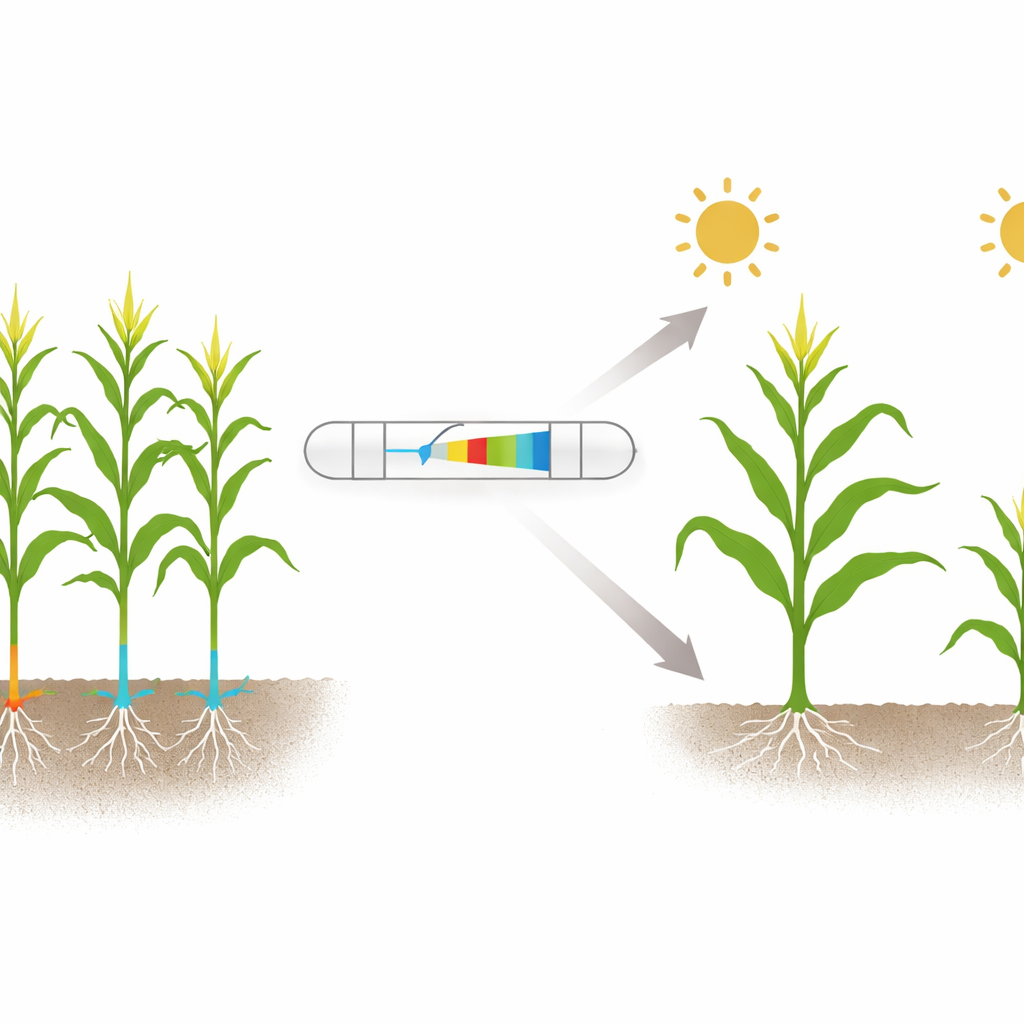
Modern elite corn lines trace back to a relatively narrow slice of the crop’s original diversity. Over decades of breeding, many useful versions of genes that help plants deal with cold, intense light, or other stresses may have been lost. The authors turned to a traditional Central European landrace called “Kemater Landmais Gelb,” which still harbors a wide range of natural variants. They measured how efficiently young plants used light in a key part of photosynthesis known as photosystem II, focusing on a widely used indicator of leaf health and stress sensitivity. By combining these measurements with genome-wide DNA markers in over 200 doubled-haploid lines derived from the landrace, they searched for regions of the genome strongly linked to better light-use efficiency.
Zeroing in on a single light-harvesting gene
The team discovered five genomic regions that together explained more than half of the genetic variation in photosynthetic efficiency, with one region at the tip of chromosome 10 showing especially large effects. To dissect this region, they created a focused mapping population from two nearly identical lines that differed mainly at this hotspot. Careful analysis of recombination events narrowed the key interval down to a stretch of just 154,000 DNA letters containing 13 genes. Among these, one stood out: a gene called lhcb6, which encodes a small protein that helps build the “antenna” that captures light and funnels it into photosystem II. Plants carrying one version of this gene consistently showed higher efficiency and better early growth than plants carrying the other version.
A jumping DNA element that dims the antenna
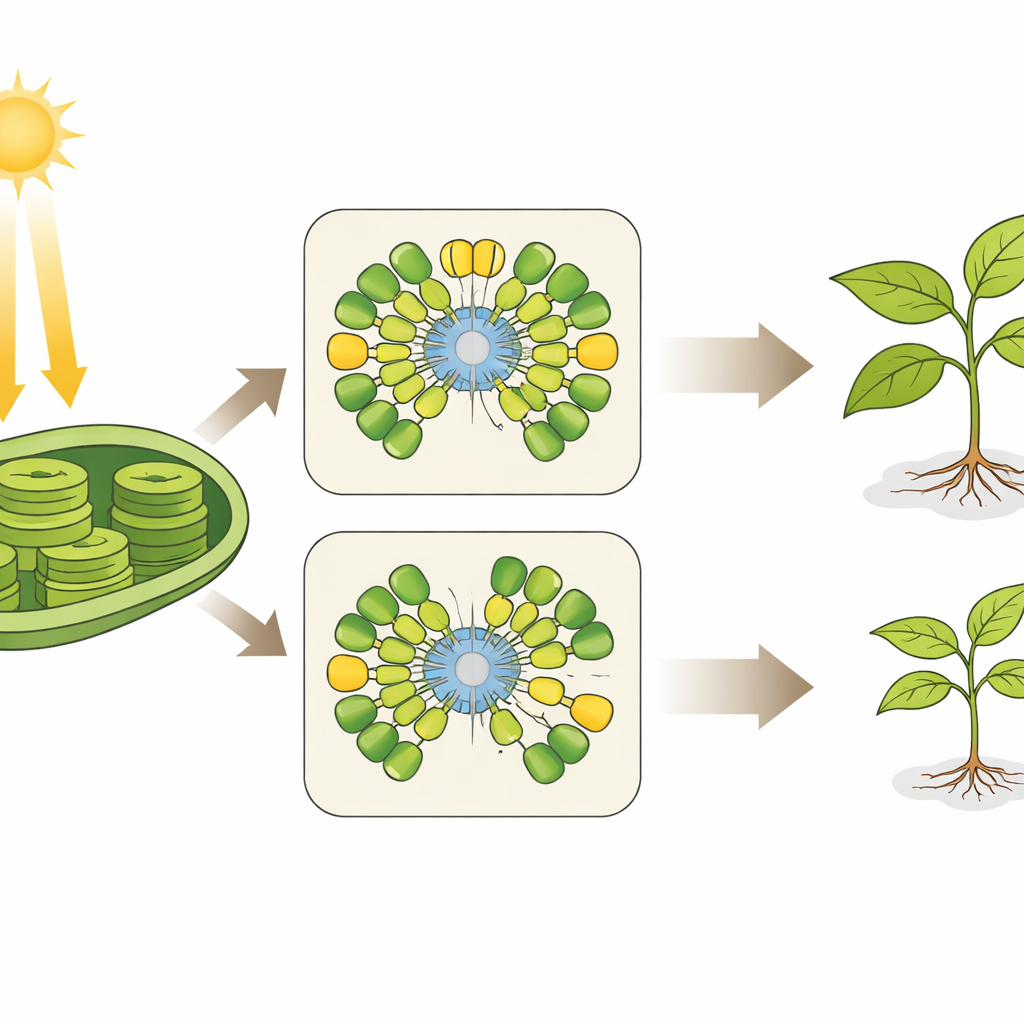
What separates the good and bad versions of lhcb6 is not a change in the protein itself, but a chunk of extra DNA lodged just before the gene. This 3.3-kilobase insertion resembles a hAT transposon—a piece of “jumping DNA” that can move around the genome. In plants with the inserted version (called lhcb6-B), lhcb6 transcript levels dropped by roughly a thousand-fold, and the corresponding LHCB6 protein in leaves was nearly absent. Proteomics showed that another antenna component, LHCB3, was also reduced, while most other light-harvesting proteins remained unchanged. As a result, these plants had altered antenna structure: they showed signs of a larger effective antenna but lower maximum efficiency and weaker capacity to safely dissipate excess light as heat, a protective mechanism known as non-photochemical quenching.
From antenna changes to growth in the field
To see how this molecular defect plays out in whole plants, the researchers developed near-isogenic lines that differed only in a small chromosome segment containing lhcb6 and neighboring genes. Under fluctuating light in growth chambers, lines with the low-activity lhcb6-B allele showed reduced photosynthetic efficiency, altered antenna behavior, and roughly half the normal protective quenching response during bright light. Their early biomass—both fresh and dry weight—was lower than that of lines carrying the high-activity lhcb6-A allele. In field-grown landrace lines, the lhcb6-B version was consistently associated with lower efficiency and shorter plants at early stages. Yet the growth penalty was relatively modest compared with similar mutants in the model plant Arabidopsis, suggesting that other maize genes partly compensate; for example, a newly identified lhcb6 paralog and enzymes that adjust chlorophyll and protective lipids appear to respond to the antenna shortfall.
New tools for smarter maize breeding
The study shows that a single natural structural change—a transposon insertion affecting when and how strongly lhcb6 is switched on—can reshape the light-harvesting antenna, alter how plants balance energy capture and protection, and nudge early growth up or down. For breeders, this creates a practical opportunity: lhcb6 alleles can now be tracked with simple DNA tests and combined with other favorable variants, such as those at a previously identified photosynthesis gene, to fine-tune how maize handles light under real-world, variable conditions. In plain terms, by reading and selecting the right versions of this antenna gene from traditional corn, breeders may grow future maize varieties that stay productive and resilient even when sunlight and temperature are far from ideal.
Citation: Urzinger, S., Würstl, L., Avramova, V. et al. Native alleles at lhcb6 shape photosynthetic efficiency and early growth in maize. Sci Rep 16, 8486 (2026). https://doi.org/10.1038/s41598-026-42348-8
Keywords: maize photosynthesis, light-harvesting antenna, lhcb6 allele, non-photochemical quenching, crop breeding