Clear Sky Science · en
La-Ni-MOF(BDC) composite with graphene oxide for enhanced bifunctional electrocatalysis in electrochemical water splitting
Clean Fuel from Ordinary Water
Imagine powering cars, factories, and homes with a fuel that gives off only water when it is used. Hydrogen can do exactly that, but producing it cleanly and cheaply is still a major challenge. This study explores a new, low‑cost material that helps split water into hydrogen and oxygen far more efficiently, bringing us a step closer to large‑scale green hydrogen as a replacement for fossil fuels.
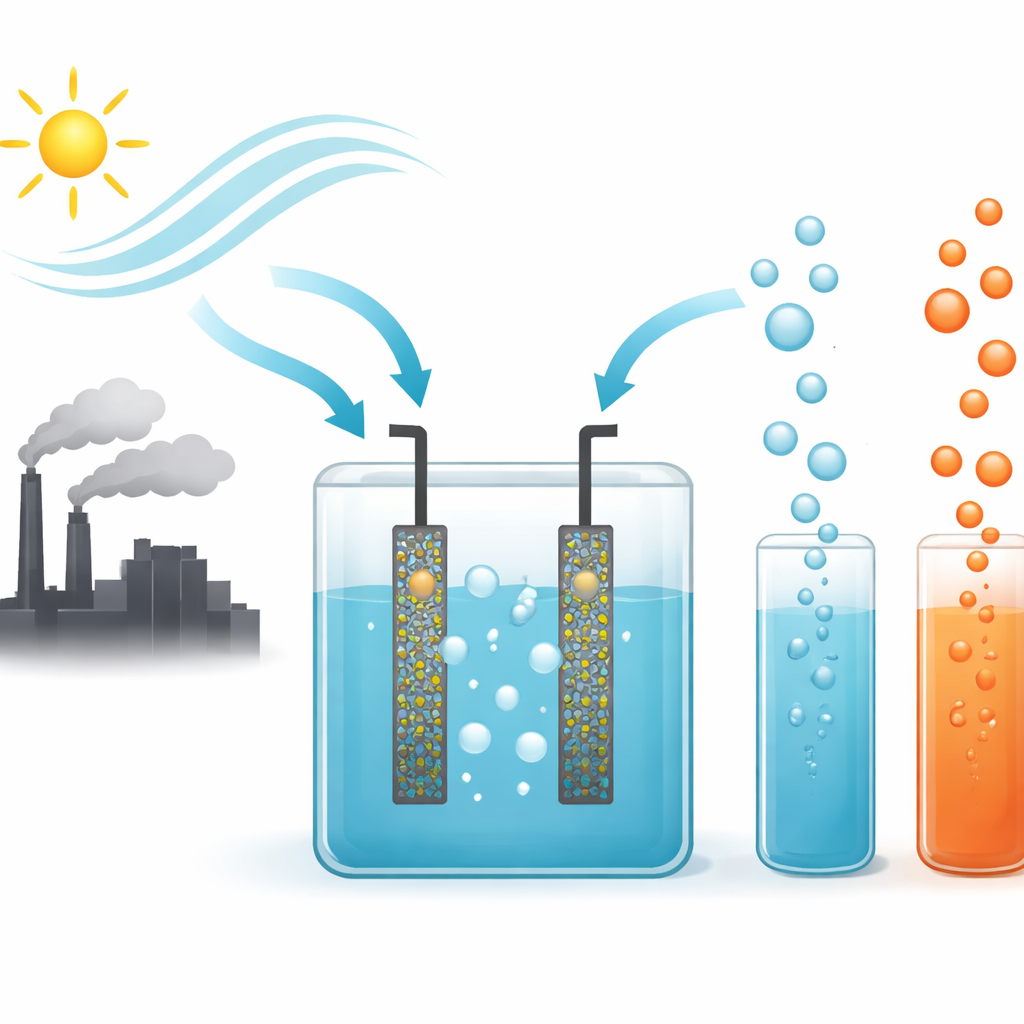
Why Water Needs a Helping Hand
Water is made of hydrogen and oxygen tightly bound together, and pulling them apart requires pushing electrons around in just the right way. That push is supplied by electricity and special surfaces called electrocatalysts, which make the reaction faster and less energy‑hungry. Today, the most effective catalysts often contain rare and costly precious metals. To make green hydrogen practical on a global scale, researchers are looking for abundant, inexpensive materials that can drive both sides of the water‑splitting process: forming hydrogen at one electrode and oxygen at the other.
Building a Smarter Catalyst
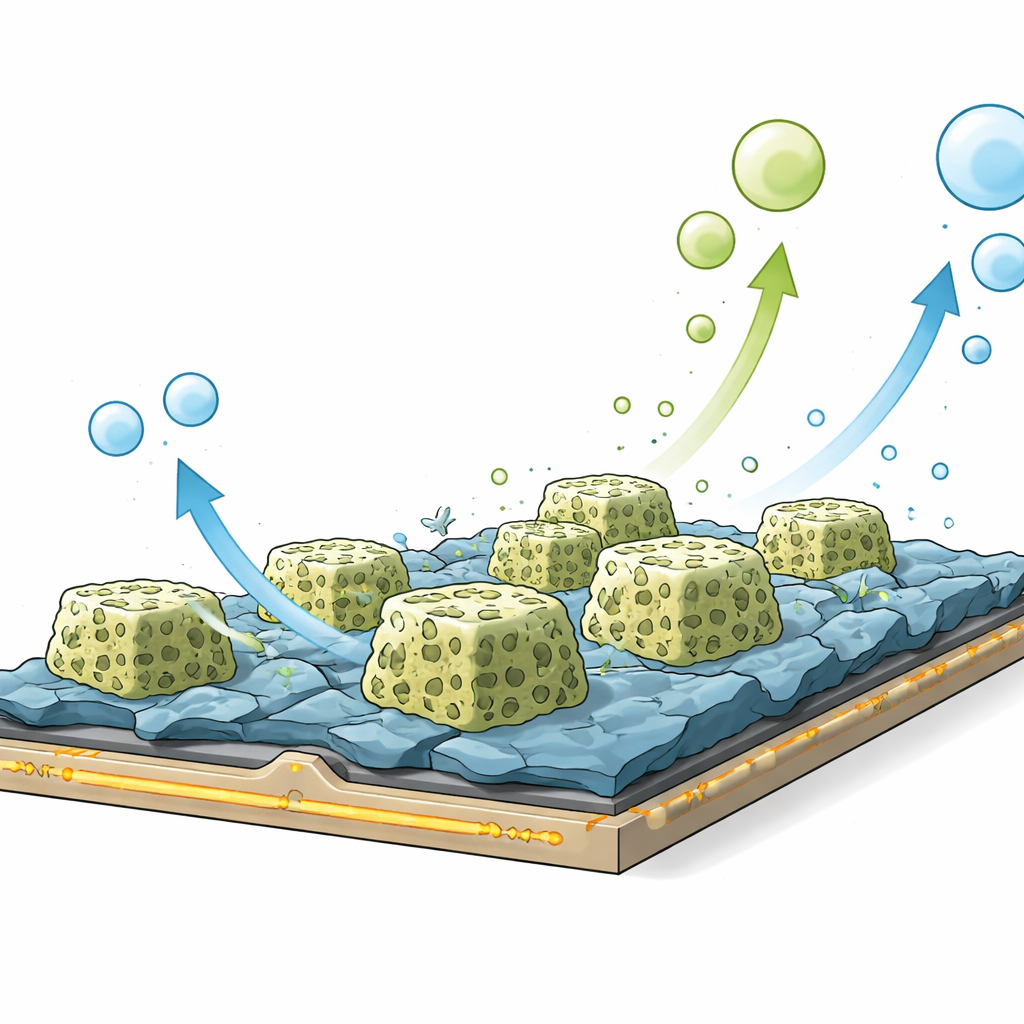
The team designed a new composite material that combines three key ingredients, each playing a different role. The core is a nickel‑based metal–organic framework, a highly porous scaffold made from nickel ions and organic linkers that offers many tiny nooks where reactions can occur. Lanthanum, another metal, is introduced alongside nickel to fine‑tune the electronic environment of these sites so that the crucial reaction steps happen more easily. Finally, this structure is grown directly on sheets of graphene oxide, an ultra‑thin carbon material that conducts electricity well and spreads the catalyst out so that more of it is exposed to the liquid. Together, these components create an interconnected network that moves charges quickly and exposes a large number of active sites to the water.
How the New Material Performs
To test their design, the researchers compared the full composite with simpler versions containing only nickel, only lanthanum, or no graphene oxide. They mounted each material onto nickel foam and measured how much extra voltage was needed to drive hydrogen and oxygen formation in an alkaline solution. The La–Ni–MOF/graphene oxide composite clearly outperformed all of the others. It produced hydrogen at a relatively low extra voltage and began generating oxygen at a lower voltage than the comparison materials, meaning it wastes less electrical energy as heat. Detailed measurements showed that electrons move through this composite more readily, that its internal resistance is lower, and that many more surface sites participate in the reactions.
Peeking Inside the Catalyst
Microscope images revealed how the structure supports this performance. The nickel‑ and lanthanum‑based framework forms porous particles that attach firmly to the wrinkled graphene oxide sheets, building a three‑dimensional network with plenty of channels for liquid and gas to move through. Surface area measurements confirmed that this hybrid has more accessible area and smaller, well‑connected pores than its separate parts. Spectroscopic and diffraction techniques showed that the chemical bonds and crystal structures remain stable, even as the material conducts current and shuttles atoms during operation. As a result, the catalyst kept working efficiently for tens of hours of continuous testing without major degradation.
What This Means for Future Energy
In plain terms, this study introduces a robust, inexpensive surface that helps electricity split water into hydrogen and oxygen more easily and for longer periods. By combining a porous nickel–lanthanum framework with conductive graphene oxide, the material offers many active reaction spots, quick charge transport, and good structural stability. While further engineering is needed before such catalysts appear in commercial devices, this work shows a promising route toward scalable, non‑precious catalysts that could make green hydrogen a more practical pillar of future clean energy systems.
Citation: Noreen, F., Zaki, M.E.A., Eid, G. et al. La-Ni-MOF(BDC) composite with graphene oxide for enhanced bifunctional electrocatalysis in electrochemical water splitting. Sci Rep 16, 8677 (2026). https://doi.org/10.1038/s41598-026-42345-x
Keywords: green hydrogen, water splitting, electrocatalyst, graphene oxide, metal–organic framework