Clear Sky Science · en
Microstructural refinement and mechanical property enhancement of AZ91 magnesium alloy via room-temperature multi-directional forging
Lighter Metals for Everyday Machines
From airplanes and electric cars to portable gadgets, engineers are chasing metals that are both very strong and very light. Magnesium alloys are among the lightest structural metals known, but they can be tricky to shape and strengthen without expensive heating steps. This study explores a simple way to squeeze more strength and toughness out of a popular magnesium alloy, called AZ91, using a careful room‑temperature forging routine instead of energy‑hungry high‑temperature processing.
How Repeated Squeezing Changes Metal
The researchers focused on a method called multi‑directional forging, which is exactly what it sounds like: a small metal block is pressed from different directions in sequence. In this work, cubes of AZ91 magnesium alloy, about the size of a large dice, were pressed nine times at room temperature. Each press gently shortened the block by only about 8 percent, and the direction of pressing was rotated so that all three dimensions were worked in turn. This low‑step, many‑pass approach was designed to avoid cracking a metal that is usually brittle when cold, while still building up a large overall deformation. 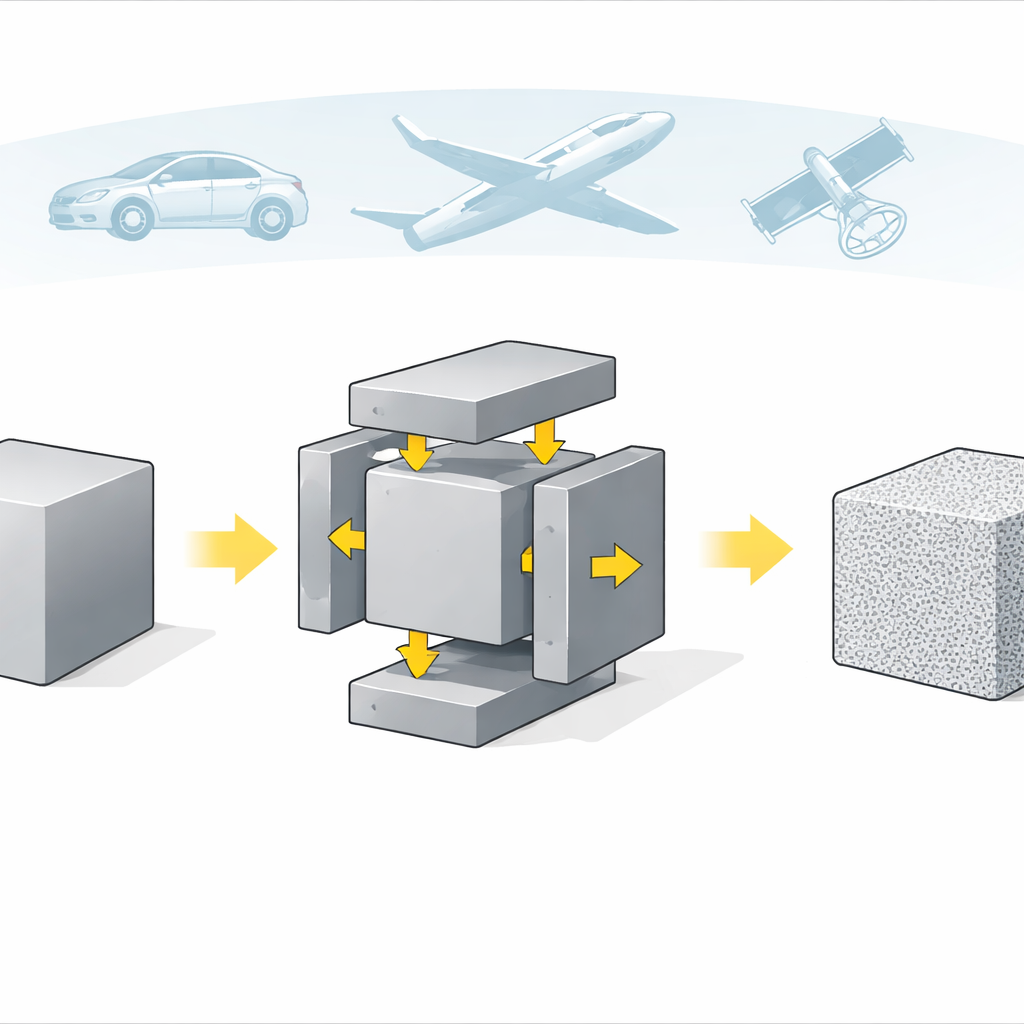
Looking Inside the Metal
To find out what these repeated presses did to the metal’s internal structure, the team examined the samples at multiple scales. Optical and electron microscopes showed how the coarse, tree‑like cast structure of the original alloy changed. After a standard heat treatment, the grains—the tiny crystalline building blocks that make up the metal—actually grew larger and more rounded. But after nine forging passes at room temperature, those big grains were broken up into much smaller ones, and the network of secondary particles rich in aluminum and other elements became more finely dispersed along the new grain boundaries. X‑ray diffraction measurements confirmed that the smallest building blocks inside the grains, called crystallites, became finer and that the density of lattice defects known as dislocations rose sharply.
Stronger and Tougher Without Heat
The structural changes translated into clear gains in performance. Compression tests showed that the alloy’s ability to withstand being squeezed increased by nearly 48 percent compared with the heat‑treated state. Its resistance to indentation, measured by Vickers hardness, rose by about 22 percent. Interestingly, the hardest region was not at the outer surface but in the core of the forged cubes, indicating that the most intense deformation occurred in the interior where the plates gripped the sample. Despite this increase in strength, the material retained good toughness, as indicated by the larger area under the stress–strain curves after forging. 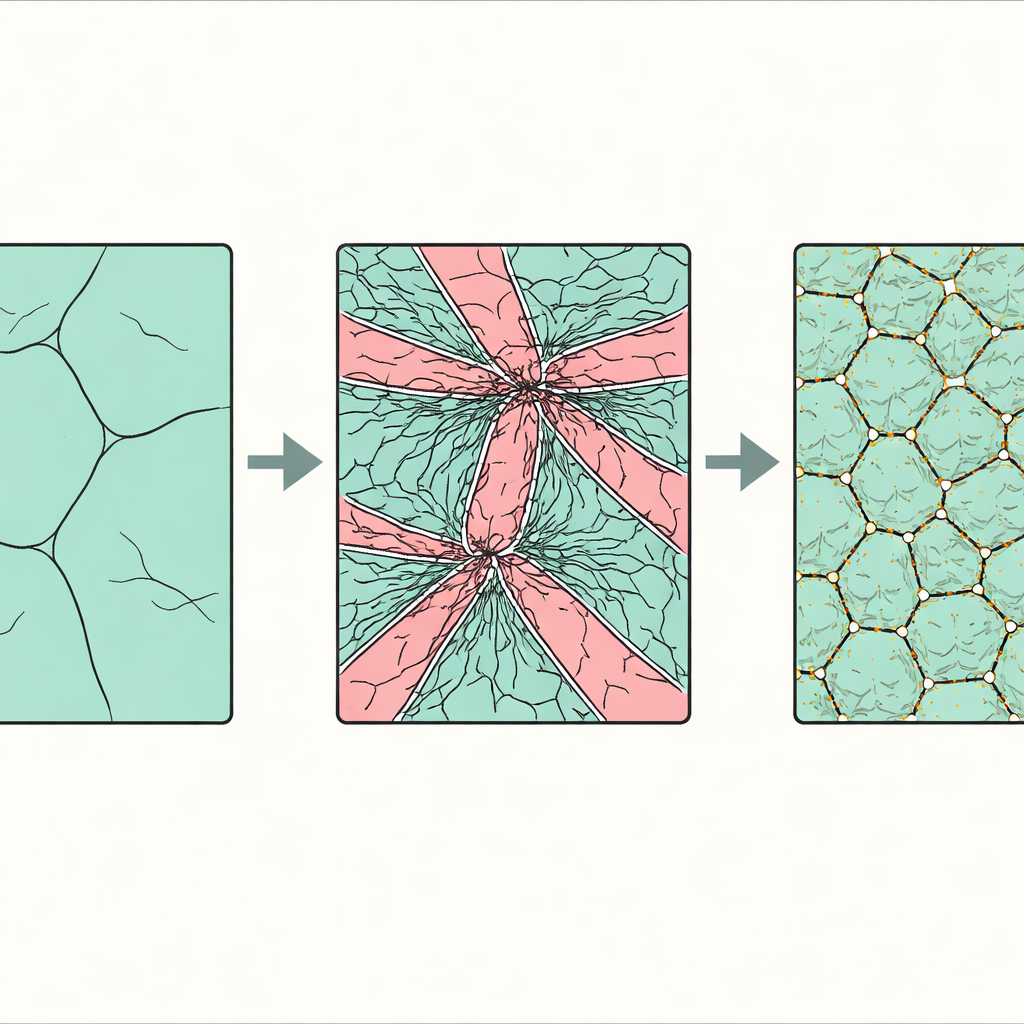
Why Smaller Structures Make Stronger Metals
The study shows that two main effects work together to harden the alloy. First, breaking large grains into smaller ones creates more boundaries that act as roadblocks to the movement of dislocations, the tiny line defects that carry plastic deformation. This follows a well‑known trend in metallurgy: the finer the grains, the stronger the metal. Second, forging at room temperature packs the material with dislocations and prevents them from rearranging and cancelling out, which would normally happen at higher temperatures. At the same time, the aluminum‑rich particles that decorate the structure are shattered into smaller pieces and spread along the new grain boundaries, where they act like pins that hold those boundaries in place and resist further sliding.
What This Means for Real‑World Parts
In plain terms, the work demonstrates that a carefully controlled series of gentle squeezes at room temperature can turn an ordinary cast magnesium alloy into a significantly stronger and tougher material, without the need for furnaces or complex tooling. By combining grain refinement, defect buildup, and particle pinning, this simple process offers a cost‑effective way to produce lightweight components for cars, aircraft, and defense systems that can carry higher loads without sacrificing safety. It suggests that with smart processing strategies, lightweight metals like magnesium can play an even bigger role in making future machines more efficient.
Citation: Şahbaz, M., Nalkıran, S. Microstructural refinement and mechanical property enhancement of AZ91 magnesium alloy via room-temperature multi-directional forging. Sci Rep 16, 9745 (2026). https://doi.org/10.1038/s41598-026-42311-7
Keywords: magnesium alloys, grain refinement, forging, lightweight materials, mechanical strength