Clear Sky Science · en
Cognitive traits modulate the effects of images and familiarity on judgments of news accuracy
Why Some Headlines Just Feel True
In a world where news flashes past us in endless scrolls, some stories simply feel more believable than others. Sometimes it’s because we have seen them before; other times it is the photo that seems to bring the claim to life. This study asks a simple but urgent question: when we judge whether online news is accurate, how much are we swayed by familiar stories and eye-catching images, and how much depends on our own thinking style?

Pictures, Familiar Stories, and Quick Judgments
The researchers focused on two well-documented quirks of human judgment. One is the “truthiness” effect: headlines paired with images often strike people as more accurate, even when the picture adds no real evidence. The other is the “illusory truth” effect: repeating a claim, or simply encountering something similar several times, makes it feel more true. Both phenomena rely on mental ease: information that is easy to process tends to be trusted. What has been less clear is whether people who are more comfortable with numbers, more reflective, or more humble about what they know are less vulnerable to these shortcuts.
Testing News Reactions in a Lab-Like Feed
To explore this, the team ran a survey experiment with 300 university students in Italy. Each participant saw 40 news items, half real and half fake, laid out to look like social media posts. For some participants, each headline came with a photo; for others, the same headlines appeared without images. After each item, students rated how accurate they thought it was, whether they had seen it before, and whether they might share it online. Separately, they completed short tests of three traits: a puzzle-based measure of reflective thinking, a brief numeracy test, and a questionnaire assessing intellectual humility—the tendency to recognize limits in one’s own knowledge.
Images and Familiarity Still Nudge Our Beliefs
Overall, the classic effects held up. Headlines shown with images were judged slightly more accurate and were a bit more likely to be shared, regardless of whether they were real or fake. Likewise, stories that felt familiar were rated as more accurate, showing that prior exposure can quietly boost credibility. At the same time, participants were fairly distrustful overall: they tended to rate claims only moderately accurate and showed low willingness to share them. This suggests that even a cautious audience can be nudged by simple design choices like adding a stock photo or repeating a story.
How Thinking Style Changes the Picture
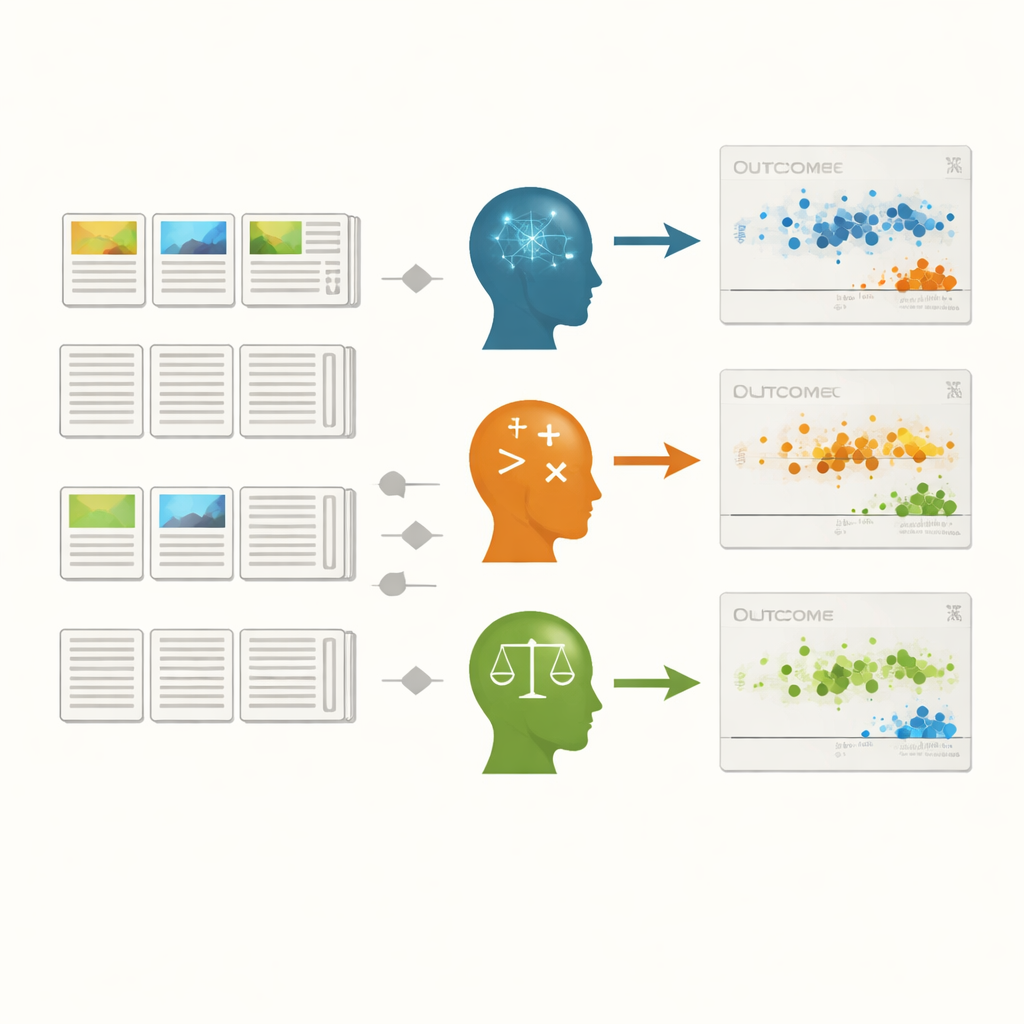
The more surprising results came from individual differences. People who scored higher on the reflective thinking test tended, on average, to rate news as more accurate, but they also showed weaker links between familiarity and perceived accuracy. In other words, reflective thinkers were somewhat less likely to equate “I’ve heard this before” with “this must be true.” Numeracy told a more mixed story. Highly numerate participants were better at downgrading fake news, yet they also showed a stronger boost in perceived accuracy when news felt familiar—suggesting that comfort with numbers does not automatically protect against the pull of repetition. Intellectual humility had only modest effects: it was linked to slightly higher accuracy ratings when images were absent and seemed to dampen the tendency to share familiar stories, but it did not broadly shield people from image or familiarity biases.
What This Means for Life Online
Taken together, the findings show that simple cues—pictures and repetition—can sway our sense of what is true, even among educated young adults who are not eager to share questionable content. At the same time, not all “good thinking” traits help in the same way. Reflective thinking somewhat reins in the influence of familiarity, numeracy sharpens detection of fake news but can also magnify the comfort of repeated claims, and intellectual humility plays only a minor role. For everyday news consumers, this means that feeling skilled or well-informed is not enough: we must remain alert to how often we have seen a story and whether an image is truly informative, rather than letting ease and familiarity stand in for truth.
Citation: Gagliardi, L., Caserotti, M., Tasso, A. et al. Cognitive traits modulate the effects of images and familiarity on judgments of news accuracy. Sci Rep 16, 10831 (2026). https://doi.org/10.1038/s41598-026-42289-2
Keywords: misinformation, fake news, media literacy, cognitive biases, social media