Clear Sky Science · en
Reconfigurable magneto-optical diffractive neural network with enhanced optical phase modulation
Smart Cameras that Think with Light
Today’s smartest phones and cars rely on power-hungry chips to recognize faces, read street signs, or spot pedestrians. This study explores a very different approach: instead of doing the math on electronic circuits, it lets light itself perform the calculations as it flies through a thin magnetic film. The result is a tiny, reprogrammable optical "brain" that can classify images quickly while using very little energy, pointing toward future cameras that understand the world the instant light hits their sensors.
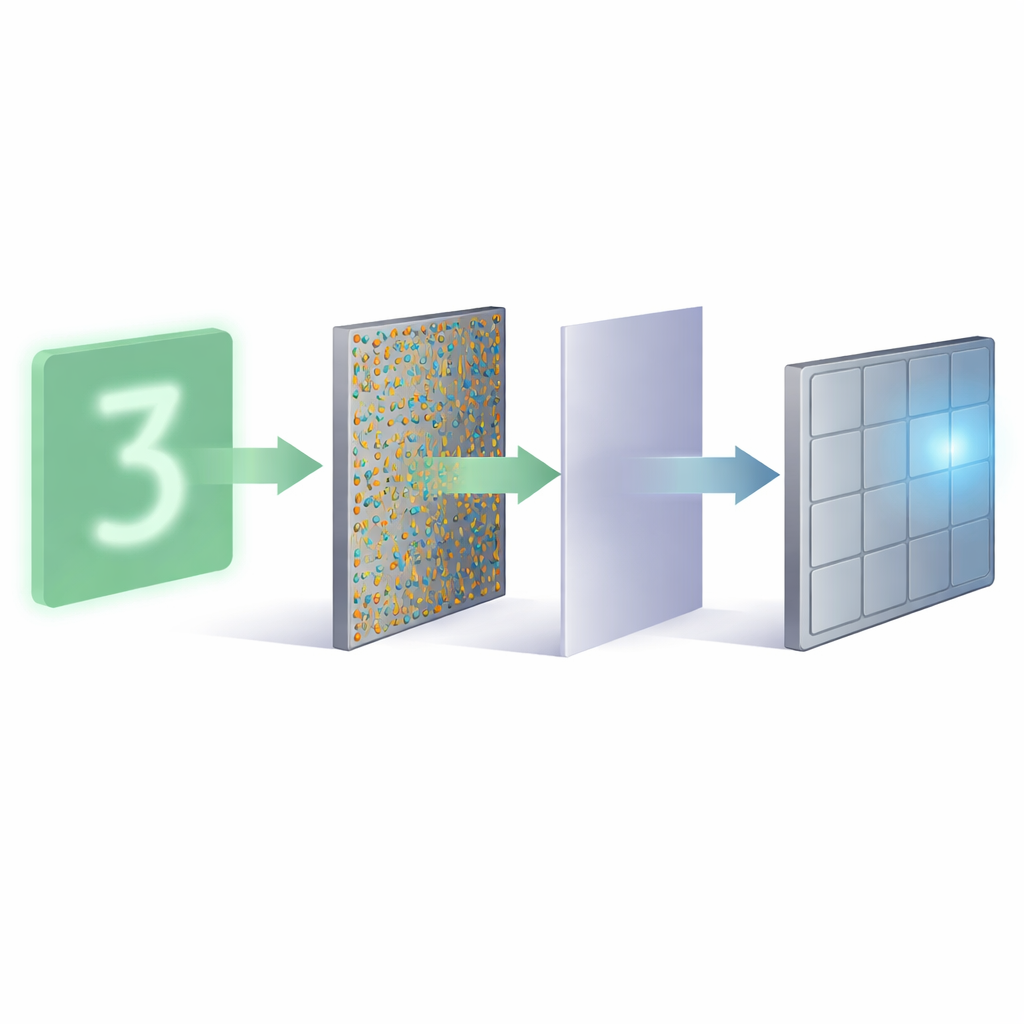
Letting Light Do the Computing
Conventional neural networks, which power many AI applications, run on silicon chips that shuttle electrons around. That costs energy and takes time. In contrast, diffractive neural networks use specially patterned transparent layers so that incoming light bends, interferes, and spreads out in just the right way to perform the same kind of calculations. Each tiny spot on such a layer acts like a neuron, nudging the light’s phase—how its waves line up—so that different input images end up producing different brightness patterns at the output.
Adding Magnetism for Flexibility
The catch with earlier optical designs is that, once fabricated, their patterns are mostly frozen. To change the task—from reading handwritten digits to spotting shoes or shirts—you often need a new device. The team behind this work instead builds the key layer from a magneto-optical film, a special glass-like material whose tiny magnetic domains twist the polarization of passing light. These domains can be written, erased, and rewritten using a laser and a magnetic field, much like recording bits on an old magneto-optical disk. That makes the optical neural network reconfigurable: the same piece of film can be redesigned in place for new recognition tasks.
Turning a Weak Effect into a Strong Signal
On its own, the twist that the magnetic film gives to light is quite small—far less than what liquid-crystal displays can manage—so it might seem too weak to build a powerful computer. The authors overcome this by exploiting a subtle diffraction effect. When polarized light hits the patterned magnetic domains, different parts of the outgoing light acquire polarization directions that differ by a right angle. By placing a polarizer after the film, the setup suppresses the parts of the beam that were hardly changed and keeps mostly the strongly twisted component. This clever filtering greatly boosts the useful signal without needing large phase shifts in the material itself.
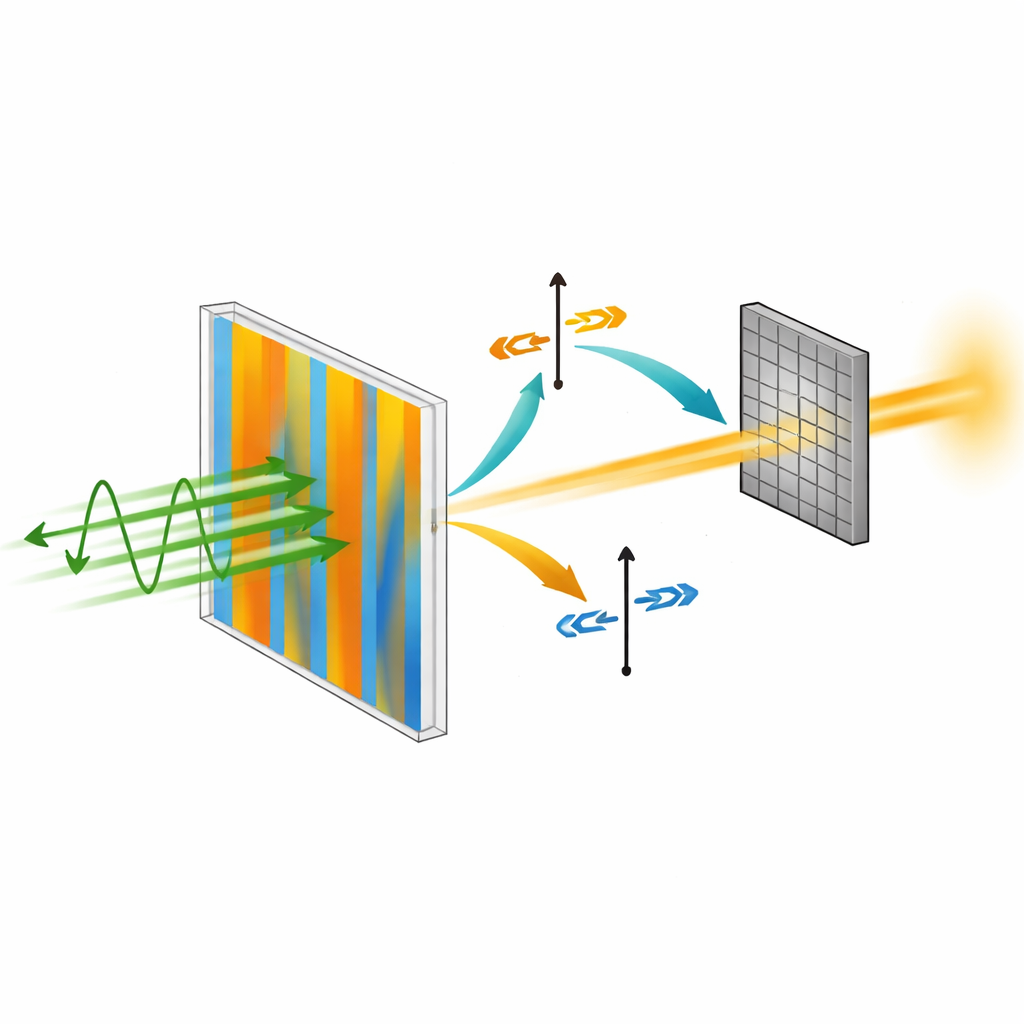
From Digits to Fashion Items
To test their design, the researchers trained a single magneto-optical layer, together with the polarizer, to recognize images from standard benchmark sets. In computer simulations, the system correctly classified handwritten digits about 98 percent of the time—similar to more complex optical networks that rely on stronger phase control. It also handled a tougher set of clothing images with nearly 89 percent accuracy when enough tiny magnetic "neurons" were used. The team then built a real version using a bismuth- and gallium-containing garnet film, a green laser, and a camera. Even with practical imperfections, the physical device reached over 83 percent accuracy for digits and 71 percent for fashion items, and it could switch between these tasks simply by rewriting the magnetic pattern.
Toward Cameras that Sense and Decide On-Chip
In everyday terms, this work shows that a thin, rewritable magnetic film can serve as the thinking layer of an optical AI system, despite only gently twisting the light that passes through it. By smartly arranging diffraction and polarization, the authors squeeze powerful pattern-recognition ability out of modest material properties. Because the device is compact, needs no power to hold its magnetic state, and works at visible wavelengths, it could one day be built directly on top of image sensors. Such "edge" cameras would not just capture scenes but instantly interpret them—recognizing digits, objects, or traffic signs—while consuming far less energy than today’s digital processors.
Citation: Sakaguchi, H., Watanabe, K., Ikeda, J. et al. Reconfigurable magneto-optical diffractive neural network with enhanced optical phase modulation. Sci Rep 16, 8920 (2026). https://doi.org/10.1038/s41598-026-42193-9
Keywords: photonic computing, optical neural networks, magneto-optical materials, image classification, neuromorphic hardware