Clear Sky Science · en
Promoting structural sustainable design through the influence of quality control assessments
Building safer and greener structures
When we think of making buildings more sustainable, we often picture new materials or bold architectural ideas. But a quieter revolution is possible simply by using what we already build more wisely. This paper explores how routine quality checks on concrete and other building elements can be turned into a powerful tool to design structures that are both safe and use less material, helping to cut costs and carbon emissions.
How quality checks quietly improve our buildings
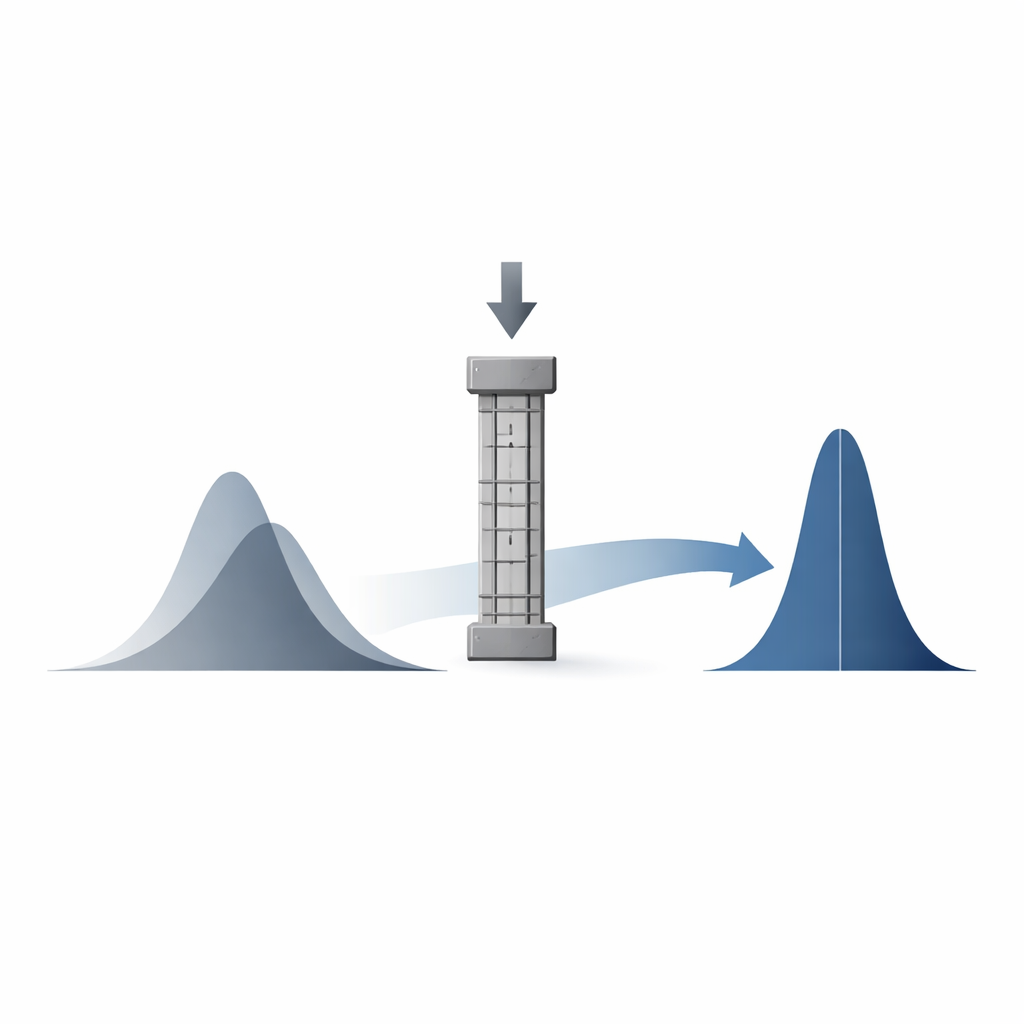
Modern construction sites already carry out many tests: concrete samples are crushed to measure strength, steel bars are checked, and column dimensions are measured. The authors show that these checks do more than just weed out bad batches; they actually “filter” the population of building elements. Lots that fail are rejected, so the pieces that end up in real structures are, on average, better than the raw statistics for all produced material would suggest. This hidden upgrade in quality means that the real strength of a structure can be higher, and its uncertainty lower, than design rules currently assume.

Turning test results into better predictions
To capture this filtering effect, the study uses a statistical framework known as Bayesian updating. In simple terms, engineers start with a best guess about how variable a property like concrete strength might be, based on past data and codes. They then update this guess by accounting for the fact that only batches that pass specific quality rules are allowed into the structure. The result is an “outgoing” distribution that reflects the material actually used after inspection: it tends to have a higher average strength and less scatter than the “incoming” distribution before checks. The authors extend earlier work by allowing several properties—such as concrete strength and geometric dimensions—to be treated together and by using a refined model that better fits real concrete data.
A test case: a single concrete column
To see how much this matters in practice, the researchers study a short reinforced concrete column under compression, a common building element. They model how its capacity depends on concrete strength, steel yield strength, cross-section size, loads, and other factors. First, they compute the column’s reliability (the probability it will perform safely) using conventional assumptions, which ignore the effect of quality control. Then they repeat the analysis using the updated, post‑inspection distributions for concrete strength and for the column’s width and height. The calculations show that quality control on concrete strength alone can raise the reliability level by up to about 10 percent, while additional checks on dimensions have only a small effect in this particular case.
Unlocking hidden safety margins
Design codes build in safety by using partial safety factors, which deliberately overestimate loads and underestimate strengths. Because quality control makes the real structure more reliable than the basic models predict, there is a safety buffer that is not fully used. The authors show that, for the studied column and realistic testing rules, this buffer is large enough to justify reducing the safety factor applied to concrete strength from 1.50 to as low as 1.30, while still meeting recommended safety targets. In practical terms, this could allow engineers to use slightly smaller sections or less concrete without increasing risk, which directly translates into resource savings and lower greenhouse gas emissions.
What this means for future construction
For non-specialists, the message is straightforward: better use of information we already collect can make structures both safer and more sustainable. By rigorously linking routine quality checks to reliability calculations, the study shows that current design practices may be more conservative than necessary, at least for some elements and materials. The proposed approach still respects safety targets but suggests they can sometimes be met with less material, especially when quality control is strict and well documented. With further data and refinement—including newer concretes and digital monitoring—the method could support design rules that are not only robust but also more climate‑friendly.
Citation: Lux, T., Feiri, T., Schulze-Ardey, J.P. et al. Promoting structural sustainable design through the influence of quality control assessments. Sci Rep 16, 8277 (2026). https://doi.org/10.1038/s41598-026-42152-4
Keywords: structural reliability, quality control, concrete strength, sustainable design, probabilistic design