Clear Sky Science · en
Appendicitis inflammatory response versus pediatric appendicitis score for grading disease severity in children
Why this matters for families
Stomach pain is one of the most common reasons children are rushed to the emergency room, and appendicitis is often at the top of the worry list. The real danger is not just appendicitis itself, but missing the more serious forms that can burst or spread infection inside the belly. This study asks a practical question that matters to parents, children, and doctors alike: when a child shows up with suspected appendicitis, which simple bedside score does a better job of flagging the kids who are in real trouble?

Two simple scores for a tough decision
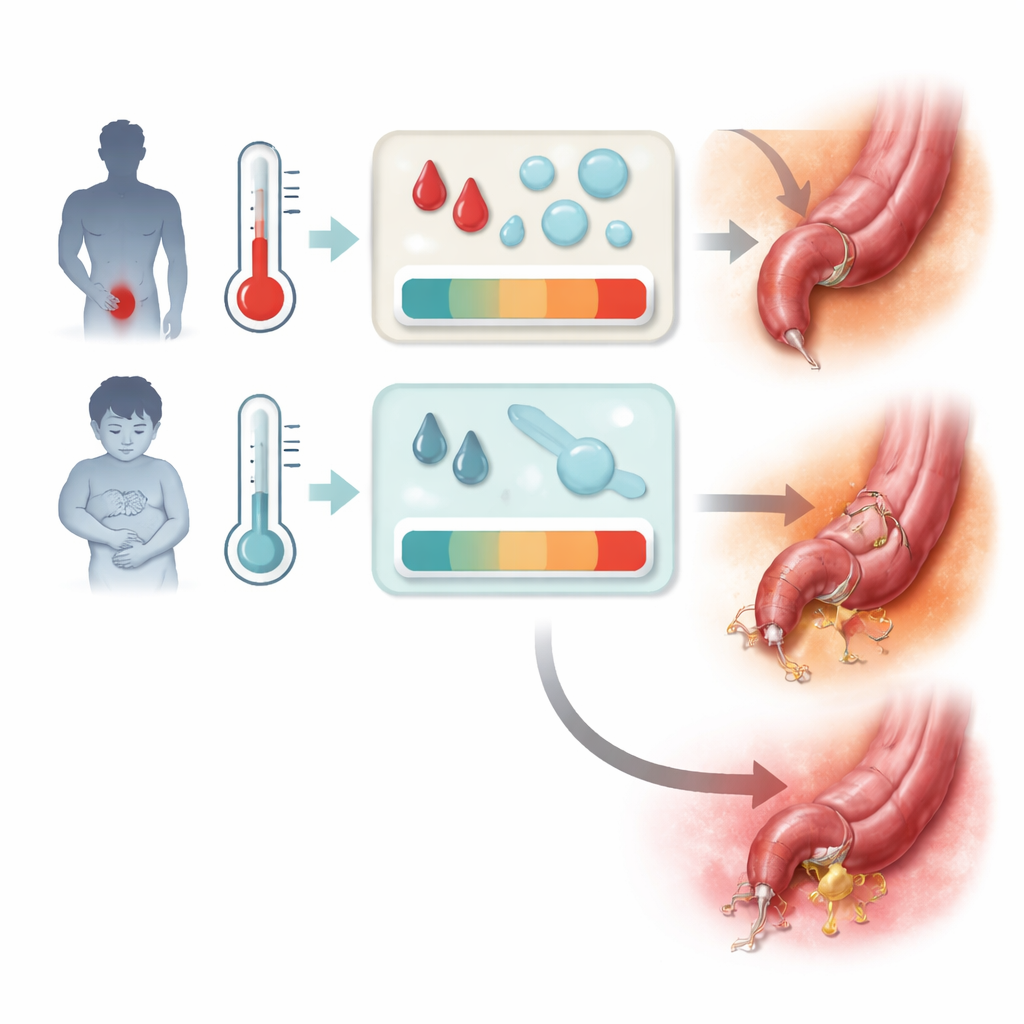
Doctors often use checklists, or “scores,” to turn a child’s symptoms, exam findings, and lab tests into a single risk estimate. This study focused on two such tools. One, called the Pediatric Appendicitis Score, is built mostly on what the child feels (such as pain that moves to the lower right side), how they look on exam, and basic blood counts. The other, the Appendicitis Inflammatory Response score, adds more detailed information about the body’s reaction to infection, especially a blood protein that rises with inflammation. Both scores sort children into low-, medium-, or high-risk groups, but they emphasize different pieces of information.
How the study was carried out
The research team followed 138 children, from infants to teenagers, who came to a university hospital with belly pain suspicious for appendicitis. All of them were scored with both tools before any operation, and nearly all went on to have their appendix removed. The surgeons carefully recorded what they saw in the operating room, labeling each case as either simple or complicated based on visible damage like holes, dead tissue, or pockets of pus. Pathologists then examined the removed appendix under a microscope to confirm whether it had actually burst. The researchers also collected blood tests and measured the width of the appendix on ultrasound or CT scans.
What the scores revealed about severity
As children moved from low- to high-risk groups on the inflammation-based score, their white blood cell counts, percentage of infection-fighting cells, and inflammation marker levels rose steadily. Higher categories on this score were clearly linked to more severe disease seen during surgery and to a higher chance that the appendix had burst. The more symptom-focused score also rose with worsening blood counts, and its high-risk group tended to have larger appendixes on scans. However, it was tied mainly to cases where the appendix had already perforated and was less reliable at spotting complicated disease before that point.
How accurate were these tools?
To judge accuracy, the team used statistical curves that compare how well each score separates mild from severe cases. For complicated appendicitis, the inflammation-based score performed slightly better than the traditional symptom score, offering more useful information for grading overall disease severity. When it came to predicting a fully perforated appendix, both tools did only moderately well and were roughly similar to each other. Importantly, agreement between what the scores predicted and what surgeons actually found was only fair, underlining that no single checklist can replace careful clinical judgment.
What this means for children with belly pain
The study suggests that the inflammation-based score is a stronger guide for recognizing children at risk of serious appendicitis before the appendix ruptures, and it can still be helpful even when scans look uncertain. The more traditional score, while useful, seems to work best when paired with clear imaging findings and tends to highlight children whose disease is already advanced. For families, this means that a few extra blood test details can help doctors decide more safely who needs close observation, who may need urgent surgery, and who might be spared unnecessary radiation from CT scans. In everyday practice, combining these insights could lead to faster care for the sickest children and fewer invasive tests for those who are likely to recover without complications.
Citation: Ibrahimoglu, H. Appendicitis inflammatory response versus pediatric appendicitis score for grading disease severity in children. Sci Rep 16, 11003 (2026). https://doi.org/10.1038/s41598-026-42122-w
Keywords: pediatric appendicitis, appendicitis severity scores, inflammatory response score, perforated appendicitis, children abdominal pain