Clear Sky Science · en
Soil organic carbon stocks after ten years of reduced tillage, compost and mulch application in temperate organic agriculture
Why the Dirt Under Our Feet Matters
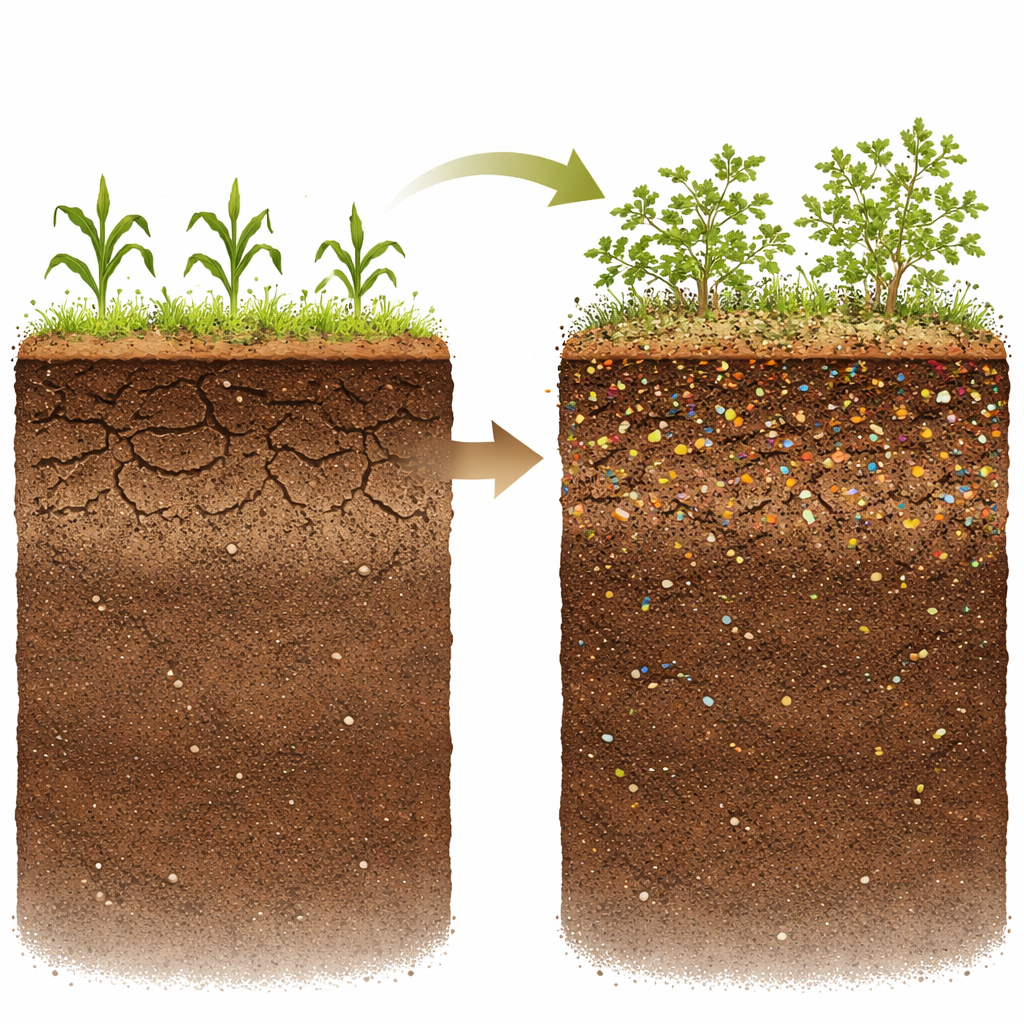
Soils quietly hold more carbon than all the world’s plants and the atmosphere combined. That carbon helps crops grow, stores water, and can keep climate‑warming carbon dioxide out of the air. This study asks a deceptively simple question with big implications for food and climate: after a decade of "regenerative" organic farming practices—less ploughing, regular compost, and plant mulch—how much extra carbon actually ends up locked into farm soils, and how deep does it go?
Farms as Hidden Carbon Banks
The researchers worked on an organic farm in central Germany that has followed strict organic rules since the late 1980s. They compared conventional ploughing with a set of practices often promoted as regenerative: reduced tillage (shallower, non‑inverting soil cultivation), repeated applications of high‑quality yard‑waste compost, and occasional mulch made from chopped cover crops laid on potato ridges. Across two nearly identical long‑term field trials, they tracked crop yields, measured the carbon and nitrogen added by compost and mulch, and estimated how much carbon crops themselves returned to the soil through residues, roots, and root exudates. After ten years, they sampled soils down to one meter deep to see where carbon had accumulated.
How Carbon Enters and Moves Through Soil
The team found that most of the carbon entering the soil did not come from trucked‑in compost or mulch, but from the plants growing in the field. Over a decade, carbon in net plant production—grain, straw, roots, and root secretions from main crops and cover crops—was the dominant source of new soil carbon. Compost and mulch added extra carbon and nitrogen, but their role was mainly indirect: by improving soil fertility and structure, they could support plant growth and thus plant‑derived carbon inputs. To keep the assessment realistic for climate policy, the authors also asked whether the added organic matter could, in principle, be produced within the farm’s own boundaries, using livestock manure as a benchmark for a "closed" nutrient cycle.
What Worked at the Soil Surface
The clearest gains showed up in the top 30 centimeters of soil. Reduced tillage on its own raised soil organic carbon stocks compared with ploughing, without lowering overall yields. Regular compost had a similar positive effect. When reduced tillage and compost were combined, carbon stocks in the topsoil rose the most, reaching about 16% higher total carbon (down to one meter) than in the ploughed plots without compost or mulch. The soil’s carbon and nitrogen contents rose together, reflecting healthier, more fertile soil. Surprisingly, mulch—even though it delivered relatively large carbon doses—did not measurably increase soil carbon stocks and in some cases appeared to have a slight negative effect, likely because its legume‑rich, nitrogen‑heavy makeup decomposed quickly and released carbon back to the air.
What Didn’t Change Deep Underground
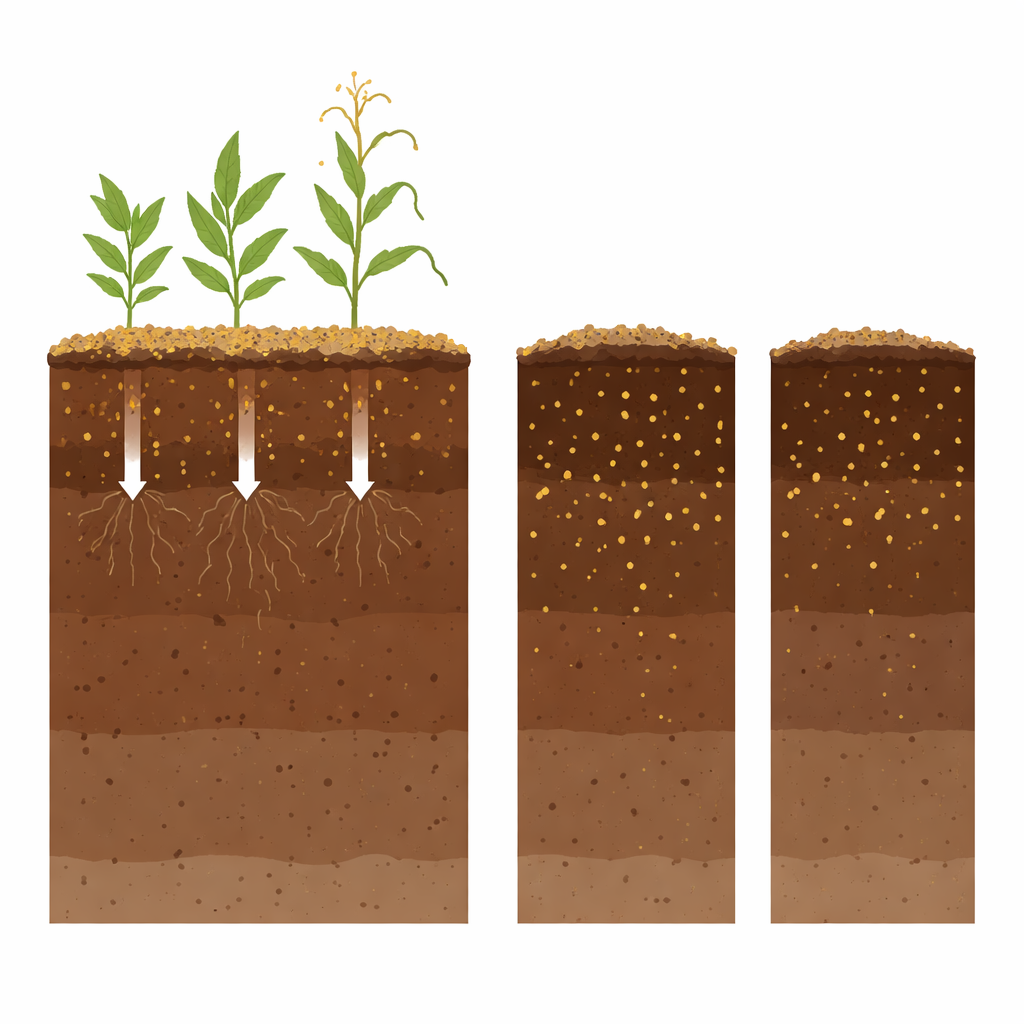
Below 30 centimeters, the story was different. Despite a decade of contrasting tillage and amendment regimes, the deeper layers showed no statistically clear differences between treatments. There were hints that higher overall carbon inputs slightly raised subsoil carbon, but the main changes stayed confined to the surface. This matters for climate: deep soil is disturbed less often, tends to hold carbon longer, and is therefore critical for truly long‑term storage. The results suggest that simply adding compost and reducing tillage, as done here, may not be enough to fill this deep "carbon vault" without additional strategies such as deep‑rooting crops, diverse cover‑crop mixes, or practices that deliberately move carbon below plough depth.
What This Means for Future Farming
In everyday terms, the study shows that regenerative organic methods can make the upper soil layers richer and more fertile, boosting carbon and nitrogen where crop roots and soil life are most active. Reduced tillage plus compost is a particularly powerful combination for building topsoil health. However, these practices alone are unlikely to deliver large, long‑lasting climate benefits through deep carbon storage, especially if they depend heavily on organic matter imported from outside the farm. To turn farms into more reliable, self‑sustaining carbon banks, future systems will need to pair gentle soil management with crops and cover crops that send roots deep into the ground, all while balancing water use and yield under a changing climate.
Citation: Niether, W., Leisch-Waskönig, S., Finckh, M.R. et al. Soil organic carbon stocks after ten years of reduced tillage, compost and mulch application in temperate organic agriculture. Sci Rep 16, 8260 (2026). https://doi.org/10.1038/s41598-026-42050-9
Keywords: soil organic carbon, regenerative agriculture, reduced tillage, compost and mulch, organic farming