Clear Sky Science · en
Functional connectivity in infants’ visual cortex and its links to motion processing and autism
Why early baby brain signals matter
Parents often wonder if there are very early signs that might hint at how their child will develop, especially when there is a family history of autism. This study looks at babies just five months old and asks a striking question: can tiny patterns of brain activity while they simply watch short videos already be linked to how strongly autistic traits show up years later? By focusing on how different parts of the visual brain "talk" to each other, the researchers explore whether early differences in motion and social processing might be part of the story of autism.
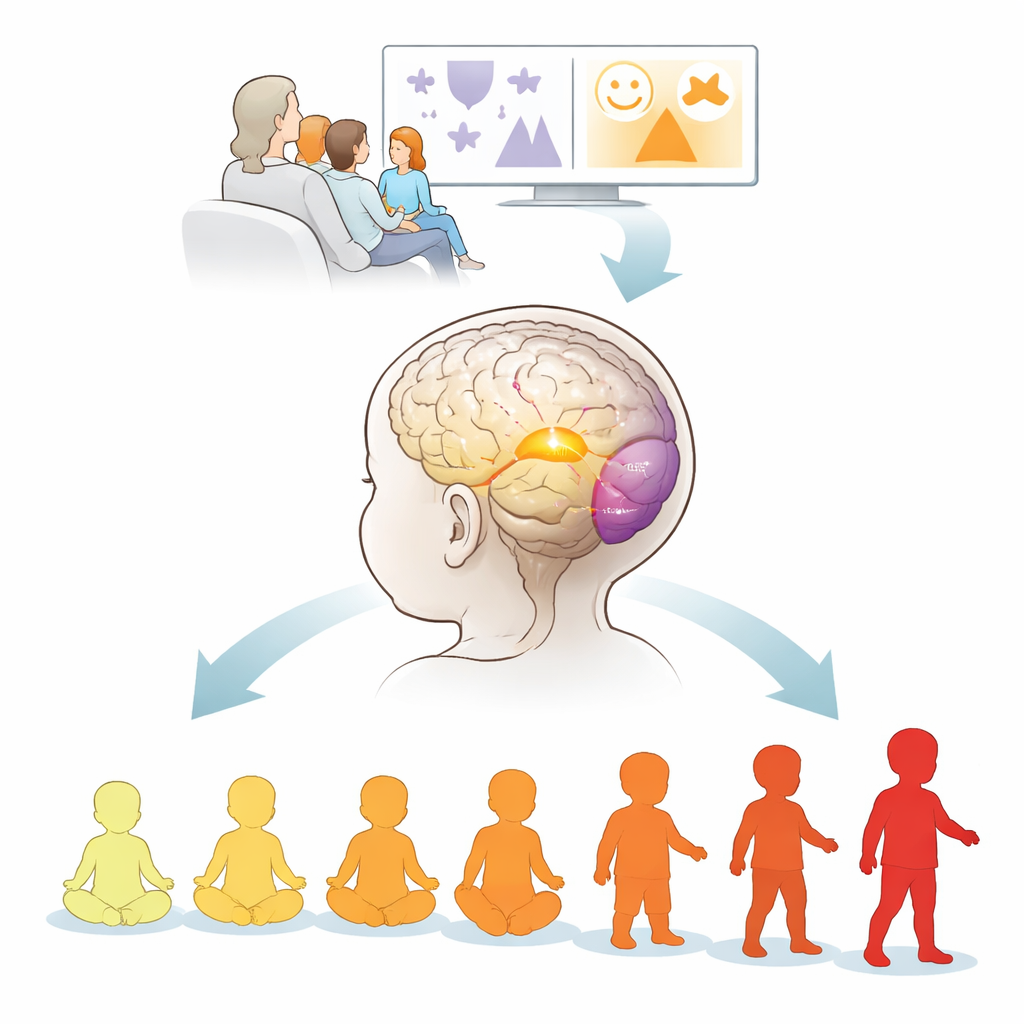
Watching simple scenes on a screen
The researchers invited 5‑month‑old infants into the lab, many of whom had an older family member with an autism diagnosis. While the babies sat on a caregiver’s lap, they watched two kinds of one‑minute videos: a woman smiling and singing nursery rhymes (a rich social scene), and brightly colored toys spinning and rotating (a non‑social scene). These clips were short, friendly, and engaging for infants, and both contained motion, but one was clearly social while the other was not. At the same visit, but in a separate experiment, the same infants also saw moving dot displays designed to test how their brains respond to overall, or “global,” patterns of motion.
Listening in on the visual brain’s conversations
While the infants watched the videos, the team recorded their brain activity using an EEG cap—essentially a soft net of sensors resting on the scalp. They focused on the back of the head, where the visual cortex sits, and measured how strongly a midline region (roughly corresponding to primary visual cortex) synchronized its activity with more side‑located regions. Instead of looking at raw power, they examined the timing relationships between signals, in three well‑known brain rhythms: theta, alpha, and gamma. These rhythms are thought to support basic attention, emotional arousal, and the way the brain binds together pieces of visual information into a coherent picture.
Distinct patterns linked to later autistic traits
The infants were followed up at 3 years of age, when trained clinicians assessed autistic symptoms using a standard observational tool. The researchers found that how strongly midline visual areas synchronized with far‑lateral regions at five months was meaningfully related to later symptom levels, especially in the theta and gamma bands. Stronger theta‑band connectivity during the non‑social toy videos was associated with more autistic symptoms at age three, particularly in babies who already had a family history of autism. In contrast, gamma‑band connectivity during the social videos related in two ways: it was tied both to later symptom severity and to an earlier measure of how strongly the infants’ visual cortex favored side regions over the midline when processing global motion.
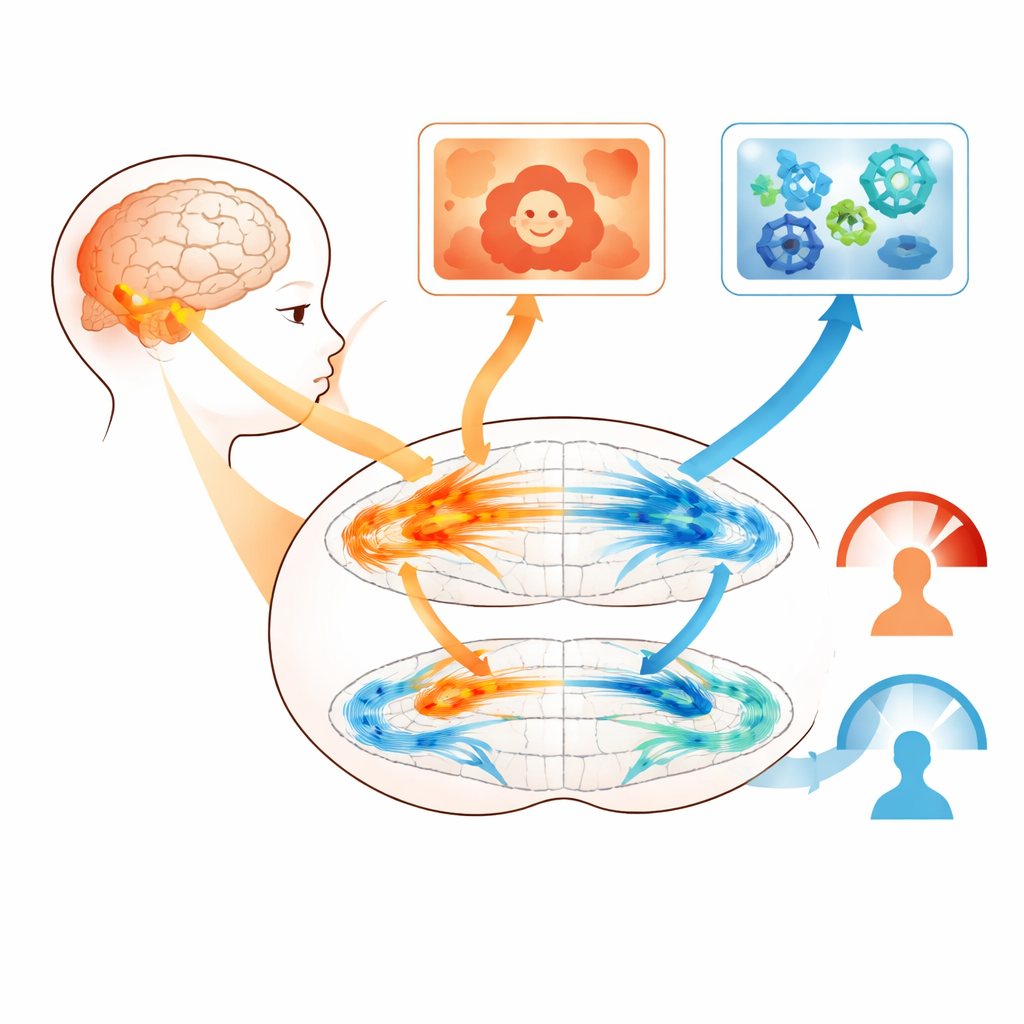
Two visual pathways, two kinds of clues
By combining the new connectivity results with their earlier global motion work in mostly the same infants, the authors identified two apparently separate but autism‑related processes in the visual system. One involves theta‑band connectivity during non‑social viewing, which predicted autistic symptom levels but did not relate to global motion processing. The other involves gamma‑band connectivity during social viewing, which was linked both to later symptoms and to how the brain handled motion in a previous experiment. Together, a small set of visual connectivity measures explained a sizable portion of the difference in later symptom severity, even though these babies were only five months old when the brain data were collected.
What this could mean for early understanding
For a non‑specialist, the key message is that the way infants’ visual brain regions communicate while they watch everyday scenes may carry early hints about how their social and sensory development will unfold. The study suggests that atypical organization within the visual cortex—both in how it responds to complex motion and in how it links social and non‑social information—could be part of the early pathway toward autistic traits. Although this research is not a diagnostic test, and larger, more diverse samples are needed, it points to the visual system as a promising place to look for early brain‑based markers that might eventually support earlier, more tailored support for children on the autism spectrum.
Citation: Hardiansyah, I., Bussu, G., Bölte, S. et al. Functional connectivity in infants’ visual cortex and its links to motion processing and autism. Sci Rep 16, 7826 (2026). https://doi.org/10.1038/s41598-026-42048-3
Keywords: infant brain, visual cortex, autism, functional connectivity, motion perception