Clear Sky Science · en
Undamped climate change poses the need for substantial shifts in cultivated crop types in Germany
Why future German harvests matter to everyone
What grows on German fields today helps feed much of Europe, but the climate that supports these crops is changing fast. This study looks at Franconia, a major farming region in southern Germany, to ask a simple but urgent question: if global warming continues unchecked, what kinds of crops will this landscape be able to grow by the end of this century? The answer points toward a dramatic shift from classic Central European crops to plants that today are more at home along the Mediterranean coast.
A region that mirrors much of Central Europe
Franconia sits in northern Bavaria and includes river valleys, rolling hills and low mountain ranges. Almost half of its land is used for agriculture, from grains to vineyards and orchards. Because the region spans cool uplands and warm lowlands, it captures a wide range of Central European weather in a relatively small area. That makes it a natural laboratory for exploring how climate change could reshape farming well beyond Germany’s borders.
Using today’s climates to imagine tomorrow’s fields
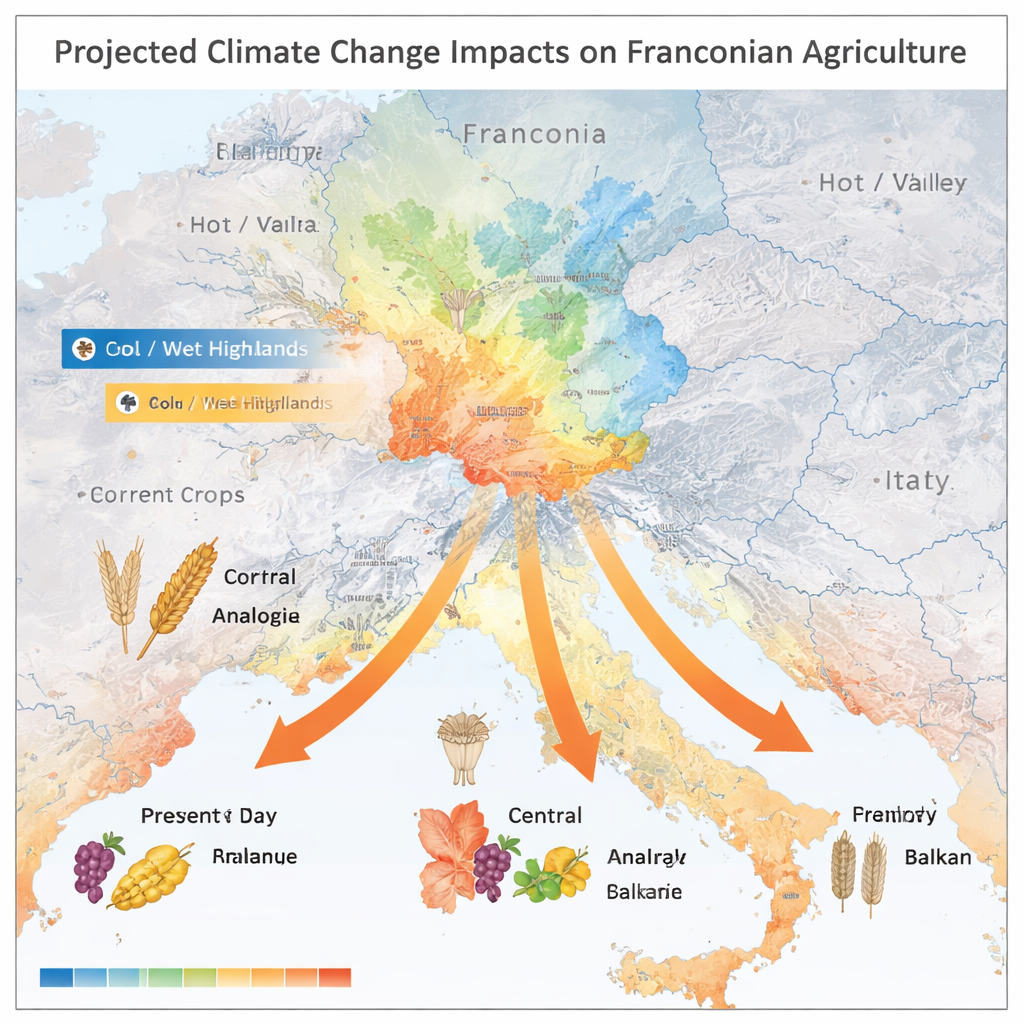
Instead of looking only at temperature and rainfall averages, the researchers built a detailed climate “fingerprint” that truly matters to crops. They combined 28 different indicators, including heat waves, cold spells, drought periods, flood-prone days and the length of the growing season. With high-resolution regional climate models, they projected how these features would look in Franconia between 2070 and 2099 if greenhouse gas emissions follow a high path. Statistical tools then grouped the region into nine climate zones, from cool, moist mountain ridges to hot, dry valleys, and traced how much warmer, longer and more extreme the growing season would become.
Finding Europe’s twin climates
To turn these projections into something farmers can picture, the team searched across Europe for places that already have the kind of climate Franconia is expected to experience. Using the same set of climate indicators and adding basic soil properties such as texture and acidity, they identified “analogue regions” whose current climate falls within the future Franconian range. Today, Franconia’s mix of cool and mild conditions resembles areas from southern Sweden down to parts of the Balkans. Under late-century warming, however, most of its subregions match today’s climates around the northern Mediterranean: northern Spain and France, northern Italy’s Po Valley, coastal and lowland zones in the Balkans and Greece. Only the highest parts of Franconia would retain a climate similar to any place in Germany.
From barley and beets to grapes, rice and olives
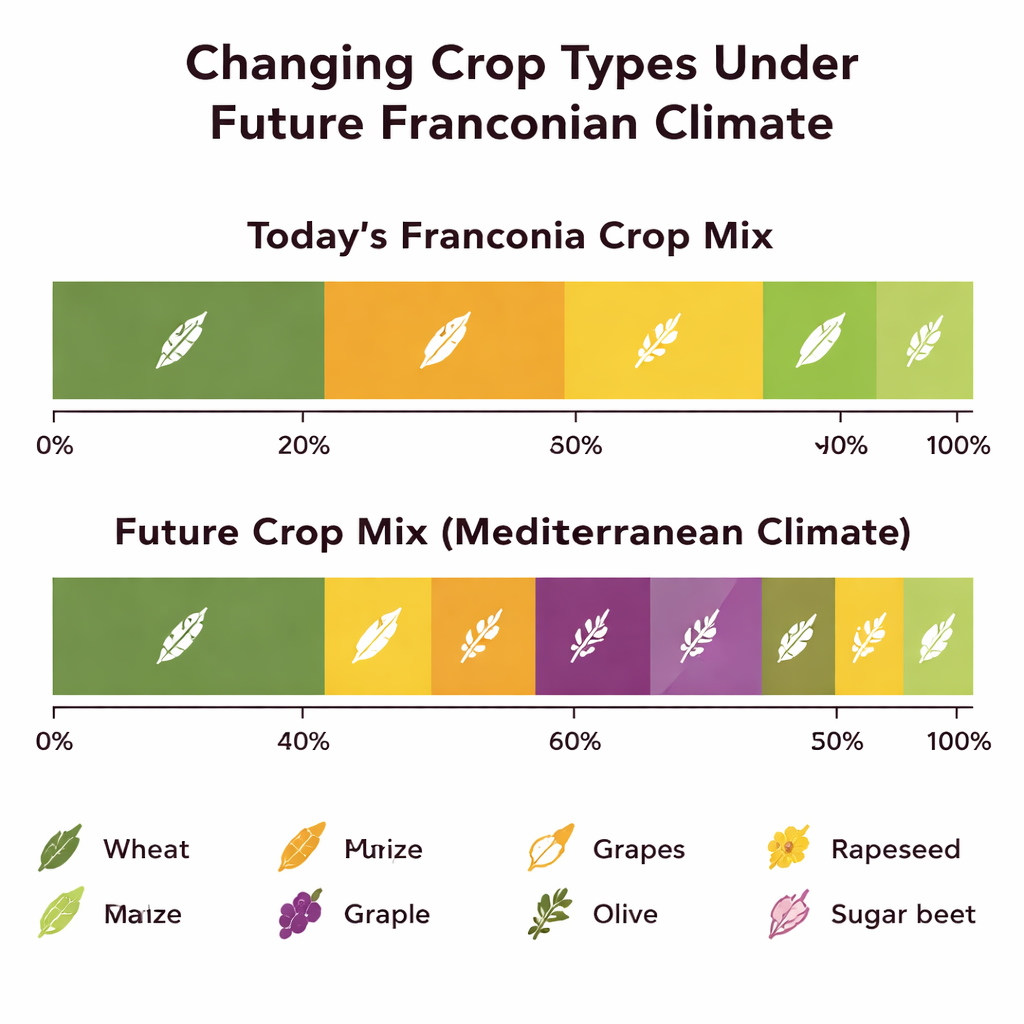
Once these European twin regions were identified, the researchers used a detailed land-use dataset to see which crops actually grow there now. This allowed them to infer what might realistically be grown in each future Franconian subregion. Today, Franconia is dominated by wheat and barley, with rapeseed, sugar beet and fodder crops filling much of the remaining land. In the analogue regions that mirror future Franconian climates, barley and sugar beet shrink, while maize and wheat remain important and rapeseed holds its ground. Mediterranean staples such as grapevines gain a strong foothold, and entirely new crops appear on the scene: rice and olives reach notable shares of the planted area, alongside smaller amounts of almonds, citrus fruits, hazelnuts, peaches, chestnuts, pumpkins and sorghum.
Limits, hurdles and real-world decisions
The study stresses that climate suitability alone does not guarantee that German farmers will immediately plant rice paddies and olive groves. Rice, for example, demands far more water than Franconia’s rivers and reservoirs can likely provide, even if the air becomes warm enough. Olives can cope with dry summers but still need a minimum level of rainfall, and their sensitivity to winter cold must be considered. On top of these biological limits come practical barriers: laws and subsidies, availability of seeds and equipment, storage and processing facilities, markets and consumer demand, and the willingness of farmers to take financial and social risks when changing long-established practices.
What this means for our food future
In everyday terms, the research shows that if climate change continues without strong mitigation, large parts of Germany will no longer be well-suited to the classic Central European mix of barley, sugar beet and fodder crops. Instead, many areas will be better matched to the crops of present-day northern Spain, southern France or northern Italy, including grapes, olives and possibly even some rice and citrus. This does not mean that such a transformation is simple or guaranteed, but it does mean that farmers, policymakers and the food industry need to prepare for a radical reshaping of what German fields can reliably produce by the end of the century.
Citation: Keupp, L., Hotho, A., Dech, S. et al. Undamped climate change poses the need for substantial shifts in cultivated crop types in Germany. Sci Rep 16, 7945 (2026). https://doi.org/10.1038/s41598-026-42040-x
Keywords: climate change and agriculture, future crops in Germany, Mediterranean crops, climate analogue regions, Franconia farming