Clear Sky Science · en
Enhanced optical and electrical properties of polyvinyl alcohol polyethylene oxide nanocomposite films incorporating hybrid carbon nanofillers
Making Everyday Plastics Work Harder
From smartphone touchscreens to solar panels and flexible medical sensors, modern devices rely on thin plastic films that can handle both light and electricity. This study explores how to turn two common, safe polymers—materials already used in packaging and biomedical products—into smart films that move charges more easily and interact more strongly with light. By sprinkling in tiny carbon structures only billionths of a meter in size, the researchers aim to create inexpensive, bendable layers for future energy storage and optoelectronic gadgets.
Blending Familiar Polymers with Tiny Carbon Add‑Ons
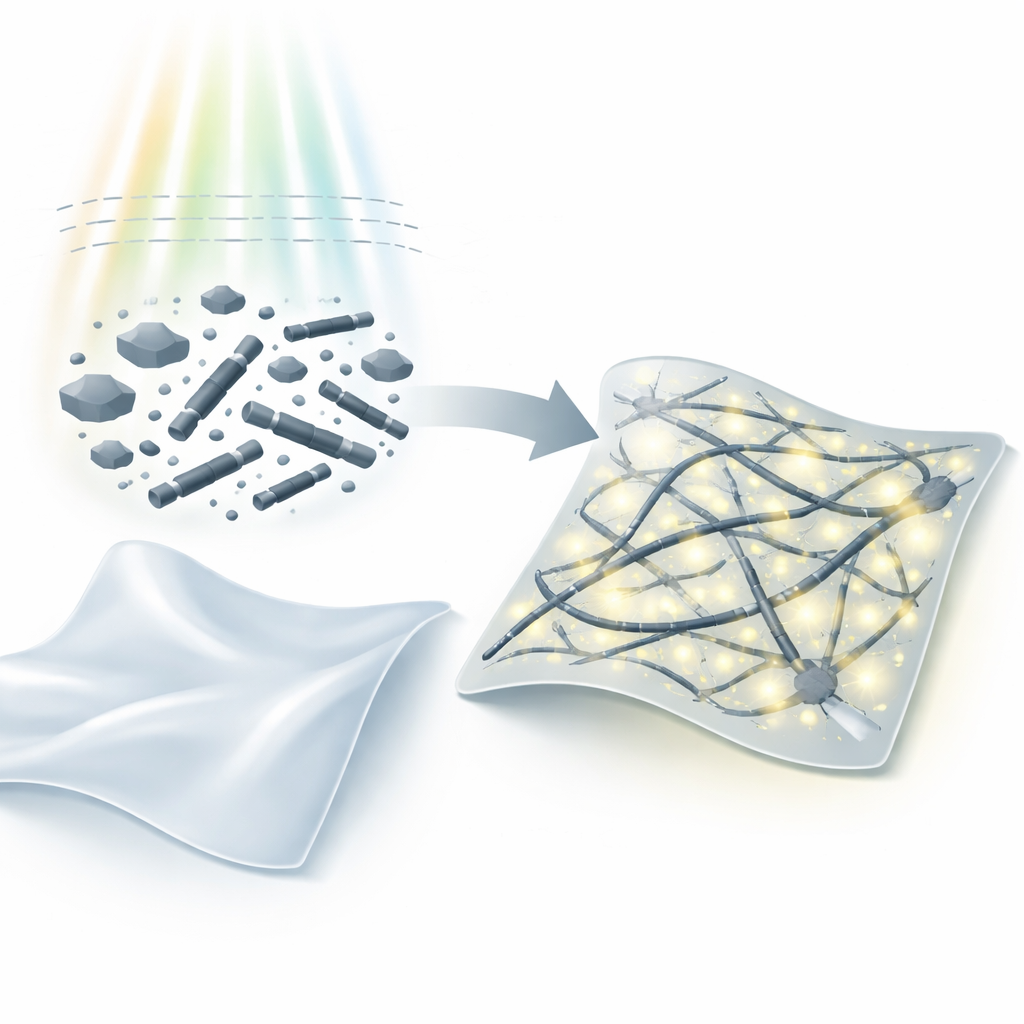
The team started with a blend of two well-known polymers: polyvinyl alcohol (PVA), valued for being non-toxic and stable, and polyethylene oxide (PEO), known for helping ions move through it. Alone, these materials are mostly electrical insulators and let visible light pass through with little interaction, which limits their usefulness in electronic and optical devices. To upgrade them, the researchers added a carefully balanced mix of two carbon nanomaterials—flat graphene plates and hollow multi-walled carbon nanotubes. These fillers were dispersed in water, mixed into the polymer solution, and then cast into thin, flexible films using a controlled drying process.
From Ordered Plastic to a Looser, Charge-Friendly Structure
Using X-ray diffraction and infrared spectroscopy, the researchers examined how the carbon additives changed the internal structure of the films. They found that as more graphene and nanotubes were added, the originally semi-ordered polymer blend became more disordered, with its crystallinity dropping to less than half of its initial value at the highest loading. This “loosening up” of the structure creates more amorphous regions—less rigid zones where polymer chains can move more freely and charges can hop from place to place. Infrared measurements also showed clear signs that the filler surfaces were interacting strongly with chemical groups on the polymer chains, confirming that the nanofillers were not just sitting inside the plastic but were actively reshaping its internal landscape.
Tuning How the Films Talk to Light
The optical measurements revealed that the modified films respond much more strongly to light than the original plastic blend. As the amount of carbon nanofiller increased, the films absorbed more light in the ultraviolet and near-visible range, and the energy needed to excite electrons across the material’s internal energy gap steadily decreased. In simple terms, the films became less like a pure insulator and more like a controllable semiconductor. At the same time, their refractive index—a measure of how strongly they bend light—rose sharply. The growth of subtle internal disorder, captured by a quantity called the Urbach energy, indicated that new electronic states were forming inside the material, making it easier for light to kick charges into motion. Together, these effects point to films that could be tailored for guiding, storing, or filtering light in compact devices.
Building Hidden Highways for Electric Charges
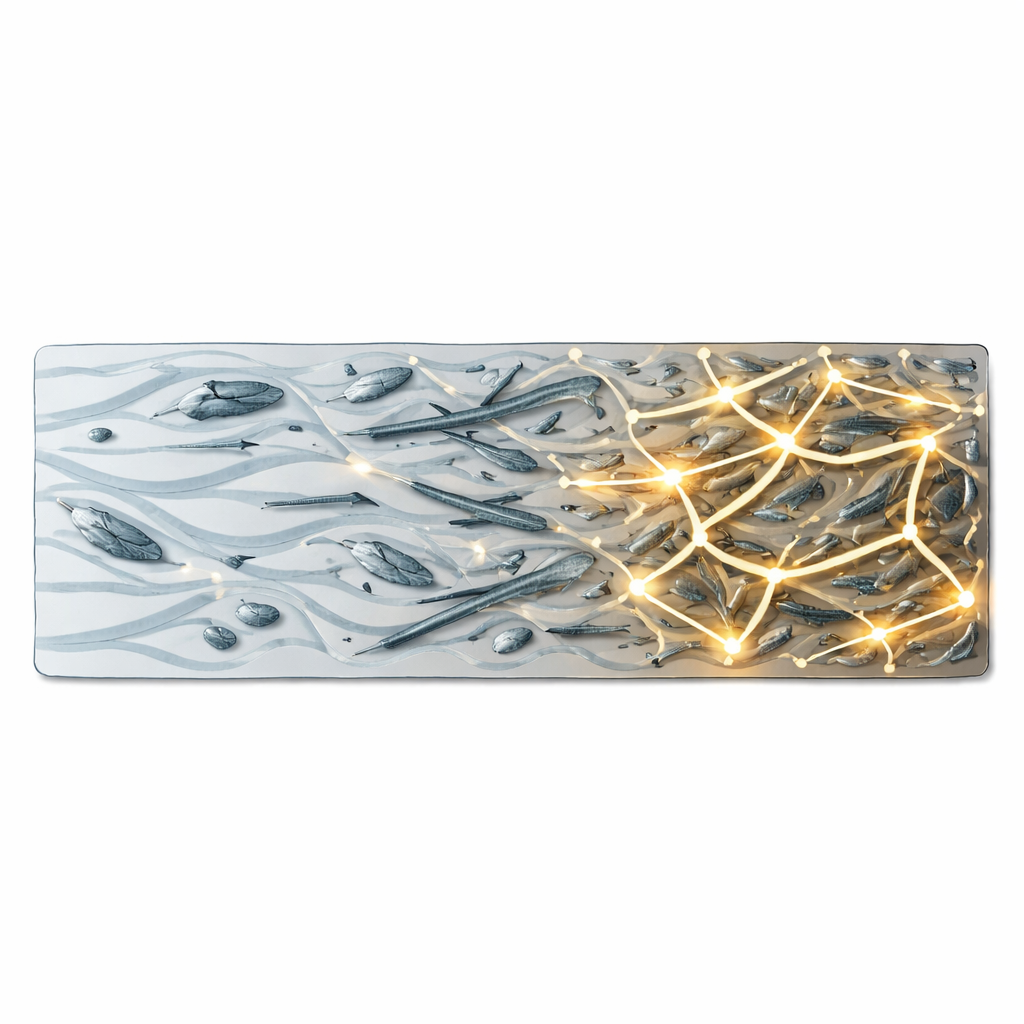
The most striking changes appeared in the electrical and dielectric behavior. Measurements over a huge range of frequencies showed that adding graphene and nanotubes built up continuous conductive pathways inside the plastic. At low filler levels, the conductivity only crept up, but at higher loadings the films developed a connected network of carbon structures that allowed charges to move far more easily. Their ability to store electrical energy, expressed as the dielectric constant, climbed dramatically as well, especially at the highest nanofiller content. This combination of improved conductivity and strong charge storage is exactly what is sought in solid polymer electrolytes and flexible energy-storage layers, where the material must both hold and rapidly move charges under an applied field.
Flexible Films for Future Devices
Overall, the study shows that mixing a modest amount of hybrid carbon nanofillers into a simple PVA/PEO plastic blend can simultaneously enhance how the film interacts with light and how it conducts and stores electricity. By carefully choosing the fraction of graphene plates and carbon nanotubes, the researchers can tune the film’s internal structure, shrink its optical energy gap, raise its refractive index, and create hidden networks that carry charge. For a general reader, the takeaway is that ordinary-looking plastic sheets can be engineered from the inside out to act as active components in flexible batteries, sensors, and light-based electronics—potentially enabling cheaper, lighter, and more adaptable technologies.
Citation: Ragab, H.M., Diab, N.S., Ab Aziz, R. et al. Enhanced optical and electrical properties of polyvinyl alcohol polyethylene oxide nanocomposite films incorporating hybrid carbon nanofillers. Sci Rep 16, 8918 (2026). https://doi.org/10.1038/s41598-026-42009-w
Keywords: polymer nanocomposite films, carbon nanotube graphene fillers, flexible optoelectronics, solid polymer electrolytes, dielectric energy storage