Clear Sky Science · en
Engineering properties and microscopic mechanism of phosphogypsum-rubber composite cemented soil
Turning Waste into Stronger Ground
Modern cities depend on stable ground for roads, railways, and foundations, but the soils we build on are often weak and easily damaged by water. At the same time, industry produces mountains of waste, from used car tires to phosphogypsum, a by-product of making fertilizer. This study explores a way to tackle both problems at once: blending waste tire rubber and phosphogypsum into cement-stabilized soil to create a tougher, less brittle, and more water-resistant material for construction. 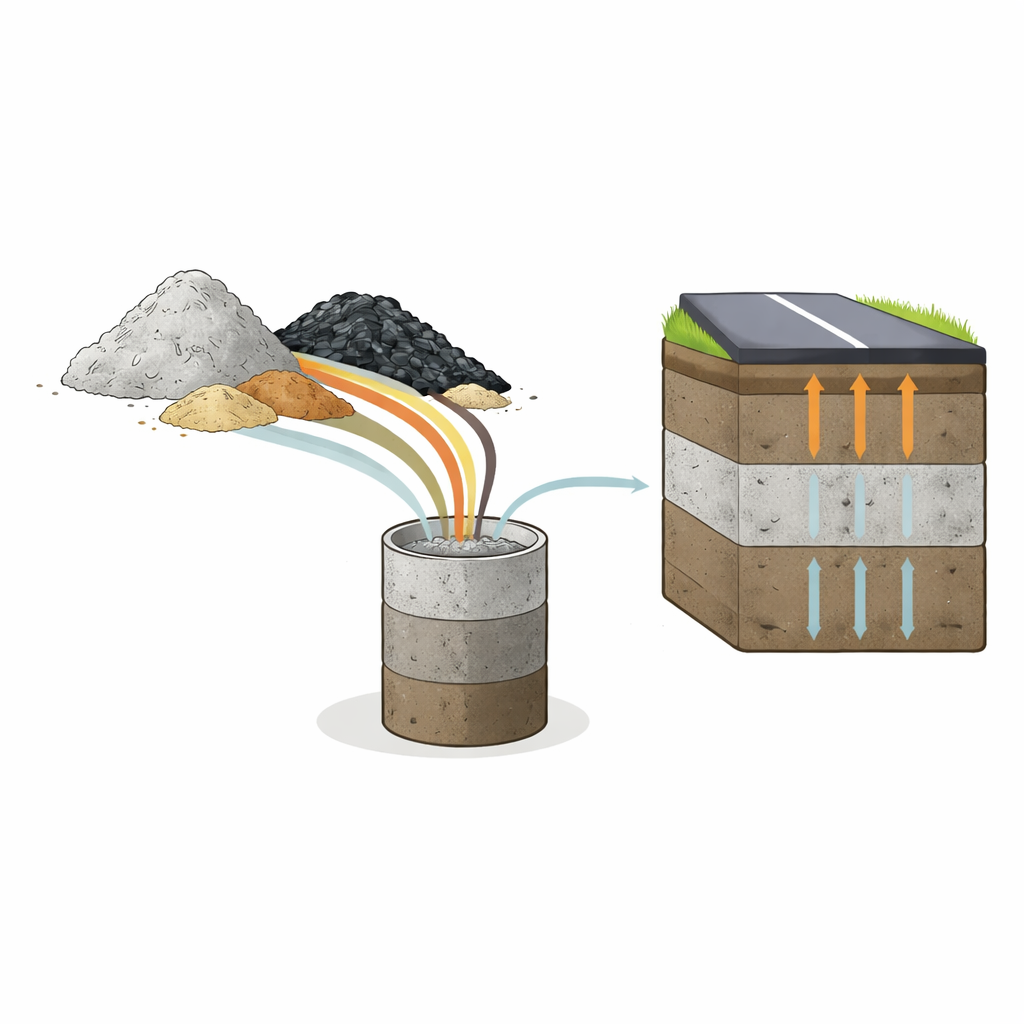
Why Ordinary Cemented Soil Falls Short
Engineers commonly mix cement into soft or clay-rich soils to make them strong enough for roadbeds and foundations. While this method works, the resulting material can be brittle, crack easily, and lose strength when soaked. It also relies heavily on cement, whose manufacture is energy-intensive and emits large amounts of carbon dioxide. Meanwhile, discarded tires and phosphogypsum stacks occupy valuable land and can damage the environment. Using these wastes to upgrade cemented soil promises both better performance and a smaller environmental footprint.
Blending Soil, Phosphogypsum, and Rubber
The researchers collected clayey soil from a metro construction site, phosphogypsum from a fertilizer plant, and ground rubber from waste tires. They mixed these with a modest amount of ordinary cement and carefully varied the proportions of phosphogypsum and rubber. Standard laboratory tests then measured how tightly the mixtures could be compacted, how much weight they could carry before failing, and how easily water could pass through them. To see what was happening inside, the team also used X-ray diffraction to detect new minerals and electron microscopes to visualize the tiny structures formed as the material hardened.
Finding the Sweet Spot for Strength and Toughness
The experiments showed that phosphogypsum and rubber play complementary roles. Phosphogypsum, when added in the right amount, made the soil-cement mixture significantly stronger and denser. An addition of about one quarter phosphogypsum (by weight of the soil–phosphogypsum blend) gave the best results, boosting compressive strength several times over untreated soil and improving early-age strength, which matters during construction. Too much phosphogypsum, however, left unreacted particles that weakened the structure and made it more porous. Rubber particles behaved differently: small amounts, around 1–1.5%, slightly increased strength and stiffness, but larger amounts gradually reduced peak strength. At the same time, more rubber made the material less brittle, allowing it to deform more before breaking and to retain more strength after cracking—an important feature for resisting impacts and repeated loading.
Keeping Water at Bay
Water movement through the soil is critical for long-term stability, especially under roads. The study found that stabilizing the clay with cement, phosphogypsum, and a small amount of rubber dramatically reduced how easily water could seep through. With about 25% phosphogypsum and around 2% rubber, the material’s permeability dropped to extremely low levels, far better than typical requirements for highway subgrade materials. Phosphogypsum-based reaction products filled pores and tightened the network of particles, while compressible rubber fragments helped block and reroute water paths. Over time, as curing continued, the internal structure became even denser and water flow decreased further. 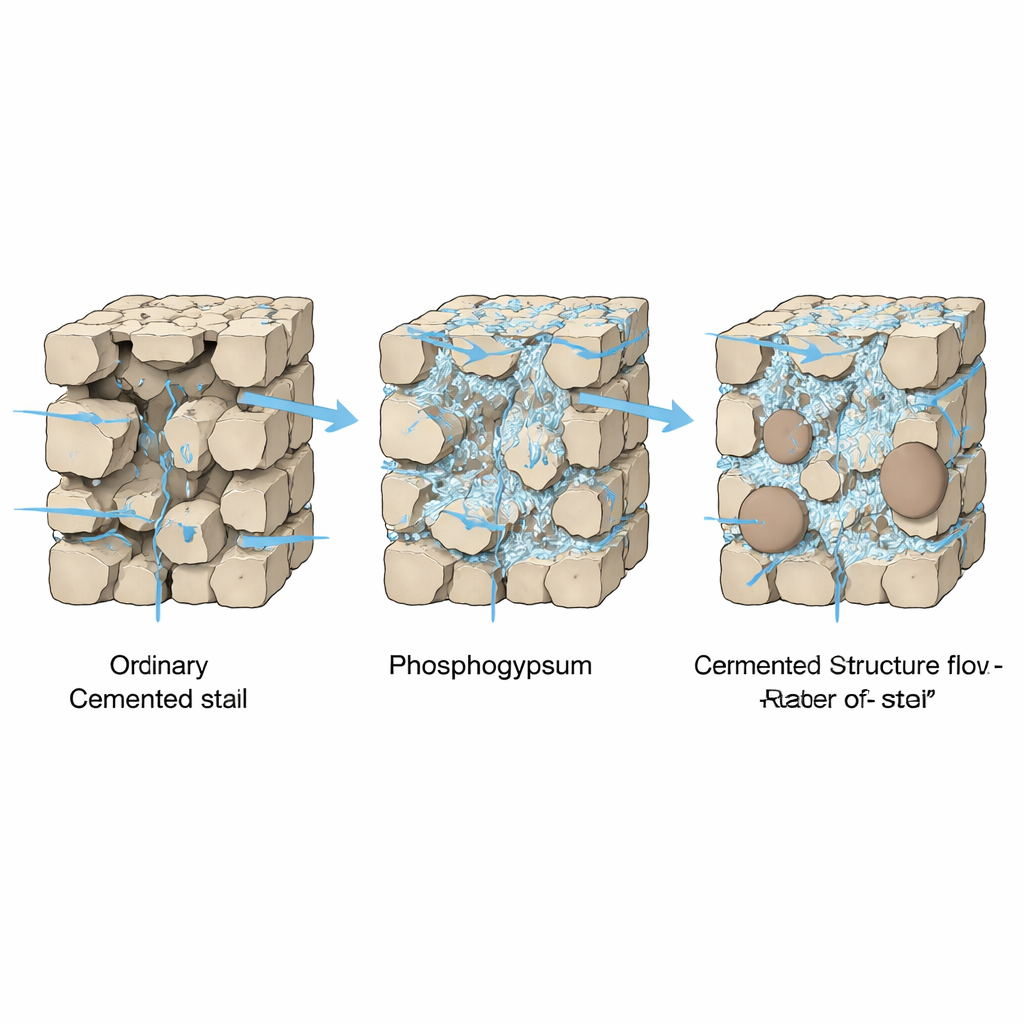
What Happens at the Microscopic Level
Microscope images revealed why the performance changed so much. In mixtures without phosphogypsum, tiny gel-like phases formed between soil grains, but many large voids remained. Adding phosphogypsum led to abundant needle-shaped crystals and additional gel that wove through the soil, binding grains together and filling gaps. This created a compact, interlocked skeleton that could carry higher loads and left fewer channels for water. At very high phosphogypsum contents, excess fine particles and local acidity began to break down some of these needles, explaining the drop in strength. Rubber particles did not chemically react but acted as soft inclusions: when few in number, they fit into gaps and added friction; when abundant, they created weak spots and small cavities along their boundaries, reducing overall strength but increasing the ability to stretch and absorb energy.
A Balanced and More Sustainable Building Ground
Overall, the study shows that a carefully balanced mix of phosphogypsum and waste tire rubber can transform weak clay into a strong, tough, and highly water-resistant construction material. An optimal recipe—roughly 8% cement, 25% phosphogypsum, and about 1–2% rubber—strikes a useful balance between stiffness and flexibility while sharply limiting water flow. For a non-specialist, the message is straightforward: by smartly combining two troublesome industrial wastes with small amounts of cement, engineers can build safer roads and foundations while cutting down on pollution and landfill burdens.
Citation: Ma, Q., Li, Y., Shu, H. et al. Engineering properties and microscopic mechanism of phosphogypsum-rubber composite cemented soil. Sci Rep 16, 8853 (2026). https://doi.org/10.1038/s41598-026-42001-4
Keywords: phosphogypsum, waste tire rubber, cement-stabilized soil, roadbed materials, soil improvement