Clear Sky Science · en
Behavioral differences in cooperation between patients with schizophrenia and control participants
Why this study matters for everyday social life
Schizophrenia is often described in terms of hallucinations and delusions, but some of its most disabling aspects are quieter: trouble reading other people, predicting how they will act, and adjusting one’s own behavior in social situations. This study uses a simple decision-making game to ask a human question with real-world echoes: when trust and self-interest collide, do people with schizophrenia cooperate differently from others, and what does that reveal about how they understand and adapt to those around them?
A simple game of trust and self-interest
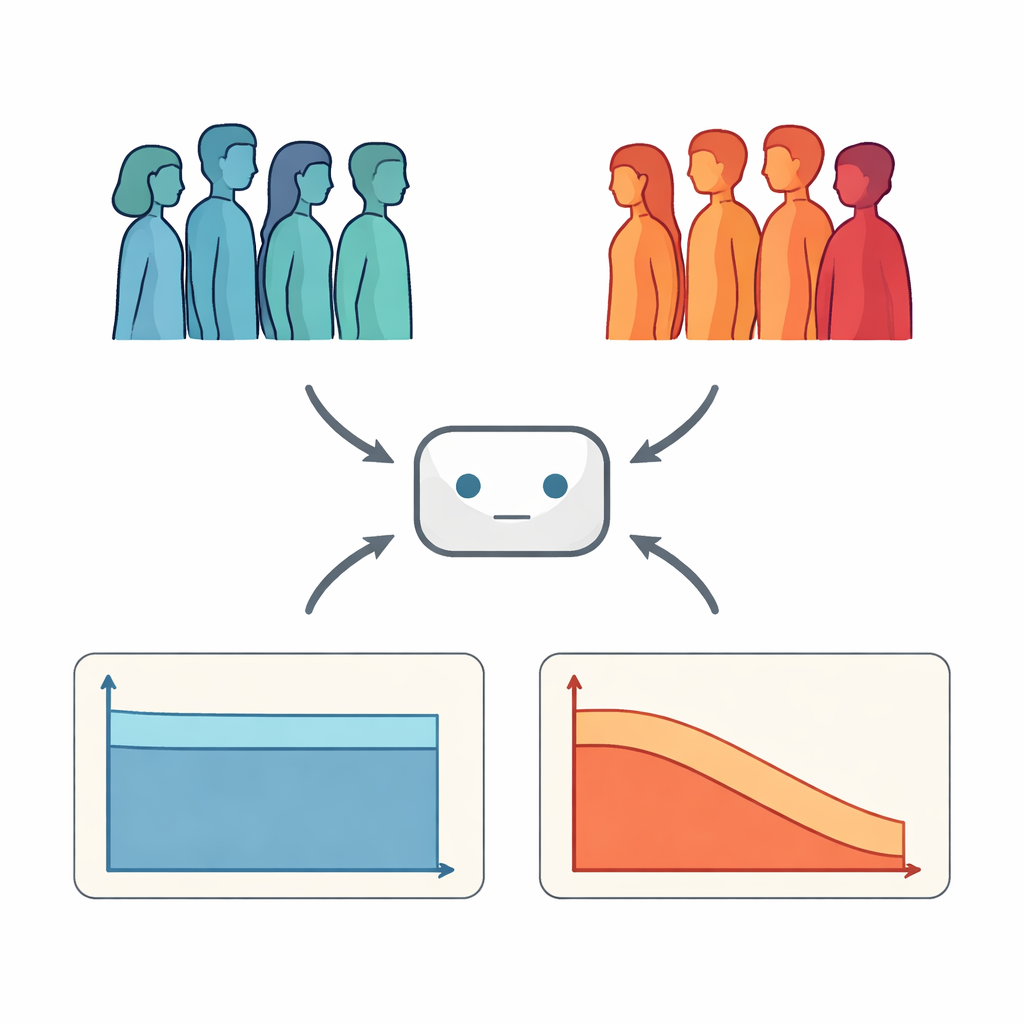
The researchers compared two groups: 44 hospitalized adults with clinically stable schizophrenia and 59 university students without psychiatric diagnoses. Everyone played versions of the classic Prisoner’s Dilemma, a two-person game in which each player chooses whether to cooperate or to act selfishly. Mutual cooperation helps both, but each player can gain more in the short run by breaking cooperation if the other stays loyal. Instead of facing real partners, all participants interacted with an artificial agent trained on data from earlier experiments to behave like a typical human player. This allowed the team to run the same controlled interactions in a hospital and a university lab, and to focus on how people responded to the structure of the game rather than to quirks of a particular partner.
One-off encounters versus ongoing relationships
The experiment mixed ten “one-shot” games—fresh starts with no future consequences—with three repeated games, each lasting ten rounds with the same artificial partner. In everyday terms, this is like comparing a single, anonymous exchange with a stranger to an ongoing relationship where today’s generosity can shape tomorrow’s response. Among the student controls, cooperation in one-shot games started low and quickly dropped to near zero: most quickly decided that playing it safe for themselves made more sense when there was no tomorrow. In contrast, patients with schizophrenia cooperated far more often in these one-off encounters and kept doing so across rounds. When the game became repeated, students noticeably adjusted: their initial cooperation jumped and stayed high for a while before falling near the end, as if recognizing that future payoffs were about to run out. Patients, however, showed nearly the same moderate cooperation level no matter whether the interaction was one-off or repeated, and they continued to cooperate even in the final rounds.
What people expect and how well they predict others
To peek inside the decision process, the team repeatedly asked participants what they believed their partner would do and whether their own choice was guided more by cool reasoning or by emotion. Students’ expectations of partner cooperation rose across the repeated games, and they became increasingly accurate at predicting the artificial agent’s behavior as the game went on. Patients with schizophrenia, by contrast, held fairly stable expectations throughout and improved more slowly at guessing what the partner would do. Statistical analyses showed that for students, cooperation was shaped by a mix of expecting cooperation, feeling positive emotions such as empathy, and recognizing whether the interaction was one-off or repeated. For patients, only their belief about the partner’s next move clearly influenced whether they cooperated; their decisions did not track the type of game or the passage of rounds in the same flexible way.

Different styles of strategy and adaptation
Looking at whole patterns of play, the researchers tried to classify people’s behavior into familiar strategy types, such as “always cooperate,” “always defect,” or “tit-for-tat” (mirroring the partner’s previous move). Students often used clear, recognizable strategies in the repeated games, including always cooperating for stretches or closely matching the agent’s last action—tactics that make sense if one is tracking and exploiting patterns over time. Patients with schizophrenia, however, much more often followed idiosyncratic, hard-to-classify patterns, and overall they showed less of the typical “end-of-the-game” drop in cooperation that arises when people anticipate that a relationship is about to end. This combination—high cooperation, weaker adaptation to context, and less identifiable strategy use—painted a consistent picture of difficulty adjusting behavior to changing social environments.
What the findings mean for understanding schizophrenia
To a layperson, the key message is that people with schizophrenia in this study were not less willing to cooperate; in fact, they often cooperated more than others, especially when there was no chance of future interaction. The difference lay in flexibility. While control participants tuned their trust and self-protection to whether they were in a one-off or ongoing relationship and learned quickly from experience, patients tended to respond in a more fixed way, with slower updating of what they expected from others and less use of clear-cut strategies. By turning social interaction into a structured game, this work shows how subtle patterns in everyday choices—when to trust, when to hold back, and how quickly we learn from others’ behavior—can serve as behavioral markers of schizophrenia. Such game-based approaches could eventually complement traditional interviews and questionnaires, helping clinicians capture real-life social difficulties in a precise, observable way.
Citation: Sabater-Grande, G., Barreda-Tarrazona, I., Fuertes-Saiz, A. et al. Behavioral differences in cooperation between patients with schizophrenia and control participants. Sci Rep 16, 8907 (2026). https://doi.org/10.1038/s41598-026-41966-6
Keywords: schizophrenia, cooperation, Prisoner’s dilemma, social decision-making, artificial agents