Clear Sky Science · en
Deep recurrent neural networks for water hammer transient prediction and dynamic protection optimization in long distance pipelines
Why sudden pipe shocks matter
When you turn off a tap at home, the small thud you sometimes hear is a hint of a much bigger problem called water hammer. In huge pipelines that move drinking water across tens or hundreds of kilometers, these pressure shocks can be violent enough to crack pipes, damage pumps, and cut off water to entire cities. This paper explores how advanced artificial intelligence can learn the behavior of these dangerous surges in real time and automatically choose the best way to protect the pipelines before serious damage occurs.
The hidden shockwaves inside big pipes
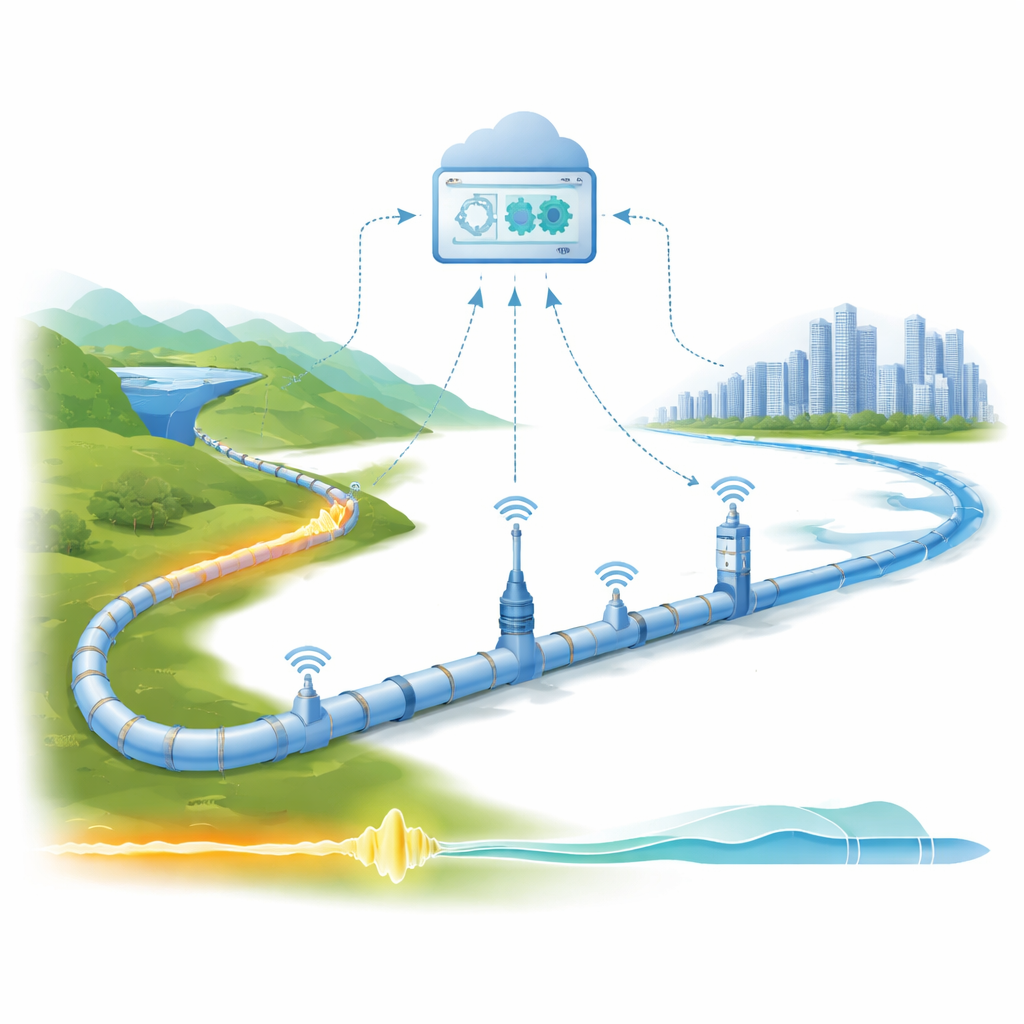
Water hammer happens when flowing water is forced to slow down or stop suddenly, for example when a pump trips or a large valve snaps shut. The moving water has momentum, and when that motion is interrupted, a pressure wave races back and forth along the pipe, reflecting at bends, junctions, and reservoirs. In modern long-distance water systems, these waves travel through pipes laid over hills and valleys, past many pumps and valves. The result is a complex pattern of rising and falling pressures that is difficult to predict accurately with traditional engineering formulas alone. Yet knowing how high those pressures will rise, and how long the surges will last, is critical for avoiding ruptures and costly failures.
Teaching machines to read the pulse of a pipeline
The authors propose an intelligent prediction system built around a form of deep learning designed for time series, a bidirectional Long Short-Term Memory (LSTM) network. Instead of watching just one gauge, the system listens to a whole network of pressure sensors spaced along the pipeline. It learns typical surge patterns by analyzing thousands of simulated and real events, including pump shutdowns, rapid valve movements, and emergency stops. An attention mechanism allows the model to “focus” more on the sensors that matter most for each situation and to downplay faulty or noisy readings. Tests show that this approach predicts future pressures more accurately than classic hydraulic simulations and earlier machine-learning methods, while running fast enough for real-time use.
Letting the system decide how to protect itself
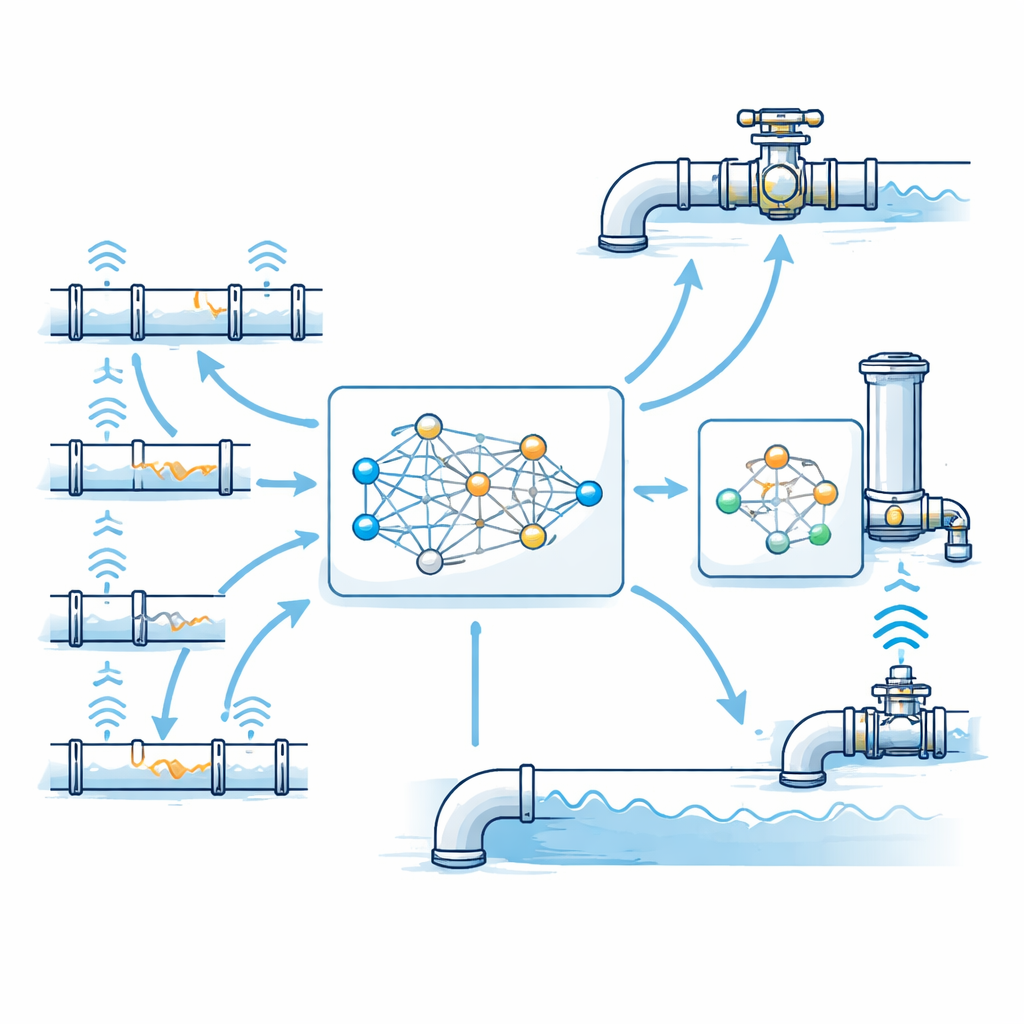
Prediction alone is not enough; operators also need to know how to act. To tackle this, the authors pair the prediction model with a decision-making module based on deep reinforcement learning, specifically a Deep Q-Network. This virtual agent learns by trial and error in a simulated pipeline: it tries different combinations of actions such as adjusting valve closing speeds, activating surge tanks, opening relief valves, and changing pump speeds. After each trial, it is rewarded for keeping peak pressures low, responding quickly, and avoiding unnecessary water loss or energy use. Over thousands of episodes, it discovers protection strategies that juggle safety, speed, and cost better than fixed, one-size-fits-all rules traditionally used in control rooms.
Putting the smart guardian to the test
The combined system is tested on both computer models and real pipeline data. The deep learning predictor consistently tracks measured pressure surges with small errors, even when sensors fail or their signals are noisy. When several sensors go offline, the attention mechanism shifts weight to the remaining healthy ones, so performance degrades gradually instead of collapsing. The reinforcement learning controller then uses these predictions to act just before pressures become dangerous. Compared with conventional protection schemes, the intelligent framework cuts the maximum surge pressures, reduces how violently pressures oscillate, and shortens the time the system needs to settle back to normal. It also trims unnecessary device operations, which reduces wear and operational costs.
What this means for future water security
For non-specialists, the key message is that the authors have built a kind of digital nervous system and reflex for long water pipelines. By continuously sensing, forecasting, and then choosing the best response, their approach helps pipelines ride out sudden shocks more safely and efficiently. Utilities could see fewer bursts and shutdowns, faster recovery from incidents, and better use of costly protection hardware. While the current work focuses on a single long pipeline, the same ideas could eventually extend to full city networks and other critical infrastructure. In short, the study shows how modern AI can turn a traditionally reactive, rule-based discipline into a proactive, adaptive shield for the water systems that cities depend on.
Citation: Dong, R., Du, J. & Liu, C. Deep recurrent neural networks for water hammer transient prediction and dynamic protection optimization in long distance pipelines. Sci Rep 16, 8687 (2026). https://doi.org/10.1038/s41598-026-41915-3
Keywords: water hammer, pipeline safety, deep learning, sensor networks, reinforcement learning