Clear Sky Science · en
Experimental and numerical investigation of single-slope solar still performance enhanced by porous absorbing materials: thermal, economic, and environmental assessments
Turning Sunlight into Drinking Water
For millions of people living in dry, sunny regions, salty or brackish water may be abundant while safe drinking water is scarce. One simple device, the solar still, can turn sunlight into fresh water using only a shallow basin, a transparent cover, and the natural cycle of evaporation and condensation. This study explores how adding everyday porous materials such as a kitchen sponge or volcanic stone can make these low‑tech devices produce more water, at lower cost, while also cutting climate‑warming emissions.
A Simple Box that Mimics the Water Cycle
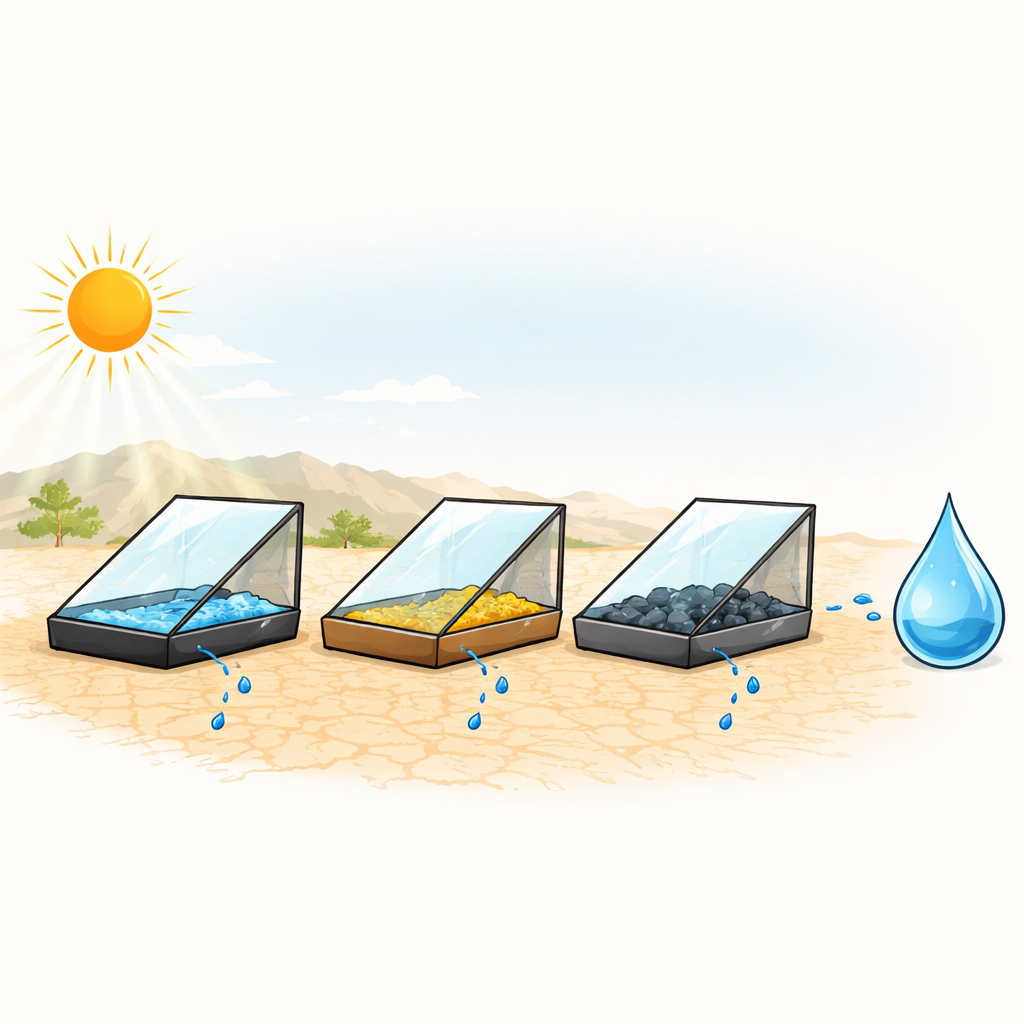
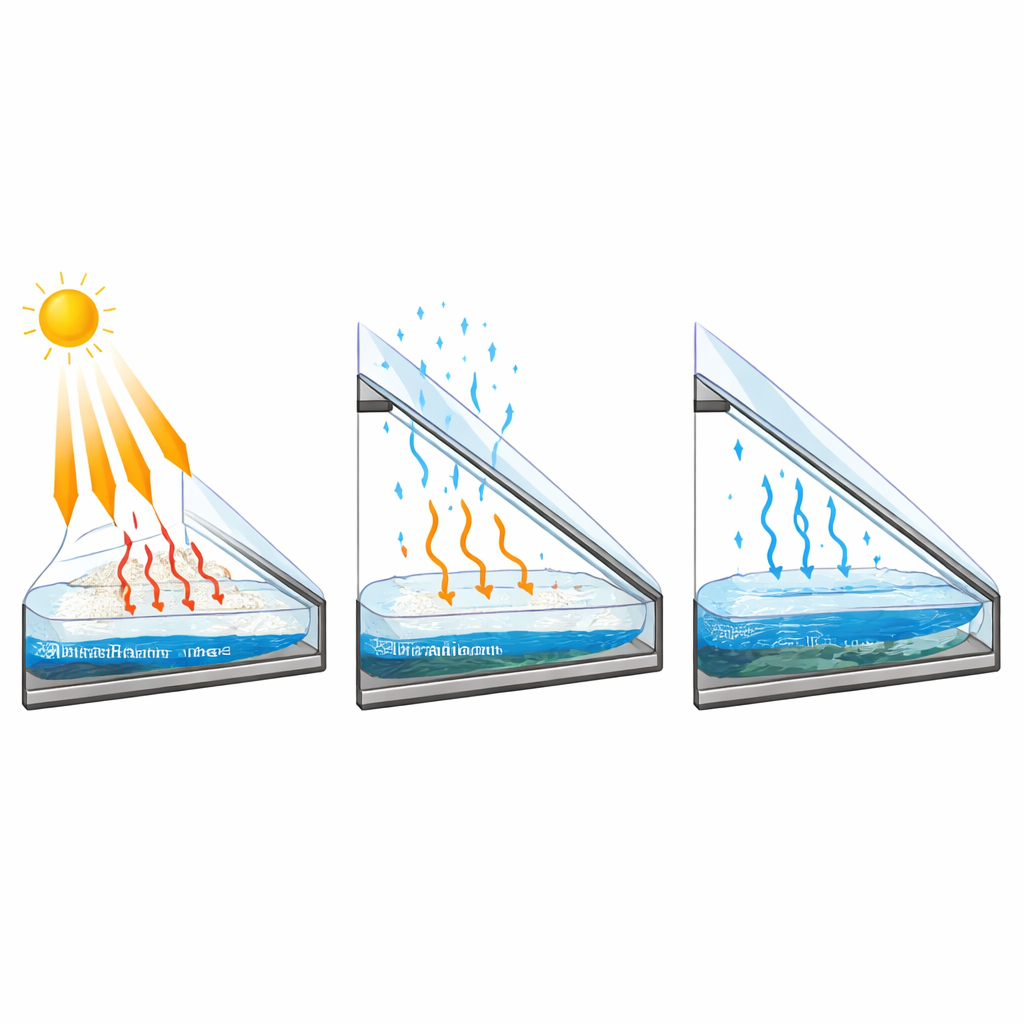
A single‑slope solar still is essentially a small greenhouse laid on its side. Salty water sits in a dark basin under a slanted glass cover. Sunlight passes through the glass, warms the water, and causes it to evaporate. The moist air rises, touches the cooler glass, and forms droplets that run down into a collection channel as distilled, drinkable water. Traditional designs are cheap and robust but suffer from low output: even on a bright day, they typically produce less than a liter per square meter, limiting their usefulness for families or villages that need reliable supplies.
Adding Sponges and Stones to Boost Output
The researchers tested three versions of this basic still in the hot, dry climate of Karbala, Iraq: a traditional unit with a bare basin; a version whose basin was filled with pumice stone, a lightweight porous rock; and another filled with melamine sponge, a very light, highly porous foam often used for cleaning. These materials soak up water and expose it to air through countless tiny pores. That greatly increases the area where evaporation can occur, while also changing how heat is stored and released inside the device.
Real‑World Experiments and Computer Checks
All three stills were run side by side outdoors under natural sunlight, using shallow brackish water similar to what might be found in rural wells. The team carefully measured temperatures of the water, vapor, and glass, as well as the amount of distilled water produced each hour. At the same time, they built a detailed computer model of heat and fluid flow inside the stills using engineering simulation software. The simulated temperatures and outputs matched the experiments closely—within about 2.4 percent—giving confidence that the model captured the key physics and could be used to explore performance in other conditions.
More Water, Less Cost, and Cleaner Air
The porous materials made a clear difference. The melamine sponge still produced about 1.35 liters of fresh water per day—56.9 percent more than the traditional unit—while the pumice stone version raised output by about 22.9 percent. Higher water and vapor temperatures inside the modified stills translated into more evaporation and faster condensation on the glass, and the melamine sponge’s extremely high porosity (more than 99 percent empty space) proved especially effective. Thermal efficiency, a measure of how much incoming sunlight is turned into evaporation, rose from about 31.5 percent in the traditional still to 38.2 percent with pumice and 49.3 percent with sponge.
Looking at Money, Energy, and the Environment
Because these systems are meant for low‑income, off‑grid communities, the team examined not just physics but also economics and environmental impact. Even after accounting for purchase, maintenance, and eventual scrap value, the melamine sponge still delivered the lowest cost of water, about 0.076 US dollars per liter, a 35 percent drop compared with the traditional design. Its financial payback time—how long it takes savings from producing water to cover the initial investment—was about two and a half years, shorter than both the bare still and the pumice‑filled version. From an energy perspective, the stills recovered the energy used to manufacture them in well under a year, although the quality of that energy (its ability to do useful work) remained limited, reflecting a fundamental drawback of low‑temperature heating. Environmentally, replacing electricity‑driven desalination or pumping with these sun‑powered stills could avoid roughly 1.6 metric tons of carbon dioxide emissions per year for each melamine sponge unit.
What This Means for Thirsty, Sunny Regions
In plain terms, packing the basin of a simple solar still with an inexpensive, highly porous sponge turns it into a far more productive, cost‑effective water maker. While the process is still best suited to small‑scale use—households, farms, or remote sites—it offers a promising, low‑maintenance way to turn harsh sunlight and marginal water into a steady trickle of safe drinking water. The study shows that thoughtful use of common materials can nearly halve the cost per liter, speed up payback, and cut climate pollution, making solar stills a more practical tool in the fight against water scarcity.
Citation: Majeed, S.H., Rashid, F.L., Azziz, H.N. et al. Experimental and numerical investigation of single-slope solar still performance enhanced by porous absorbing materials: thermal, economic, and environmental assessments. Sci Rep 16, 8487 (2026). https://doi.org/10.1038/s41598-026-41901-9
Keywords: solar desalination, solar still, porous materials, melamine sponge, off-grid water