Clear Sky Science · en
A sparrow search algorithm-optimized LSTM framework with EMD denoising for rolling element bearing remaining useful life prediction
Why Knowing When Machines Will Fail Matters
From factory lines to wind turbines, many machines rely on spinning metal rings called bearings to keep moving parts running smoothly. When a bearing fails without warning, it can bring an entire production line to a halt, causing costly downtime and even safety risks. This paper presents a new way to forecast how long a bearing has left before it fails, even when its signals are buried in noise. The method blends clever signal cleaning, a brain-inspired prediction network, and a statistical model of risk to give maintenance teams earlier and more reliable warnings.
Hidden Clues in Noisy Vibrations
Bearings quietly age as tiny cracks and surface wear grow over time. Engineers monitor this process using vibration sensors, but in real factories these signals are messy: strong background noise and several overlapping vibration patterns make early damage extremely hard to spot. The authors tackle this by first passing the raw vibration signal through a technique called Empirical Mode Decomposition, which automatically splits the complex motion into a handful of simpler building blocks. They then look at the energy in each of these components and identify the one that best tracks how damage accumulates. This component becomes the core “health indicator” that summarizes the bearing’s condition on a scale from “new” to “near failure.” 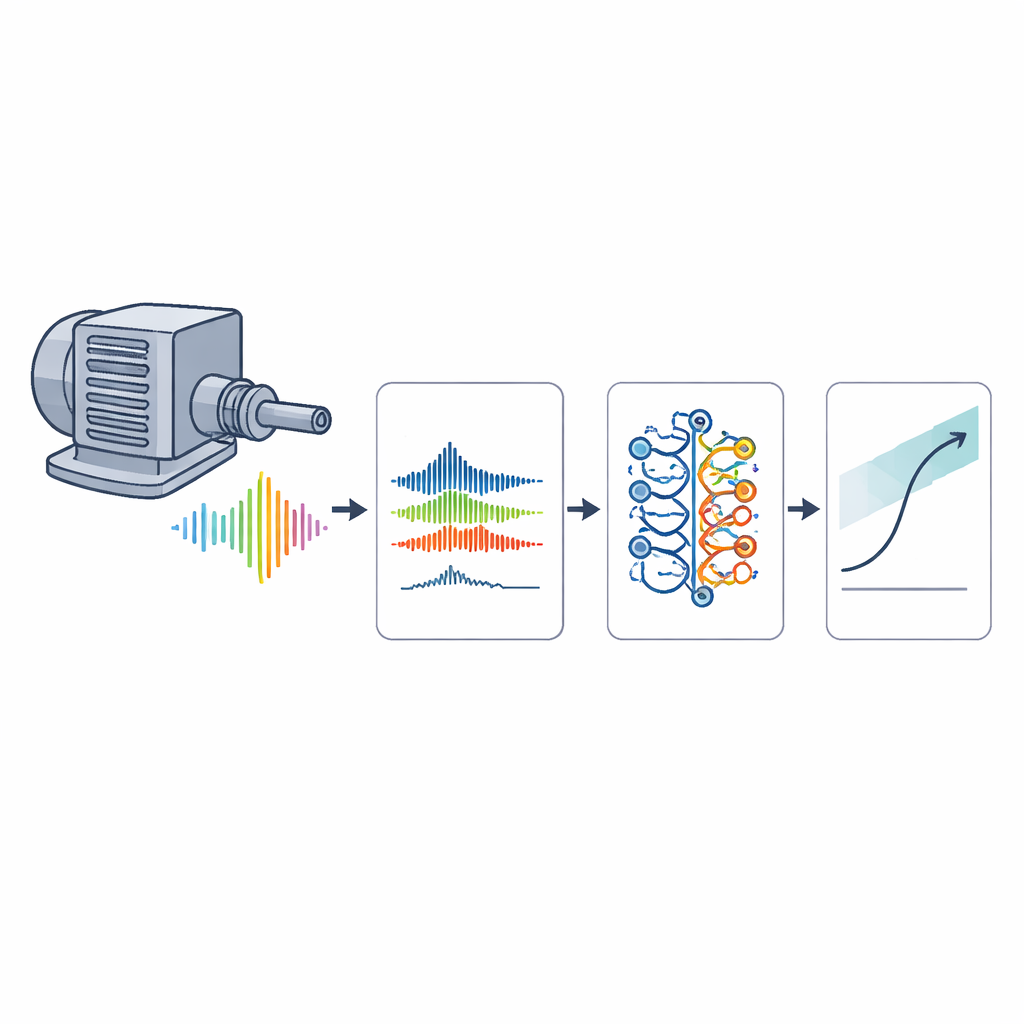
Teaching a Digital Memory to Track Wear
Damage in a bearing does not rise smoothly: it may slow down, speed up, or even appear to “recover” briefly when stresses are relieved or lubrication improves. Capturing such long-term, irregular patterns requires more than traditional trend lines. The study uses a Long Short-Term Memory network—a type of deep-learning model designed to remember important information from far back in a time series. It learns the relationship between the recent history of the health indicator and how much useful life remains. Because the performance of this network strongly depends on settings such as learning rate and the number of internal units, the authors avoid manual trial-and-error and instead let an optimization scheme search for the best configuration automatically.
Letting a Virtual Sparrow Flock Tune the Model
To fine-tune the prediction network, the paper employs the Sparrow Search Algorithm, a nature-inspired method that mimics how flocks of sparrows explore for food while avoiding danger. In this digital version, each “sparrow” represents a candidate set of network settings. Some sparrows act as adventurous scouts, others follow promising leads, and a few remain on the lookout for poor choices that trap the search in bad regions. Through many rounds of this collective search, the flock converges on a near-optimal set of hyperparameters for the memory network. This automated tuning helps the model learn complex degradation patterns more accurately and with fewer wasted training runs than conventional approaches.
From a Single Number to Full Risk Curves
Many prediction tools output just one number for remaining life, giving the illusion of certainty in situations that are inherently uncertain. Here, the authors go further by wrapping the network’s output inside a probabilistic framework. They assume that the health indicator drifts toward a failure threshold with some randomness, similar to a particle wandering under a steady push and random jostling. Under this assumption, the time it takes for the bearing to hit the failure level follows a specific probability law. This allows the method to provide not only an expected remaining life but also a spread around that value, along with survival curves and hazard rates that are directly useful for planning maintenance and managing risk. 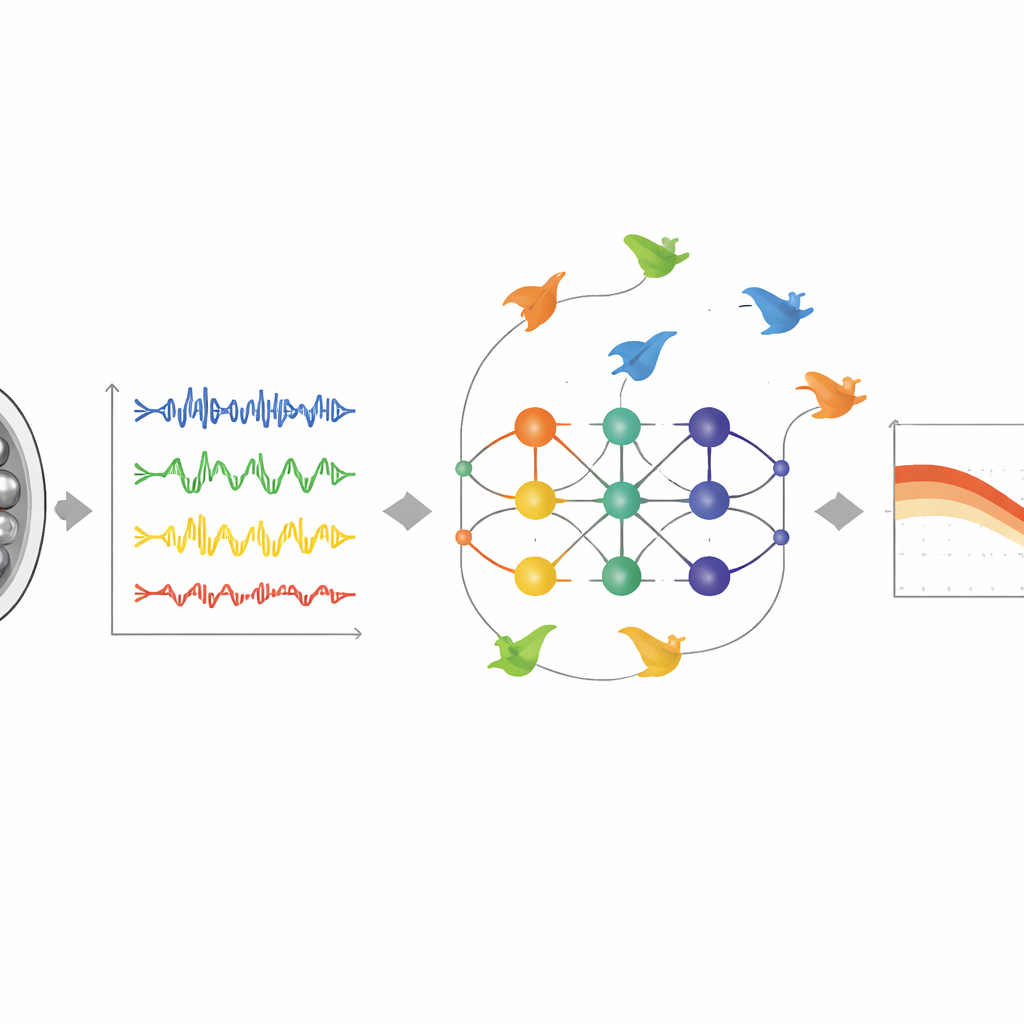
How Well the New Method Performs
The authors test their hybrid framework on a widely used bearing life dataset collected under different speeds and loads. They compare their approach—combining signal decomposition, sparrow-based tuning, and memory networks—against two established alternatives that use genetic algorithms and particle-swarm optimization to tune similar networks. Under carefully matched computational effort, the new method delivers sharper predictions, lower error on unseen data, and narrower spreads in the distribution of errors. It tracks the true degradation trend more faithfully, especially when the bearing enters rapid wear stages, indicating that the combination of better denoising and smarter parameter search pays off.
What This Means for Real-World Machines
In straightforward terms, this work offers a more reliable “health meter” and “crystal ball” for machine bearings. By cleaning the vibration signals, teaching a memory-based model to read them, and placing the results inside a risk-aware statistical shell, the method can tell maintenance crews not only when a bearing is likely to fail but also how confident that estimate is. While the current study is limited to a single dataset and still too heavy for real-time use on small devices, it points the way toward smarter, more dependable predictive maintenance systems that could reduce unplanned shutdowns and extend the life of critical machinery.
Citation: Li, Q., Zhang, B. & Fang, X. A sparrow search algorithm-optimized LSTM framework with EMD denoising for rolling element bearing remaining useful life prediction. Sci Rep 16, 8676 (2026). https://doi.org/10.1038/s41598-026-41852-1
Keywords: predictive maintenance, bearing failure, vibration monitoring, deep learning, remaining useful life