Clear Sky Science · en
Reevaluation of ECGs of a German non coronary sudden cardiac arrest cohort
Why this matters to everyday people
Sudden cardiac arrest is often imagined as something that happens only to very old or very sick people, usually because of clogged heart arteries. But this study from a German hospital shows that sudden collapse from heart rhythm failure can also strike younger adults whose arteries are clean—and that a careful second look at a simple heart test, the electrocardiogram (ECG), can uncover hidden electrical problems that standard checks may miss.
Looking at sudden collapse in younger adults
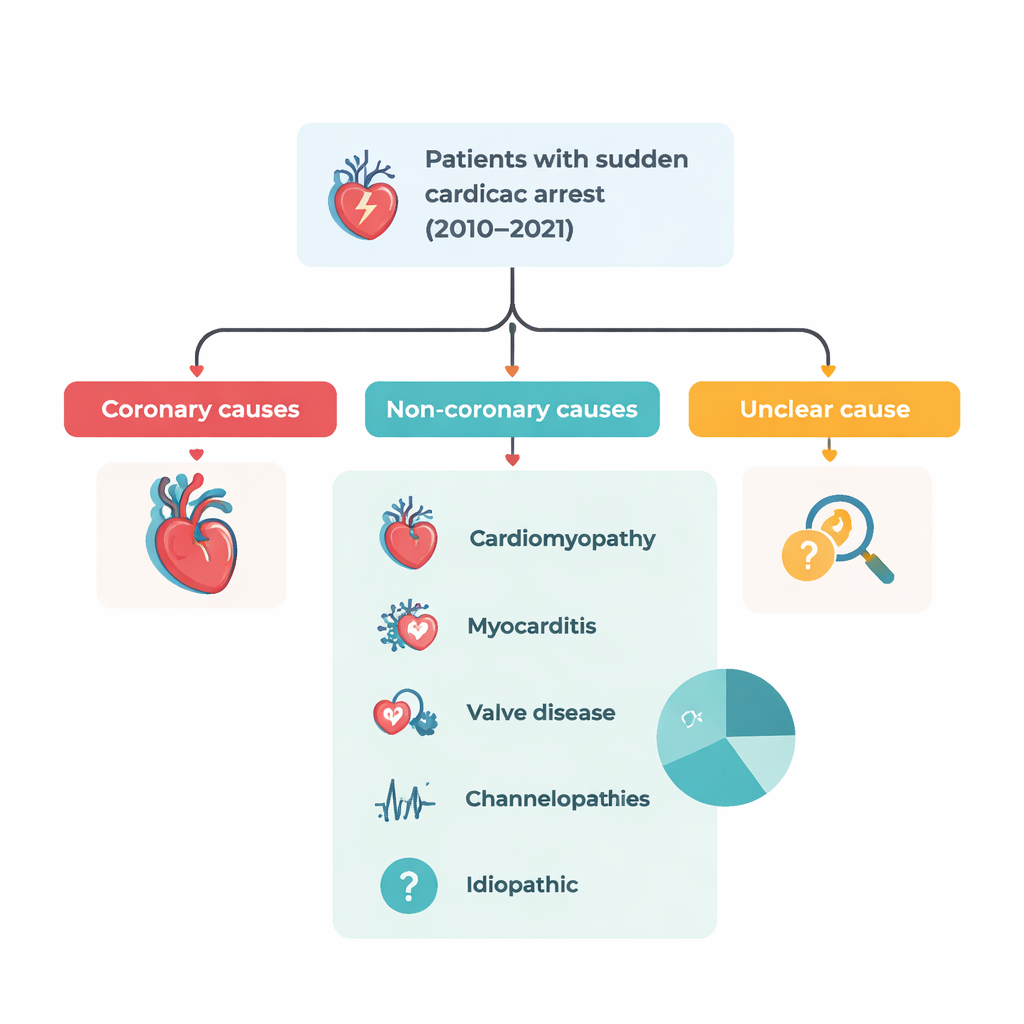
The researchers examined 232 patients aged 65 or younger who were treated for sudden cardiac arrest between 2010 and 2021 at a German referral center. Most had heart problems related to blocked or damaged coronary arteries, but the team focused on the 48 people whose arrests were clearly not caused by artery disease. These “non-coronary” cases included heart muscle diseases (cardiomyopathies), heart inflammation (myocarditis), valve problems, and people whose hearts looked normal despite exhaustive testing. Surprisingly, more than half of this non-coronary group fell into that last category, labeled “idiopathic”—meaning no clear cause could be found at first.
Where and how these emergencies happen
In this younger group without artery disease, sudden cardiac arrest tended to happen in ordinary settings rather than during extreme exertion. About a third collapsed at home and another third in public places; many arrests occurred during routine daily activities or light work, not intense sports. Encouragingly, nearly nine out of ten events were witnessed by someone nearby, and nearly half of patients received chest compressions from lay bystanders before professional help arrived. Ambulance crews most often recorded a chaotic rhythm called ventricular fibrillation, which can be reversed with a shock if treated quickly. Even with rapid care, nearly one in three of these patients died in the hospital, underscoring how unforgiving sudden cardiac arrest can be.
Following patients over years, not just days
For survivors, the story did not end at discharge. Most received an implantable cardioverter-defibrillator (ICD), a small device placed under the skin that can detect and shock dangerous rhythms automatically. Over an average of more than four years of follow-up, about a third of ICD recipients in the non-coronary group experienced new episodes of life-threatening rhythm disturbances that the device successfully treated. A few patients received unnecessary shocks, illustrating both the power and the downside of relying on implanted electronics for protection. Still, these devices clearly prevented further sudden deaths in several people who might otherwise have had no warning.
What a second look at heart tracings revealed
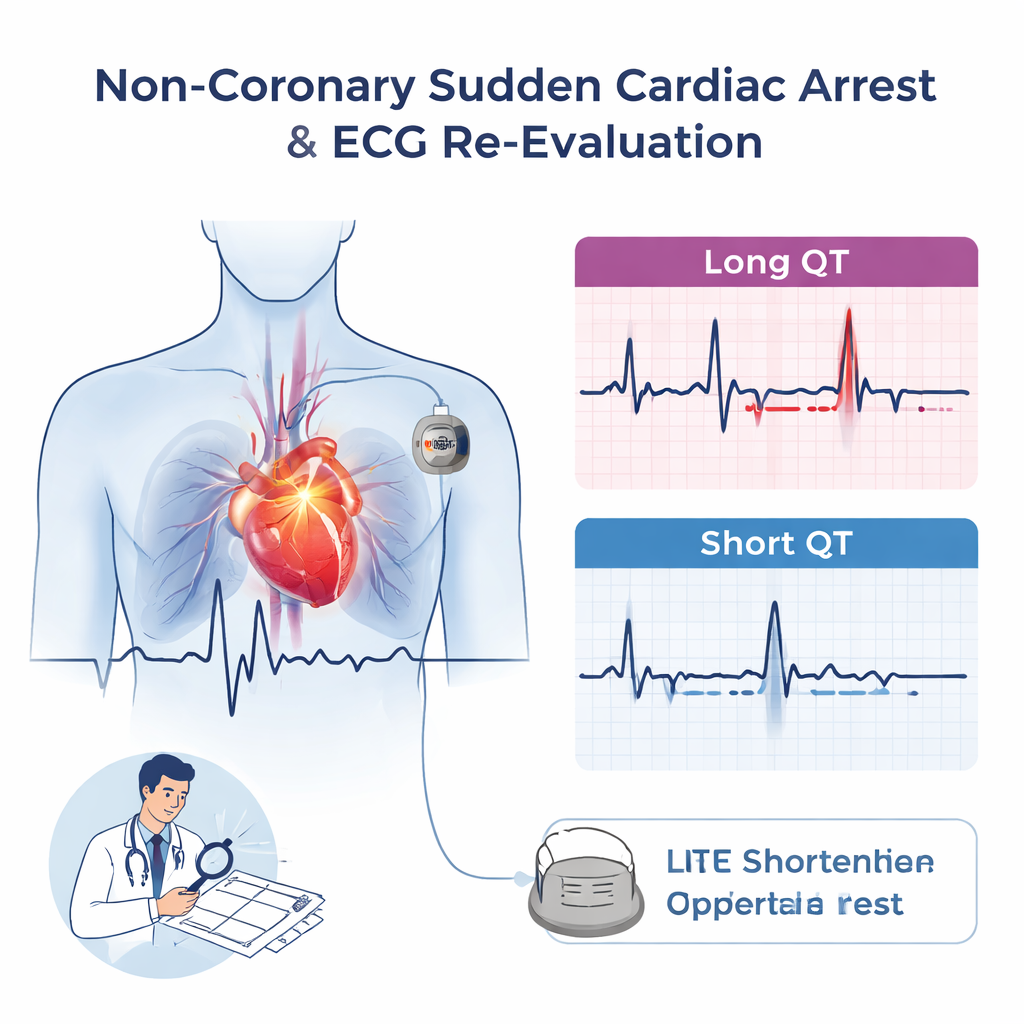
A central question in this study was why so many patients remained “idiopathic” after modern scans, lab tests, and initial ECGs. To probe deeper, two cardiologists went back and re-read at least two ECGs from every case, this time taken days after the arrest, when the immediate effects of cooling therapy, drugs, or electrolyte imbalances had worn off. In two patients who had previously defied explanation, the reviewers found telltale patterns of rare inherited electrical disorders: one with a strikingly prolonged QT interval (long QT syndrome) and one with a distinctly shortened QT (short QT syndrome). Both conditions disrupt the timing of the heart’s electrical reset phase and are known to trigger sudden dangerous rhythms in otherwise healthy people. Finding even two such cases in a small group suggests that some hidden electrical diseases may be missed unless ECGs are checked repeatedly and very carefully.
What this means for patients and families
For lay readers, the takeaway is not to fear every skipped heartbeat, but to recognize that sudden cardiac arrest in younger adults is not always about clogged arteries—and that answers can sometimes be found in details of the heart’s electrical tracing. This study shows that more than half of non-artery-related arrests initially lacked a clear cause, yet careful ECG re-evaluation uncovered specific, treatable conditions in some of them. Identifying problems like long or short QT syndrome matters because it guides life-saving choices, such as ICD implantation, careful drug selection, and family screening. In plain terms, a second, expert look at an ECG after a cardiac arrest can mean the difference between an unsolved mystery and a clear plan to protect both the survivor and their relatives.
Citation: Kreimer, F., Thiesing, P., Akin, I. et al. Reevaluation of ECGs of a German non coronary sudden cardiac arrest cohort. Sci Rep 16, 7744 (2026). https://doi.org/10.1038/s41598-026-41843-2
Keywords: sudden cardiac arrest, electrocardiogram, long QT syndrome, short QT syndrome, implantable defibrillator