Clear Sky Science · en
GO@CNT@Fe₃O₄@CuO quaternary nanohybrids enhance dielectric-magnetic synergy for high-performance epoxy-based electromagnetic absorbers
Why blocking stray waves matters
From smartphones and Wi‑Fi routers to 5G antennas and radar, our world is awash in invisible electromagnetic waves. While these signals enable modern communication and sensing, their uncontrolled spread can interfere with sensitive electronics and may pose health concerns if exposure grows unchecked. Engineers therefore look for special coatings that can soak up unwanted microwaves instead of letting them bounce around. This paper reports a new lightweight material built from nanoscale building blocks that efficiently absorbs microwave radiation in a key frequency window used for radar, satellites, and 5G links.
Building a smarter microwave sponge
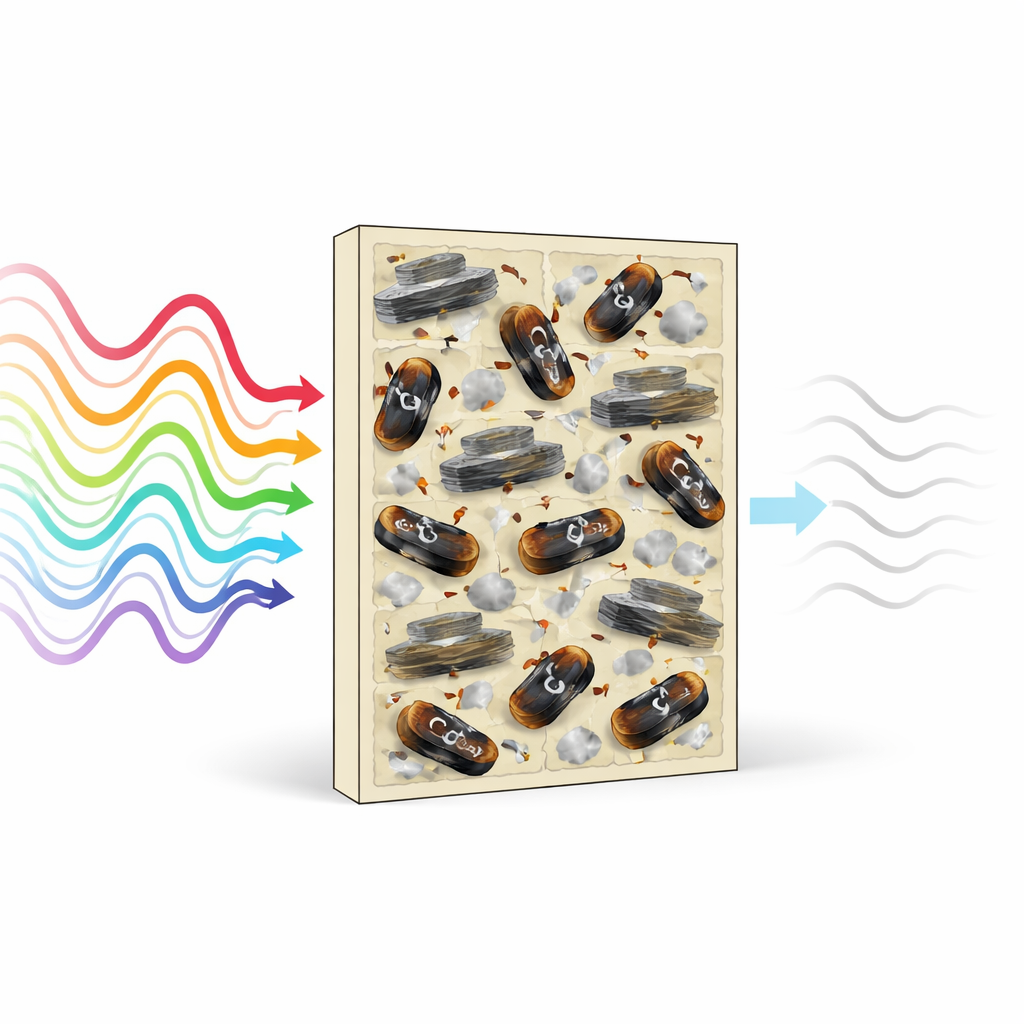
Most traditional shielding materials simply reflect electromagnetic waves, pushing the problem elsewhere. What researchers want instead is an absorber: a material that lets waves enter and then quietly converts their energy into heat. To achieve this, the material must carefully balance how it responds to electric and magnetic fields so that waves are not reflected at the surface. The authors designed a complex “core‑shell” nanoparticle—abbreviated GO@CNT@Fe₃O₄@CuO—that combines four different ingredients: carbon sheets (graphene oxide) and carbon nanotubes that handle electrical effects, magnetite (Fe₃O₄) that responds to magnetic fields, and copper oxide (CuO), a semiconductor that fine‑tunes how charges move and pile up. These particles are mixed into a strong, durable epoxy resin similar to those already used in aerospace and structural composites.
How the tiny particles are made
The team built their nanostructures layer by layer. First, they synthesized graphene oxide sheets and mixed them with carbon nanotubes so that the tubes lie across and between the sheets, forming a connected conductive network. Next, they grew tiny magnetite spheres directly on this carbon framework, creating a magnetic shell without large clumps. Finally, they deposited a thin outer skin of copper oxide around the magnetite. Microscopy images show that the resulting particles look like small multi‑layered islands: flat and tubular carbon in the middle, surrounded by a magnetic layer, then by a thinner copper oxide coating. Thermal and X‑ray measurements confirm that the structure is stable up to high temperatures and that all four components are present in the intended crystal forms.
Turning a glue into a wave absorber
To turn these nanostructures into a useful coating, the authors dispersed only 5 percent by weight of the particles into liquid epoxy, added a hardener, and cured the mixture into solid slabs of different thicknesses. They then measured how these samples interacted with microwaves in the X‑band range (about 8–12.5 gigahertz), which is widely used in radar and satellite communication and is also relevant for emerging 5G systems. Compared with plain epoxy or epoxy filled with simpler particles, the material containing the full four‑component nanohybrids showed a striking ability to let waves enter and then attenuate them, rather than reflecting them at the surface. At a thickness of 5 millimeters, it reduced reflected power by up to 37.5 decibels at 10.25 gigahertz and maintained strong absorption across a 3.2‑gigahertz span.
What happens to the trapped energy
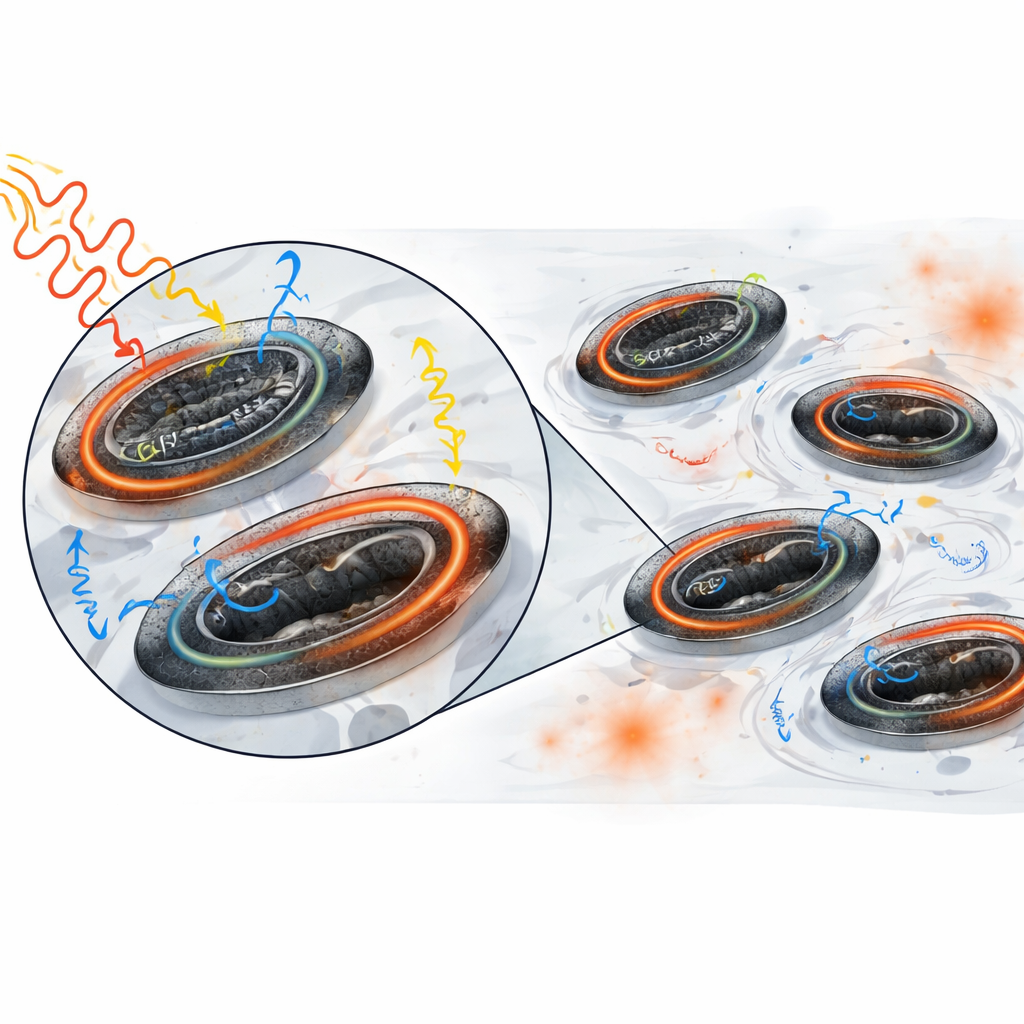
Inside the material, several mechanisms work together to dissipate the incoming microwave energy. The carbon sheets and nanotubes provide pathways for electrical currents that turn wave energy into heat. At the many boundaries between the four components and the surrounding epoxy, charges are slightly separated and then forced to oscillate by the alternating field, a process that also wastes energy as heat. The magnetite layer responds to the magnetic part of the wave through tiny magnetic resonances, while the copper oxide shell increases the number of defects and interfaces where charges can shuffle and relax. Because these electrical and magnetic effects are carefully balanced, the incoming wave sees an impedance similar to that of air, slips into the coating with little reflection, and is then gradually extinguished by these internal processes.
Why this matters for future devices
The study shows that by deliberately combining conductive, magnetic, and semiconducting ingredients into a single nanoscale package, it is possible to create efficient microwave absorbers using only a small amount of filler in an otherwise standard epoxy. In plain terms, the researchers have developed a thin, lightweight paint‑like material that can be applied to structures and devices to keep stray microwaves from escaping or interfering with nearby electronics. While challenges remain in scaling up the synthesis and ensuring long‑term stability and low cost, the work offers a blueprint for designing next‑generation coatings for 5G infrastructure, aerospace vehicles, and wearable gadgets that need both strong communication signals and reliable protection from electromagnetic pollution.
Citation: Gholidizchi, L.A., Ebrahimkhas, M. & Hooshyar, H. GO@CNT@Fe₃O₄@CuO quaternary nanohybrids enhance dielectric-magnetic synergy for high-performance epoxy-based electromagnetic absorbers. Sci Rep 16, 8927 (2026). https://doi.org/10.1038/s41598-026-41828-1
Keywords: electromagnetic absorption, microwave shielding, epoxy nanocomposite, core-shell nanoparticles, 5G radar materials