Clear Sky Science · en
Noradrenergic activity as a key target in modulating consciousness
Why this research matters for everyday awareness
Every day, we switch effortlessly between feeling wide awake, drowsy, focused, or spaced out. Yet scientists still struggle to explain how the brain turns raw signals into the rich, conscious world we experience. This study asks a deceptively simple question with big implications: how does one specific brain chemical, noradrenaline, help determine what we actually notice, as opposed to what stays in the shadows of unconscious processing?
A closer look at a key brain messenger
Noradrenaline is a chemical messenger that helps regulate alertness and readiness to respond. It is released from a small hub deep in the brainstem and sent widely across the brain. Many sedative drugs and sleep loss change noradrenaline levels, but it has been unclear whether these changes affect only how awake we feel, or also which sights and sounds reach conscious awareness. The authors set out to isolate noradrenaline’s role by comparing two ways of lowering arousal: a targeted sedative drug called Dexmedetomidine and a full night without sleep. They then examined how these states changed brain activity and subtle shifts in visual attention.
Peeking into conscious and hidden vision
Participants lay in an MRI scanner and performed a simple visual task: reporting where a small grey disc appeared on a screen. Cleverly, the researchers used a technique called continuous flash suppression to sometimes hide the disc from awareness, even though it still reached the eyes. Rapidly changing colorful patterns shown to one eye overshadowed the disc shown to the other, so the brain processed the signal without the person consciously seeing it. After each trial, participants indicated whether they had no experience of the disc, a vague impression, or a clear sighting. This allowed the team to separate brain responses to consciously seen discs from those to discs that remained unseen, while measuring blood-oxygen-level signals across the brain.
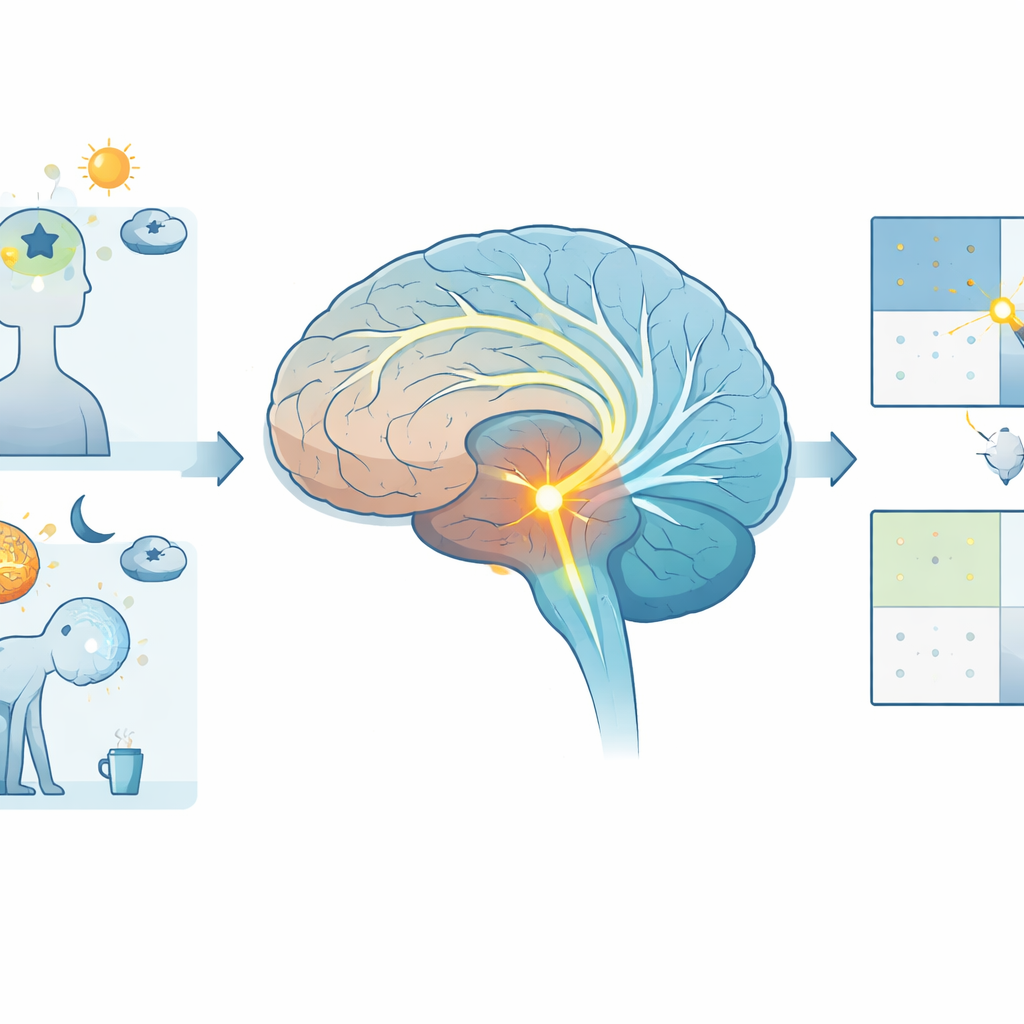
Two paths to low arousal, one brain chemical in common
Both Dexmedetomidine and sleep deprivation made people more variable in a separate tapping-to-a-metronome task, confirming that arousal dropped in both cases. Yet accuracy in locating clearly seen discs stayed high, and performance for hidden discs changed little. When the researchers examined brain activity in visual and attention-related areas, they found that both manipulations altered the pattern of responses only when participants consciously saw the disc; activity linked to unseen discs was essentially unchanged. This selective effect strongly suggests that noradrenergic activity is tied specifically to conscious processing of visual space, rather than to all visual processing in general.
When similar sleepiness leads to opposite attention shifts
One of the most striking results involved our natural “leftward bias.” Healthy people tend to pay slightly more attention to the left side of space, a mirror image of patients with right-brain damage who often ignore the left. Under Dexmedetomidine, this leftward bias shrank, fitting earlier work linking lower arousal to a drift of attention rightward. After sleep loss, however, the opposite happened: leftward bias grew stronger. Brain scans and heart-rate measurements helped resolve this puzzle. Sleep-deprived participants showed higher activity in the brain’s central autonomic network—regions that regulate bodily arousal—and a faster heart rate during the task, signs of a compensatory “push” to stay alert. In contrast, the sedative directly dampened noradrenergic output, blocking such compensation.
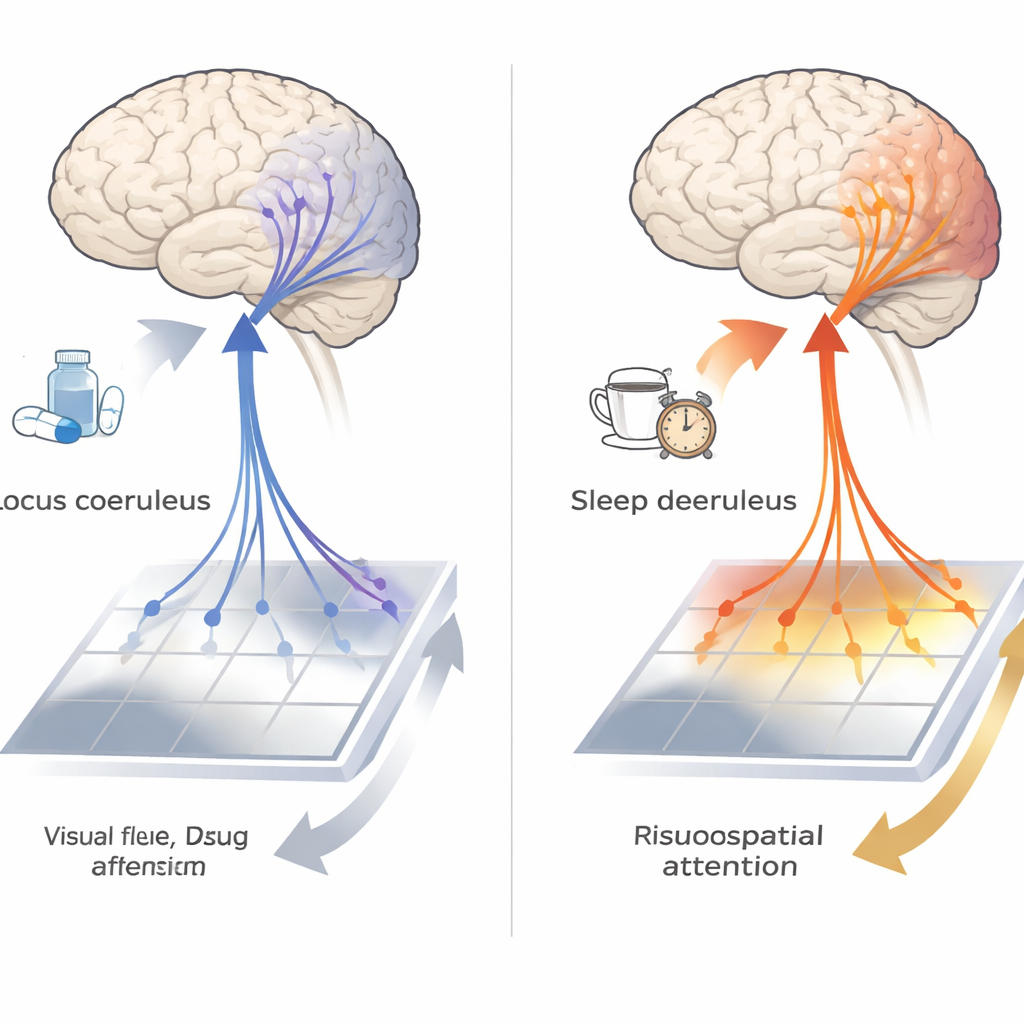
What this means for the science of consciousness
By showing that changes in noradrenergic activity reshaped brain responses only when people were consciously aware of a visual stimulus, this work highlights noradrenaline as a prime handle for experimentally probing consciousness. The findings support the idea that this chemical acts like a gain knob: boosting important signals so they stand out from background noise and are more likely to become part of our conscious experience. At the same time, the contrasting effects of a sedative drug and sleep loss warn against treating all “low arousal” states as equivalent. Instead, the specific way noradrenaline is altered—whether suppressed by a drug or ramped up by effort after sleep loss—can push attention and awareness in different directions. Understanding these mechanisms promises not only to refine theories of consciousness, but also to guide safer anaesthesia, better treatment of attention disorders, and smarter use of sleep in everyday life.
Citation: Karampela, O., Fontan, A., Lindgren, L. et al. Noradrenergic activity as a key target in modulating consciousness. Sci Rep 16, 8729 (2026). https://doi.org/10.1038/s41598-026-41819-2
Keywords: consciousness, noradrenaline, sleep deprivation, sedation, visuospatial attention