Clear Sky Science · en
Unveiling in situ oxygen, carbon and nutrient cycling of a sponge-driven biological hotspot in the arctic
Life thriving in the deep, dark Arctic
Far below the waves, in water close to freezing and with no sunlight at all, scientists have discovered a surprisingly busy community: vast fields of deep-sea sponges living on an Arctic undersea mountain. This study explores how these seemingly simple animals keep an entire hidden ecosystem going by breathing in oxygen, consuming invisible food, and recycling key nutrients that other ocean life depends on.
An underwater city of sponges
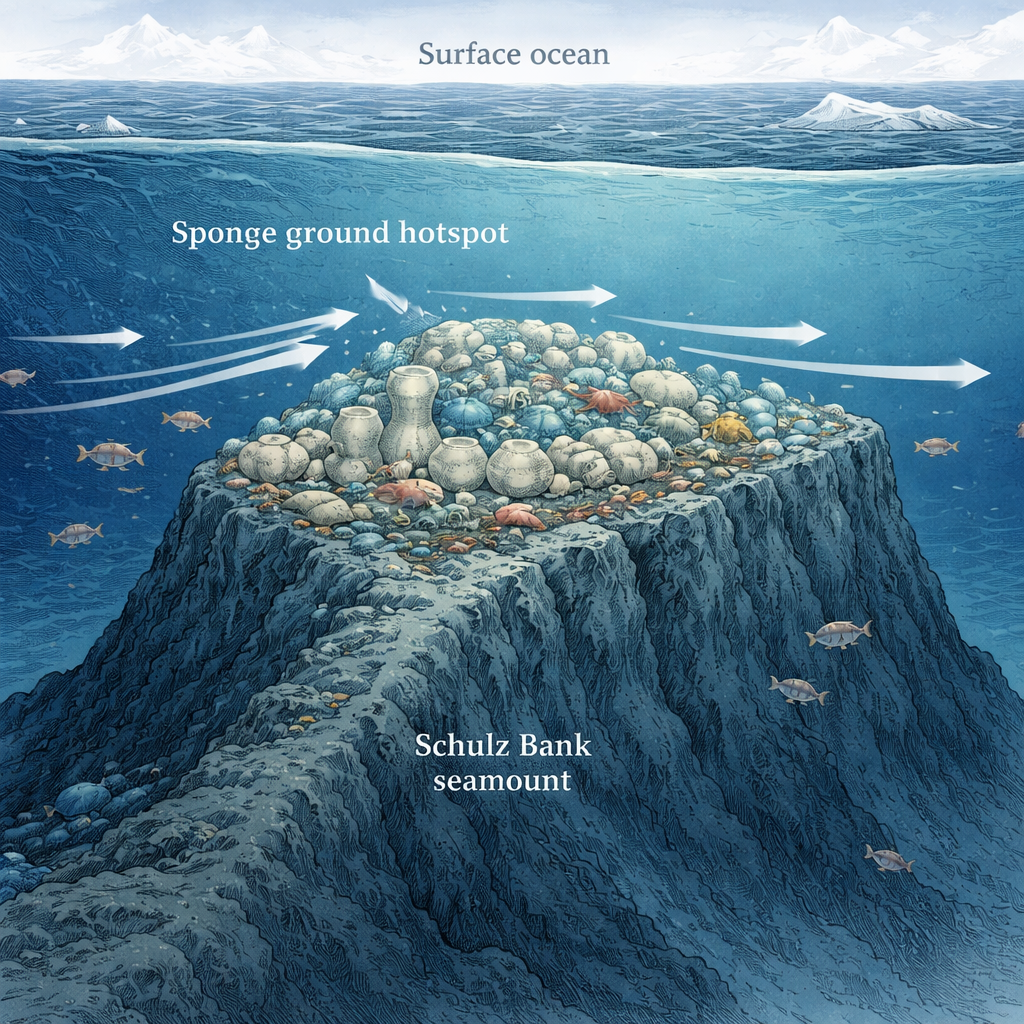
The research focuses on Schulz Bank, a towering seamount along the Arctic Mid-Ocean Ridge whose summit lies about 580 meters below the surface. Its top is carpeted with dense “sponge grounds,” where different kinds of sponges form reef-like structures built from glassy skeletal needles. These sponge fields create a three-dimensional habitat that shelters fish, corals, and many small invertebrates. Powerful currents swirl around the seamount, trapping particles and organic matter from seasonal plankton blooms and delivering them to the summit, turning it into a deep-sea biological hotspot despite the harsh, food-poor surroundings.
Measuring breath and waste on the seafloor
To understand how this community functions, the team used remotely operated vehicles to place clear acrylic chambers over patches of the sponge ground. Each chamber enclosed a small section of seafloor and its resident animals. Over several hours, instruments recorded changes in oxygen and collected water samples to track tiny microbes and dissolved nutrients such as different forms of nitrogen and phosphorus. By comparing chambers with lots of sponge biomass to those with only small or scattered sponges, the researchers could estimate how strongly sponges themselves drive the chemistry of the surrounding water.
A deep-sea hotspot for carbon use
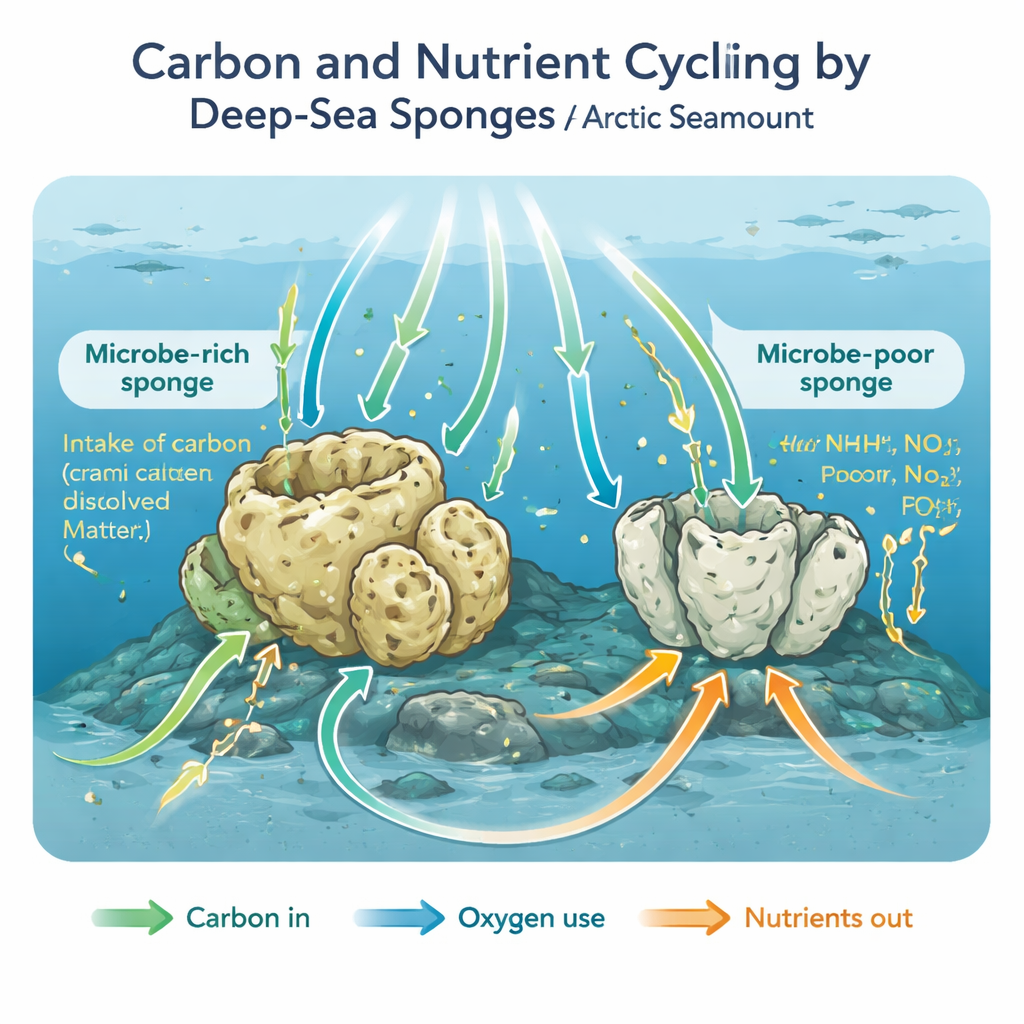
The sponge ground turned out to be a powerhouse of respiration. The community consumed oxygen at rates comparable to those measured on famous deep-sea coral reefs and much higher than nearby soft sediments in the Arctic. In simple terms, the sponges and their neighbors are burning through organic carbon much faster than the slow, steady drizzle of food from the surface could reasonably supply. This mismatch implies that sponges tap into additional, less visible food sources, especially dissolved organic carbon and microscopic plankton, which they filter continuously from the water. Their activity tightly couples the overlying water to the seafloor, rapidly transforming otherwise inaccessible carbon into forms that can fuel the wider benthic food web.
Turning waste into fertilizer for the deep
At the same time as they consume oxygen and carbon, the sponges release a steady stream of inorganic nutrients—ammonium, nitrate, nitrite, and phosphate—back into the water. These nutrients act like fertilizers, potentially feeding microbes and algae far beyond the seamount. Chambers that contained more sponge biomass generally showed higher nutrient release, underscoring the animals’ central role. The study also found that different sponge types behave differently. Sponges with few internal microbes tended to release particularly large amounts of ammonium and phosphate, while microbe-rich sponges appeared to recycle nutrients more internally and to maintain more balanced nitrogen-to-phosphorus ratios. This suggests that the mix of sponge species on a seamount can shape not just how much nutrient is regenerated, but in what chemical form.
Why this hidden recycling plant matters
Taken together, the results paint Schulz Bank as a deep-sea recycling plant: sponges pull in dilute, difficult-to-use carbon and oxygen from the water, process it, and release nutrient-rich byproducts that can support other life in the dark ocean. Although the measurements are technically challenging and based on a limited number of experiments, they confirm that sponge grounds are not just passive habitats but active engines of carbon and nutrient cycling. Because similar sponge fields are now being discovered across the world’s oceans, their combined influence could significantly affect how nutrients and energy move through deep waters. Protecting these slow-growing communities from threats such as bottom trawling, deep-sea mining, and climate-driven changes in circulation is therefore crucial for maintaining the health and productivity of the broader marine ecosystem.
Citation: Hanz, U., Mueller, B., Bart, M.C. et al. Unveiling in situ oxygen, carbon and nutrient cycling of a sponge-driven biological hotspot in the arctic. Sci Rep 16, 7743 (2026). https://doi.org/10.1038/s41598-026-41798-4
Keywords: deep-sea sponges, nutrient cycling, Arctic seamount, carbon flux, benthic hotspot