Clear Sky Science · en
Association between knee angles at initial contact and post-landing knee ranges of motion in athletes with and without anterior cruciate ligament reconstruction
Why landing mechanics matter
Every time an athlete jumps and lands, their knees absorb powerful forces in a split second. Many devastating anterior cruciate ligament (ACL) injuries occur during that instant, often without any contact from an opponent. This study asks a practical question for coaches, therapists, and players: can we judge ACL risk just by looking at the knee’s position the moment the foot hits the ground, or do we need to track how the knee continues to move during the first fractions of a second after landing?
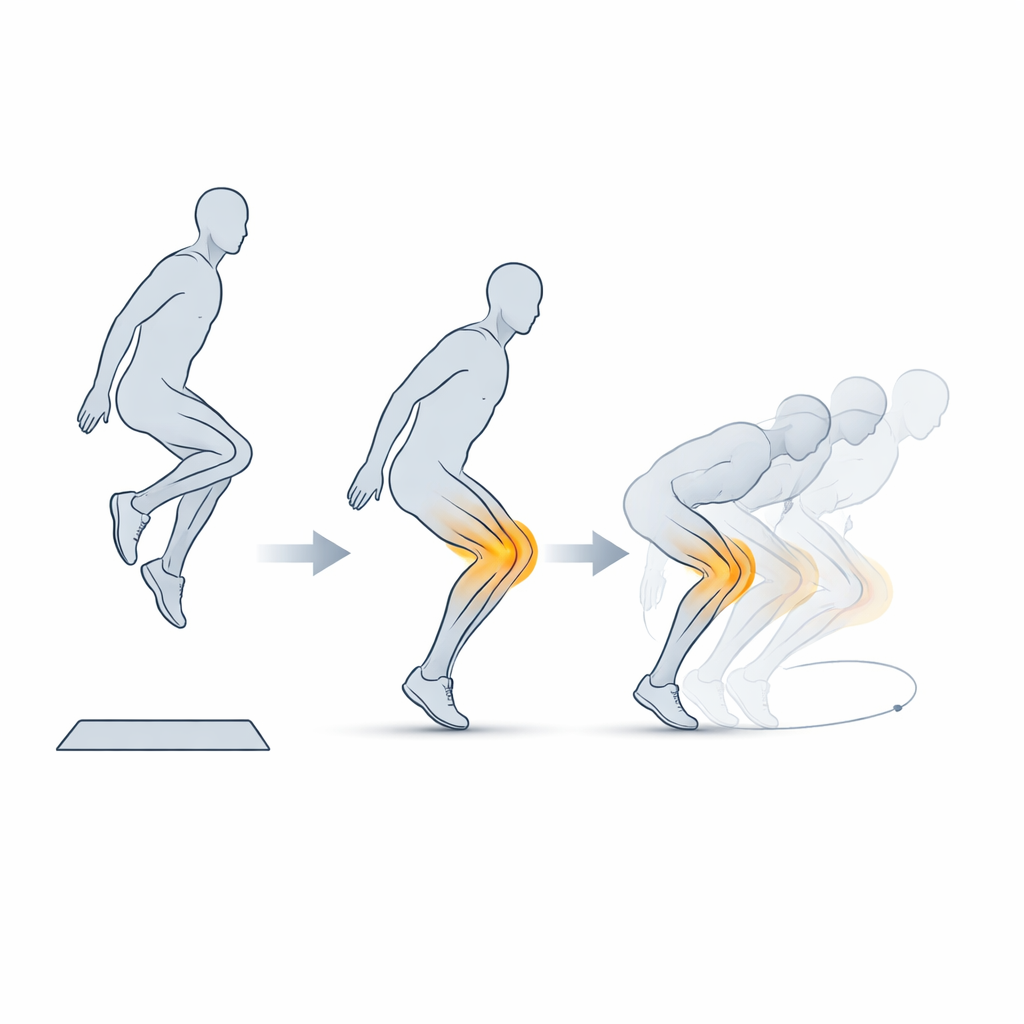
The split second that decides knee safety
The ACL is a key stabilizing ligament inside the knee, and its rupture is one of the most serious injuries in running and jumping sports. Video and motion analyses show that ACL tears usually happen within the first 100 milliseconds after the foot contacts the ground. Dangerous patterns combine a nearly straight knee with the leg collapsing inward and rotating awkwardly. Because this all happens so fast, researchers have relied on two main measurements from 3D motion capture: the knee angle at the instant of first contact, and how far the knee moves (its range of motion) during landing. In practice, these two measures are often treated as if they told the same story about risk—but that assumption had not been rigorously tested.
How the researchers tested landing moves
The team studied 11 male soccer players who had undergone ACL reconstruction and 20 healthy male soccer players. Each athlete performed two demanding one-leg tasks on force plates while wearing reflective markers tracked by high-speed cameras. In the single-leg hop, players jumped forward on one leg as far as possible and tried to land steadily. In the single-leg cross drop landing, they stepped off a small box and landed on one leg while crossing over the body, mimicking awkward game situations. For each leg and task, the researchers focused only on the landing with the highest vertical ground force, reasoning that this trial best represented the most stressful, and therefore riskiest, condition.
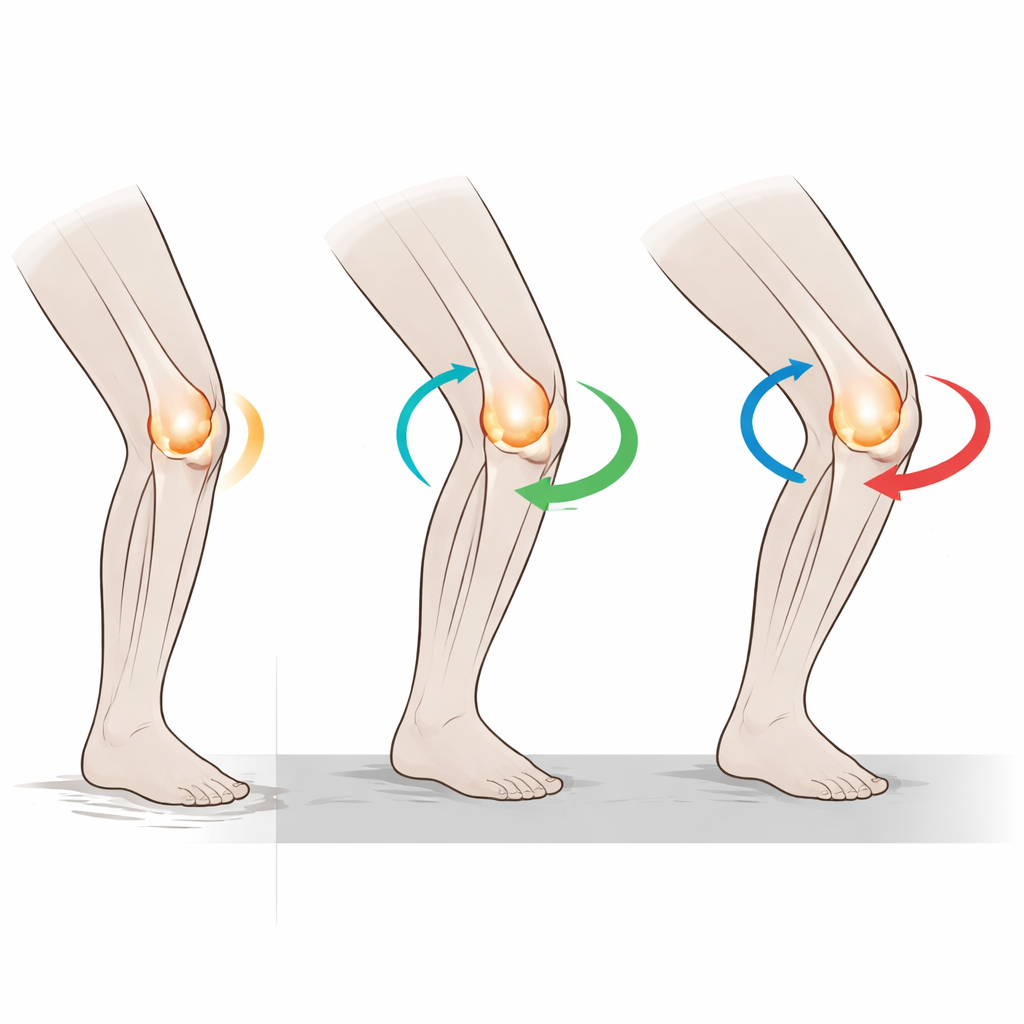
Two ways to measure knee motion after landing
From the 3D data, the authors extracted three key measures in each of the main planes of motion. First, they noted the knee angle at initial contact—how bent, inward-angled, or rotated the knee was the instant the foot hit the ground. Second, they calculated the knee’s total range of motion from that instant until the knee reached its deepest bend (full range). Third, they computed range of motion limited to only the first 100 milliseconds after contact, the critical “risk time window” when ACL injuries typically occur. They then checked how strongly these measures were statistically linked to each other, separately for reconstructed and healthy knees, for both tasks, and for all directions of movement.
What the numbers revealed about knee behavior
The researchers found that the two ways of measuring post-landing motion—the full range and the 100-millisecond range—were strongly to very strongly related across almost all conditions. In other words, how much the knee moved in that short early window closely mirrored how much it eventually moved until its deepest bend. This suggests that the first 100 milliseconds capture the essence of the landing motion while being less affected by factors such as jump distance or box height. By contrast, the angle at initial contact did not consistently track with either measure of range of motion. Meaningful links appeared mainly for motions in the frontal plane, where inward collapse (valgus) is known to be dangerous. In many other cases, the initial position of the knee told little about how it would move immediately afterward, especially in the bending and rotational directions.
What this means for injury risk and recovery
For a general audience, the main message is that how the knee continues to move right after the foot hits the ground is more informative than the snapshot of its position at that instant. The study supports using knee range of motion within the first 100 milliseconds after landing as a practical, standardized yardstick for assessing ACL-related movement patterns in both screening and rehabilitation. Relying only on how straight or inward-angled the knee appears at contact can be misleading, because athletes may still absorb forces safely—or unsafely—through the way their knee bends and twists in the moments that follow. By focusing on that brief, critical window of motion, clinicians and coaches may better detect risky landing strategies and tailor training to protect athletes’ knees and support safer returns to sport.
Citation: Baldazzi, A., Rum, L., Borzuola, R. et al. Association between knee angles at initial contact and post-landing knee ranges of motion in athletes with and without anterior cruciate ligament reconstruction. Sci Rep 16, 8693 (2026). https://doi.org/10.1038/s41598-026-41776-w
Keywords: ACL injury, knee biomechanics, sports landing, rehabilitation, soccer athletes