Clear Sky Science · en
A physics-informed hybrid ML framework for pore pressure and fracture gradient prediction in carbonate reservoirs
Why keeping wells safe matters
When engineers drill deep beneath the seafloor in search of oil and gas, they must carefully balance the pressure of the drilling fluid against the natural pressure of the rocks. If they guess too low, fluids can rush into the well and cause dangerous kicks or blowouts. If they guess too high, the rock can crack and swallow the drilling mud, wasting time and money. This paper presents a new way to predict these pressures more accurately in difficult carbonate rock formations, using a blend of traditional physics and modern machine learning.
The challenge of tricky carbonate rocks
In any subsurface rock, the fluid trapped in tiny pores pushes outward with what geoscientists call pore pressure. Above that rock, the weight of all the overlying material creates a squeezing force. Together, these pressures determine how heavy the drilling mud must be to keep the well stable. In ideal, uniform rocks, long-used formulas can estimate these pressures fairly well. But offshore carbonate reservoirs are anything but uniform: they contain voids, tight layers, natural fractures and sudden changes in rock type. In such settings, standard industry methods often miss the mark, while direct pressure measurements from downhole tools are so sparse and costly that they cannot be taken everywhere.
Blending physics rules with learning from data
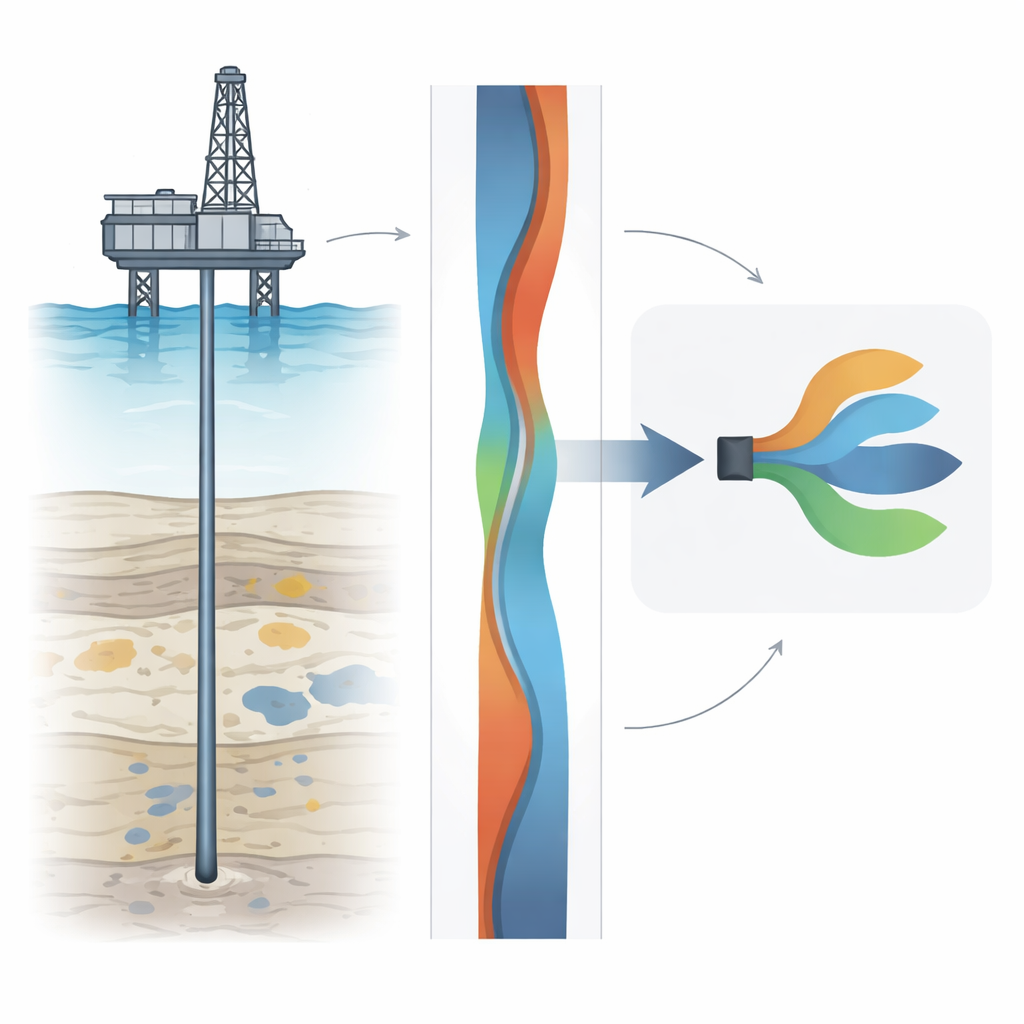
The authors propose a hybrid framework designed specifically for these complex carbonates. First, they run the familiar industry formulas, which convert measurements such as sound waves in the rock, electrical resistivity, and drilling behavior into estimates of pore pressure and the pressure needed to fracture the rock. Instead of accepting these estimates as-is, the new approach adds an Adaptive Calibration Layer that looks at the few available high-quality pressure readings and gently reshapes the traditional curves with depth. This step keeps the overall physical trends smooth while correcting local biases introduced by unusual rock textures or fluid conditions.
A smart layer that adjusts with depth
The Adaptive Calibration Layer acts like a flexible bridge between textbook equations and real data. At each depth, it learns how much to trust each classical method by comparing its prediction to nearby direct measurements. It then assigns a depth-dependent weight that nudges the classical curve toward reality without allowing wild swings. These corrected outputs are fed, along with standard well logs and drilling parameters, into a gradient-boosted learning model. This machine learning engine specializes in recognizing subtle nonlinear patterns, but it is anchored by the physically sensible, calibrated inputs, reducing the risk of overfitting to noisy or limited data.
Sharper predictions and clearer safety margins
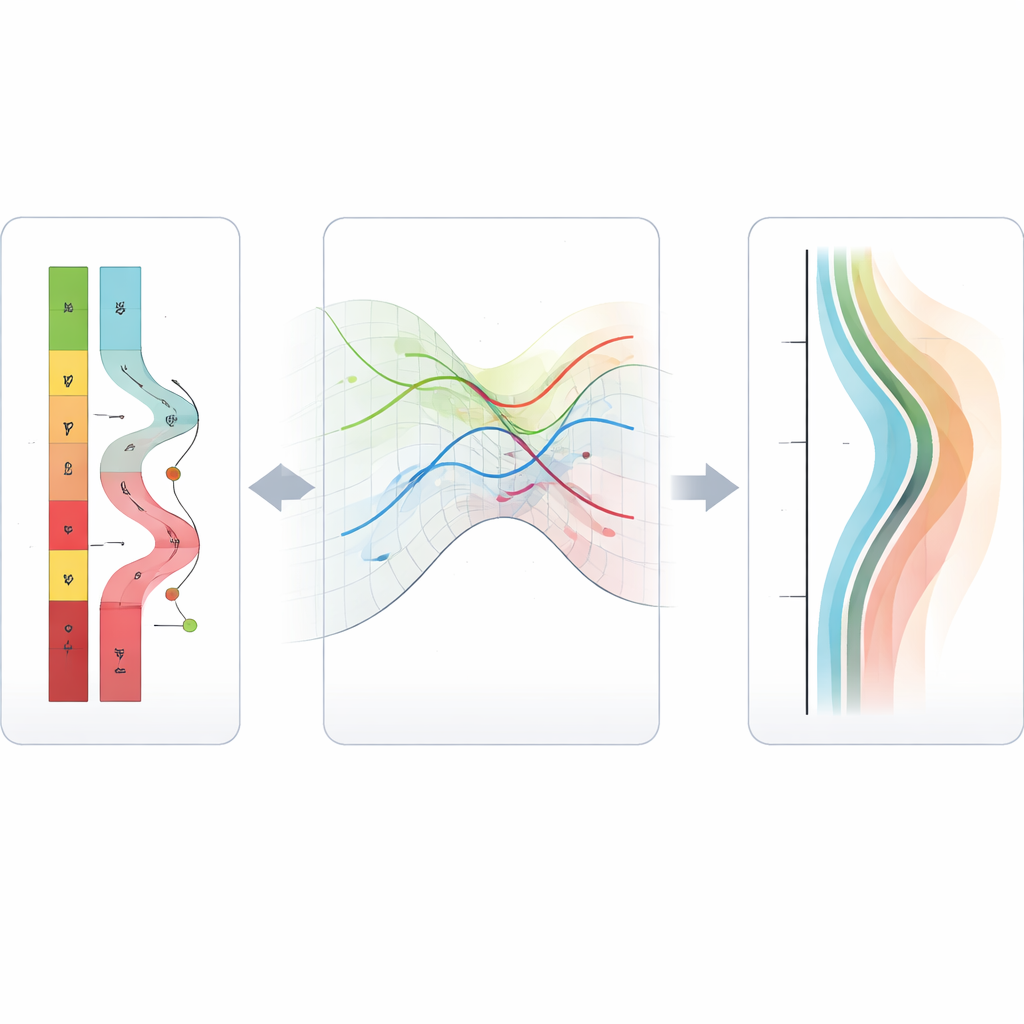
To test the framework, the team applied it to six wells in an offshore Iranian carbonate gas field. Compared with their performance before calibration, the old formulas improved substantially after being tuned with direct measurements. Yet the hybrid model still performed markedly better, cutting typical prediction errors by around 60 percent and pushing the goodness-of-fit close to what is normally seen only in well-behaved clastic rocks. An added uncertainty module repeatedly perturbs the input data and retrains the model to build an ensemble of possible pressure profiles. From this, the method produces a depth-by-depth confidence band that is usually only a few tenths of a megapascal wide, giving drillers a quantified sense of how much leeway they have.
What this means for safer and cheaper drilling
For a non-specialist, the core message is straightforward: this hybrid method gives drilling engineers a clearer picture of where the subsurface pressures really lie, and how sure they can be about those numbers. By tightening the uncertainty around both the fluid pressure in the rock and the pressure that would cause it to fracture, operators can design mud programs that are less conservative but still safe, avoiding both influxes and costly loss of drilling fluid. In complex carbonate reservoirs, where traditional rules of thumb routinely fail, combining physics-based models with adaptive calibration and machine learning offers a practical path to safer, more efficient drilling decisions.
Citation: Tahvildari, S.P., Shojaei, S. & Masihi, M. A physics-informed hybrid ML framework for pore pressure and fracture gradient prediction in carbonate reservoirs. Sci Rep 16, 8925 (2026). https://doi.org/10.1038/s41598-026-41773-z
Keywords: pore pressure prediction, fracture gradient, carbonate reservoirs, hybrid machine learning, wellbore stability