Clear Sky Science · en
Mmp2 regulates basement membrane remodeling and dedifferentiation of the visceral musculature during Drosophila metamorphosis
Why tiny fruit flies matter for body reshaping
Many animals, including the familiar fruit fly, completely rebuild their bodies as they grow up. This massive makeover, called metamorphosis, raises a basic question: how do old tissues safely loosen, change, and rebuild without the body falling apart? This study uses fruit flies to uncover how a thin support sheet around organs, the basement membrane, is carefully broken down and rebuilt so that gut muscles can transform into their adult form.
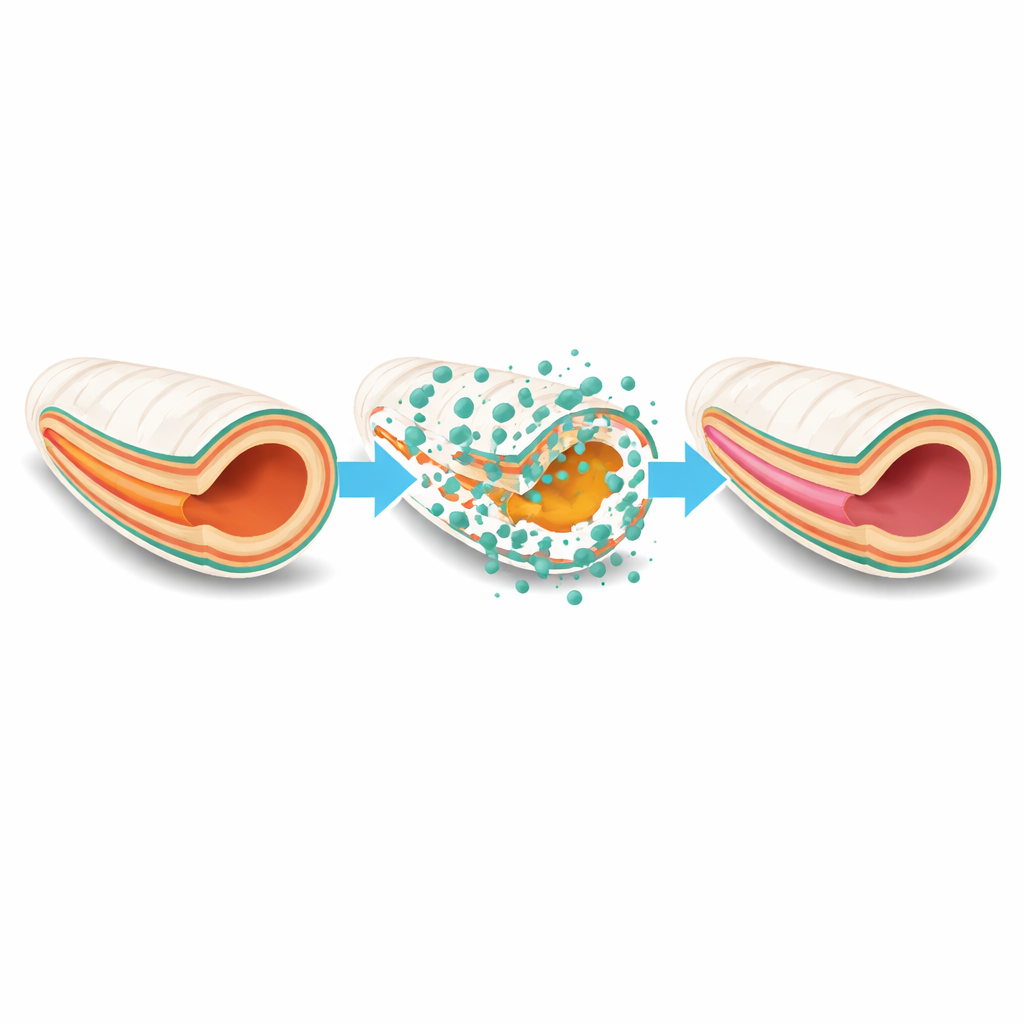
The body’s hidden support sheet
Every organ in our body, and in a fruit fly’s body, is wrapped in a delicate but tough sheet of material known as the basement membrane. It acts like a combined scaffold and filter, helping tissues keep their shape while also sending signals that guide how cells move, stick, and specialize. When tissues grow, heal, or invade, this sheet cannot stay fixed; it must be remodeled. Disrupted basement membranes are linked to human diseases such as kidney disorders and complications of diabetes, and they are often heavily altered in cancers. Understanding how this remodeling is controlled, even in a simple animal like the fruit fly, can shed light on general rules that apply across species.
A dramatic gut makeover during metamorphosis
When a fruit fly larva turns into an adult, many larval tissues die and are replaced by new ones. The muscles that surround the midgut, however, do something more remarkable: they shed their mature features, break down into smaller muscle cells, and then rebuild themselves into the adult gut musculature. This sweeping change happens while the muscles and the underlying gut epithelium share a common basement membrane. Earlier work showed that some basement membrane components disappear and later reappear during this process, but it was not clear how thoroughly the sheet is removed, or which molecules are responsible for taking it apart at the right time.
Identifying a key molecular scissor
The authors focused on a family of proteins known as matrix metalloproteases, which act as molecular scissors that cut components of the surrounding matrix. In humans there are many such proteases, often overlapping in function, which makes them difficult to study. Fruit flies have only two, called Mmp1 and Mmp2, offering a cleaner system. By selectively reducing Mmp2 activity throughout developing flies, the researchers found that pupae failed to complete metamorphosis and died. Under the microscope, these animals retained thick, persistent gut basement membranes and did not show the normal shrinking and breakdown of visceral muscles. In contrast, normal flies showed a near-complete loss of the basement membrane around the midgut at a key middle stage, followed later by its reappearance once remodeling was complete.
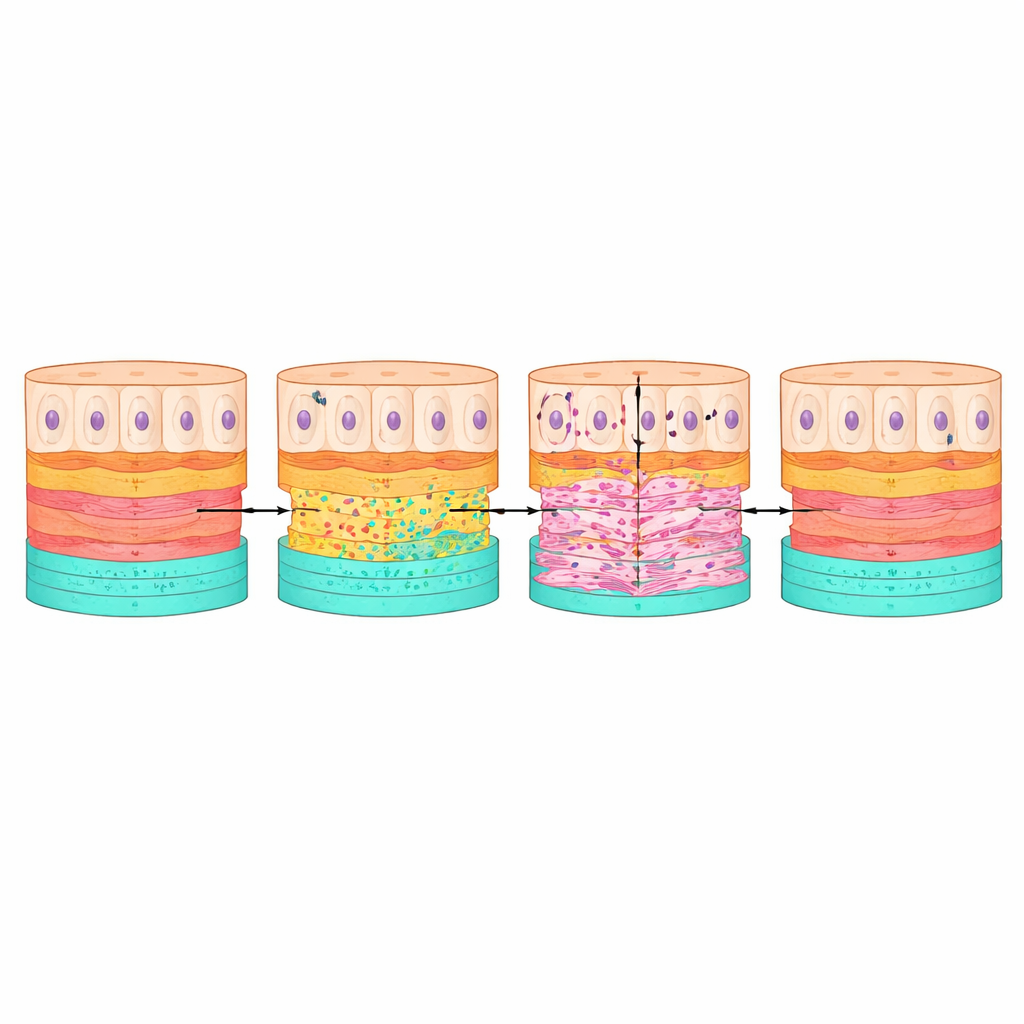
Watching the support sheet dissolve and return
To follow events in more detail, the team used fluorescent tags and specific antibodies to visualize major basement membrane components, including laminins, collagen IV, perlecan, and nidogen, alongside a fluorescently labeled version of Mmp2. Early in pupal life, these components formed a continuous layer around the midgut muscles. As metamorphosis progressed, Mmp2 protein built up around the visceral muscles just as the laminin-rich inner part of the basement membrane began to vanish. By the time the basement membrane was completely gone from internal organs, Mmp2 itself had largely disappeared. Later, as the muscles and gut reassembled into their adult form, the basement membrane components returned, but Mmp2 did not. When Mmp2 was knocked down, none of these components were properly cleared: all five main building blocks of the basement membrane stayed in place, and a thick sheet surrounded the muscles even at stages when it should have been absent.
How a controlled breakdown enables new growth
Putting these observations together, the authors propose that Mmp2-driven removal of the basement membrane is a necessary first step for gut muscle cells to shed their old identity and reorganize into adult tissue. Without this targeted breakdown, the muscles remain locked in their larval state, the gut cannot compact and reshape, and the animal fails to survive metamorphosis. For non-specialists, the message is that careful dismantling of structural supports is just as important as building them in the first place. Insights from this simple insect model may help us understand how similar enzymes contribute to normal tissue renewal, wound healing, and, when misregulated, to diseases such as cancer in more complex organisms.
Citation: Töpfer, U., Dahlitz, I. & Holz, A. Mmp2 regulates basement membrane remodeling and dedifferentiation of the visceral musculature during Drosophila metamorphosis. Sci Rep 16, 7827 (2026). https://doi.org/10.1038/s41598-026-41763-1
Keywords: basement membrane, tissue remodeling, metamorphosis, matrix metalloprotease, Drosophila gut