Clear Sky Science · en
Multi-objective optimization of hybrid laser cleaning process parameters for carbon deposits based on bayesian-SVR and NSGA-II
Why cleaner engines matter
Anyone who has driven a car for years has felt an aging engine lose some of its punch. One hidden culprit is a tough, sooty layer of carbon that slowly coats the tops of pistons, wasting fuel and raising emissions. This study explores a new, laser-based way to strip those carbon deposits efficiently while protecting the metal underneath. It also shows how modern data tools can tune the process on a computer, cutting down on trial‑and‑error in the workshop.
The problem with stubborn engine soot
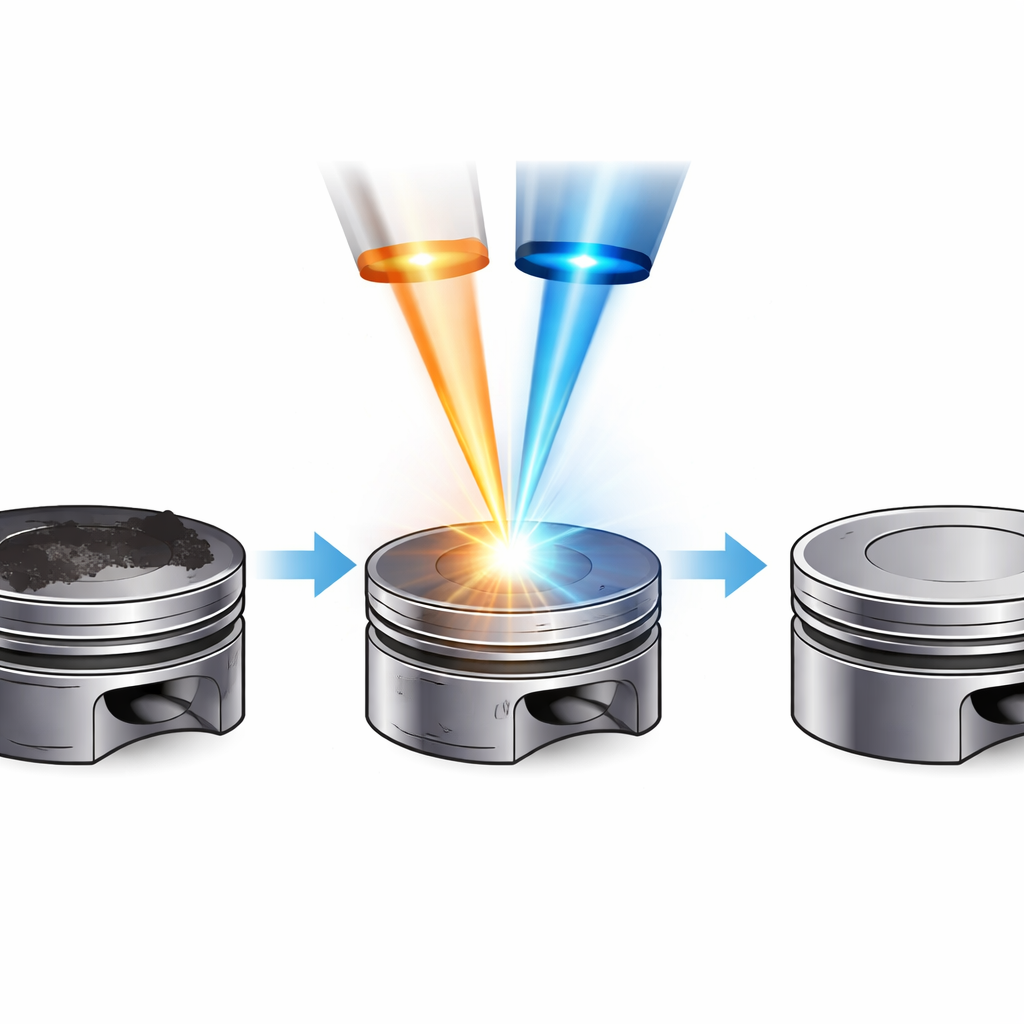
Inside a running engine, fuel does not burn perfectly cleanly. Over time, thin layers of carbon stack up on the crown of each piston. These deposits change the shape of the combustion chamber, lowering efficiency, increasing fuel consumption, and boosting harmful exhaust. In extreme cases they can trigger knocking and even engine damage. Traditional cleaning methods rely on chemicals, blasting, or manual scraping. These approaches are messy, slow, can roughen or pit the metal surface, and may create environmental hazards from waste solvents and debris.
A smarter way to shine it clean
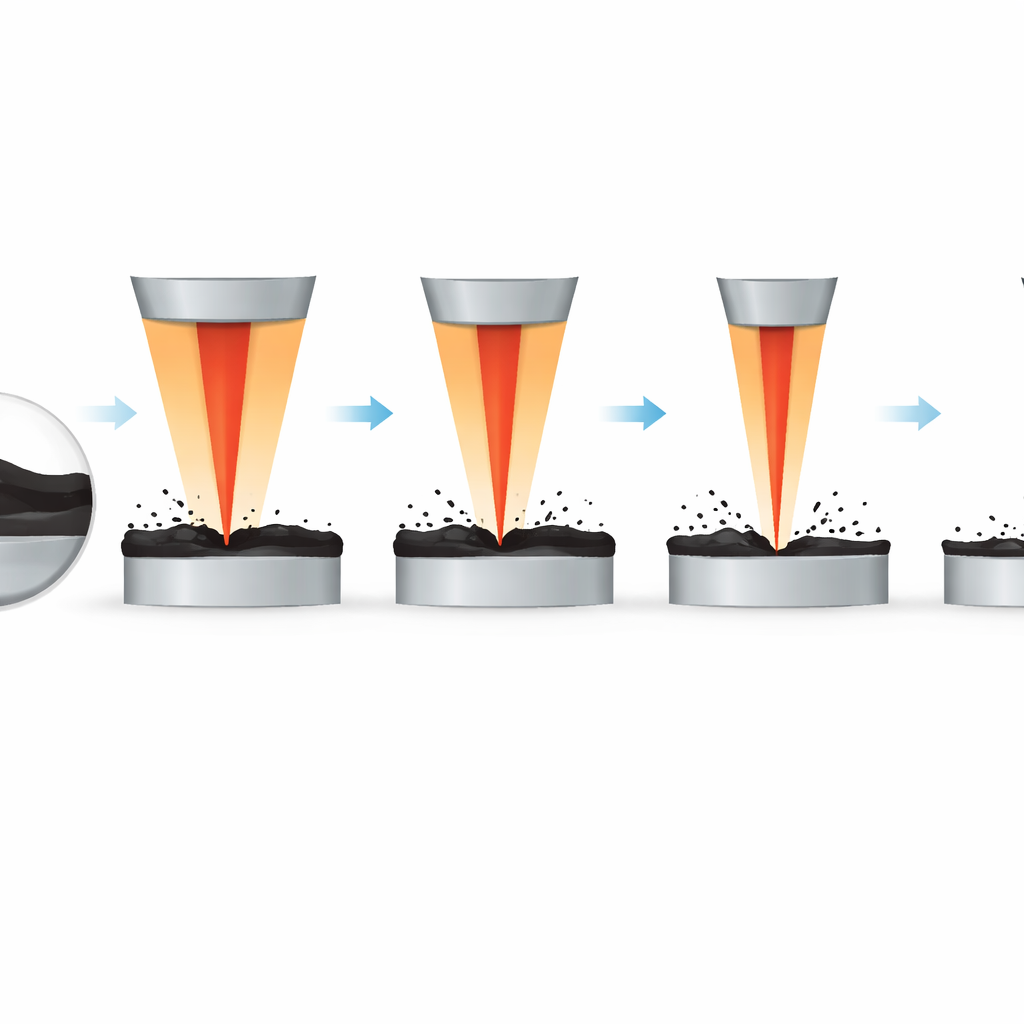
The researchers focused on a “hybrid” laser cleaning system that combines two kinds of industrial laser beams: a continuous beam that gently preheats and softens the carbon, and a pulsed beam that delivers short, powerful bursts to knock it away. They tested this approach on used pistons from a high‑mileage BMW engine, whose crowns were coated with carbon roughly the thickness of a human hair. Two simple measures defined success: how smooth the metal surface was after cleaning, and how much carbon remained. The challenge is that pushing the lasers too hard can strip carbon thoroughly but leave a rough, damaged surface; running them too gently protects the metal but leaves too much residue.
Letting the data do the tuning
Rather than adjusting laser settings by hand, the team turned to machine learning—computer models that learn patterns from data. From 81 carefully designed experiments, they recorded four key knobs on the cleaning system: the power of each laser, the speed at which the beam swept across the surface, and how often the pulsed beam fired. They then trained several types of models to predict surface smoothness and leftover carbon from these settings. A method called support vector regression performed best, especially after an extra round of “Bayesian” fine‑tuning of its internal parameters. With this improved model, the predictions of how much carbon would remain became much closer to the measured values.
Balancing clean surfaces and gentle treatment
Once they had reliable predictors, the authors used an evolutionary search method to hunt for the most promising laser settings. Instead of outputting a single “best” recipe, this search produced a family of solutions that trade off smoothness versus cleanliness. Some settings yielded extremely smooth piston crowns but left a bit more carbon; others drove the residue very low but at the cost of a slightly rougher finish. Within this family, the researchers highlighted three typical choices: a low‑roughness option, a low‑residue option, and a balanced setting between the two. When they tested the balanced recipe in fresh experiments, both the final roughness and remaining carbon were within 10 percent of the model’s predictions—good enough for real‑world shop tolerances.
What this means for engines and beyond
For a general reader, the takeaway is that shining lasers at dirty engine parts is only half the story. The real advance lies in using data and algorithms to steer those beams in an informed way. This study shows that even with a modest number of experiments, computers can help uncover operating “sweet spots” that human trial‑and‑error might miss, cutting waste and protecting components. The authors emphasize that their results apply within the specific conditions they tested and that larger datasets will be needed to generalize more broadly. Still, the work points toward a future in which cleaning and refurbishing high‑value parts—from car engines to aircraft components—can be made cleaner, safer, and more energy‑efficient by pairing advanced lasers with data‑driven optimization.
Citation: Su, Y., Hu, Y., Zhang, Q. et al. Multi-objective optimization of hybrid laser cleaning process parameters for carbon deposits based on bayesian-SVR and NSGA-II. Sci Rep 16, 8681 (2026). https://doi.org/10.1038/s41598-026-41748-0
Keywords: laser cleaning, engine carbon deposits, machine learning optimization, multi-objective design, surface roughness