Clear Sky Science · en
Quantification of smoking-related airway remodelling in COPD, using N-Tidal
Why this matters for everyday health
For people who smoke or used to smoke, one of the biggest worries is how much lasting damage has been done to their lungs—and whether trouble is brewing long before they feel short of breath. This study explores whether a simple handheld breathing test, using carbon dioxide in exhaled air, can reveal hidden changes in the airways caused by years of smoking. If successful, this approach could help doctors spot a dangerous turning point earlier, when prevention and quitting might still protect lung function.
A simple breath test with new power
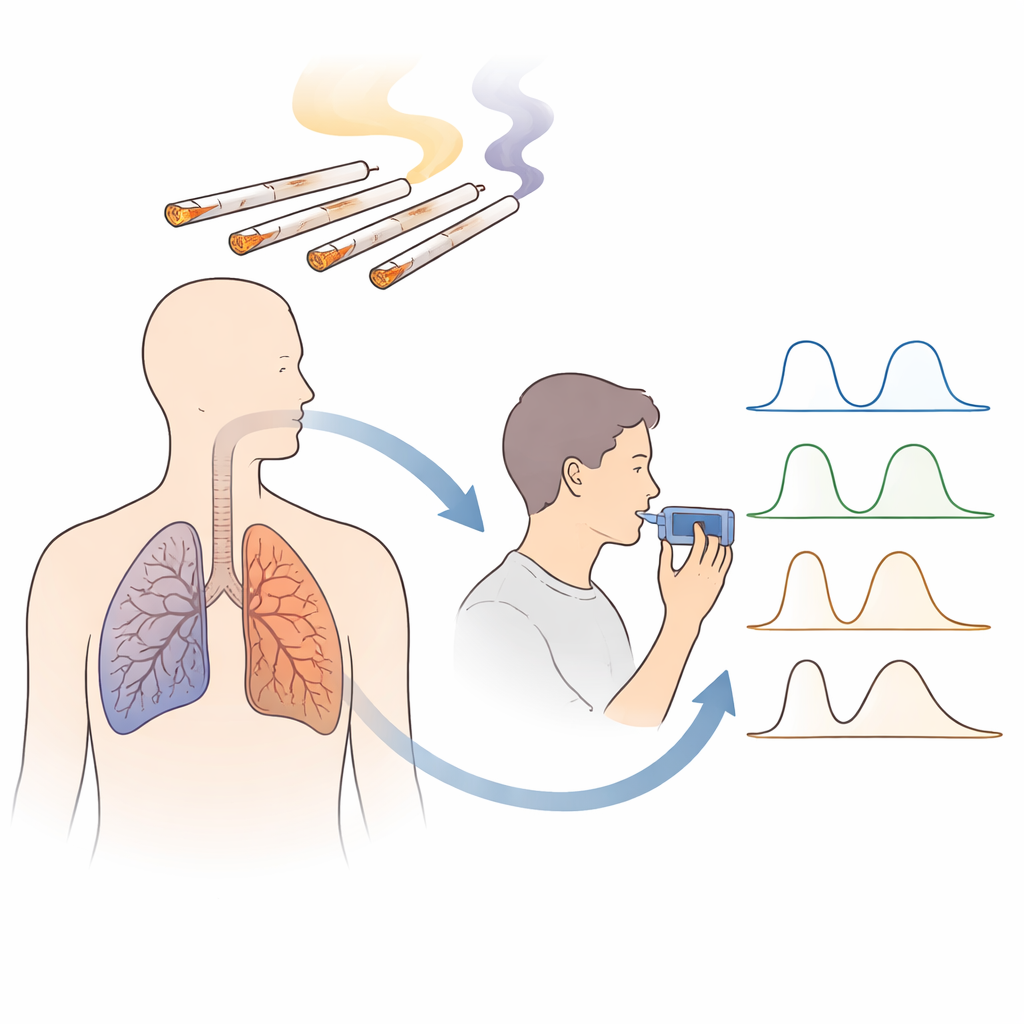
The researchers focused on capnography, a technique that records how carbon dioxide levels rise and fall in each breath. Traditionally used in operating rooms and intensive care, capnography has become more practical in daily life thanks to a portable device called N-Tidal. Patients with chronic obstructive pulmonary disease (COPD) used this device at home, breathing normally into a small handheld sensor for just over a minute, twice a day, for up to a year. From these repeated measurements, the team examined the detailed shape of each person’s breath waveform, looking for telltale signs of smoking-related injury inside the lungs.
Linking lifetime smoking to hidden airway damage
The study drew on data from 147 people in the United Kingdom with confirmed COPD, all diagnosed following national clinical guidelines. For each participant, the researchers collected medical histories, including “pack years” of smoking, a common way to capture lifetime exposure (for example, one pack a day for 25 years equals 25 pack years). They then zeroed in on a particular part of the capnography trace known as the alpha region—a bend in the curve that reflects how smoothly air moves from the larger breathing tubes into the tiny air sacs. Earlier work had suggested that this region becomes more curved as COPD worsens, making it a promising window into structural changes in the airways.
A tipping point in smoking exposure
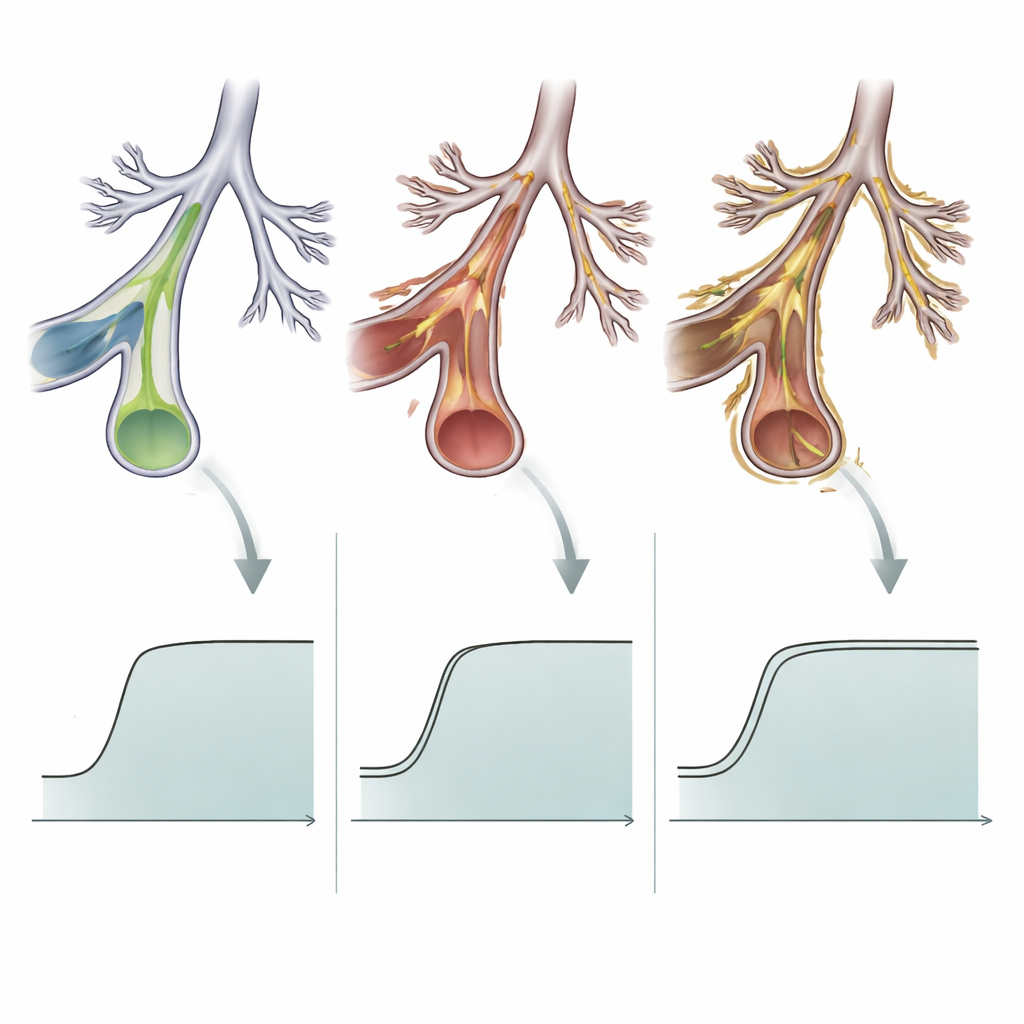
When the team compared the alpha-region features of the CO2 waveforms with each person’s pack years, a striking pattern emerged. The relationship was strongly positive but not straight-line: the curve steepened and then flattened out, with a clear inflection at around 25 pack years. Below this level, the waveform changes were smaller and more gradual. Above it, the signal shifted sharply, suggesting a threshold beyond which the lungs are much more likely to show permanent remodeling. People with over 40 pack years almost all showed markedly altered waveform shapes, consistent with widespread, uneven emptying of air from damaged airways.
Outperforming standard lung tests
The researchers also compared lifetime smoking exposure with standard breathing tests, including the familiar spirometry measures that require forcefully blowing into a tube. These conventional metrics did show that heavier smokers tended to have worse lung function, but the relationships were weak and nearly linear, with no obvious tipping point. In contrast, the CO2 waveform features from the N-Tidal device captured a much clearer and earlier shift in the lungs’ behavior. This suggests that carefully analyzing the shape of a relaxed breath may reveal structural injury that standard tests miss or detect only later in the disease.
What this could mean for smokers and clinicians
The study concludes that a portable capnography device can pick up smoking-related airway remodeling in people with COPD by reading subtle changes in the geometry of a single breath’s CO2 curve. Although the work focused on patients who already have COPD, it raises the possibility that similar measurements could one day be used to estimate a smoker’s risk of developing serious airway obstruction before symptoms become obvious. By highlighting a possible tipping point around 25 pack years, the findings hint at a window of opportunity for more targeted counselling, early intervention, and stronger motivation to quit, using a quick, noninvasive test that turns an ordinary breath into a powerful early warning signal.
Citation: Lim, R.H., Talker, L., Broomfield, H. et al. Quantification of smoking-related airway remodelling in COPD, using N-Tidal. Sci Rep 16, 8713 (2026). https://doi.org/10.1038/s41598-026-41699-6
Keywords: COPD, smoking, capnography, airway remodeling, early lung detection