Clear Sky Science · en
“Short-term effects of a single kangaroo mother care session on urinary allantoin and maternal–infant bonding in preterm neonates: a quasi-randomized controlled trial”
Why close contact matters for tiny newborns
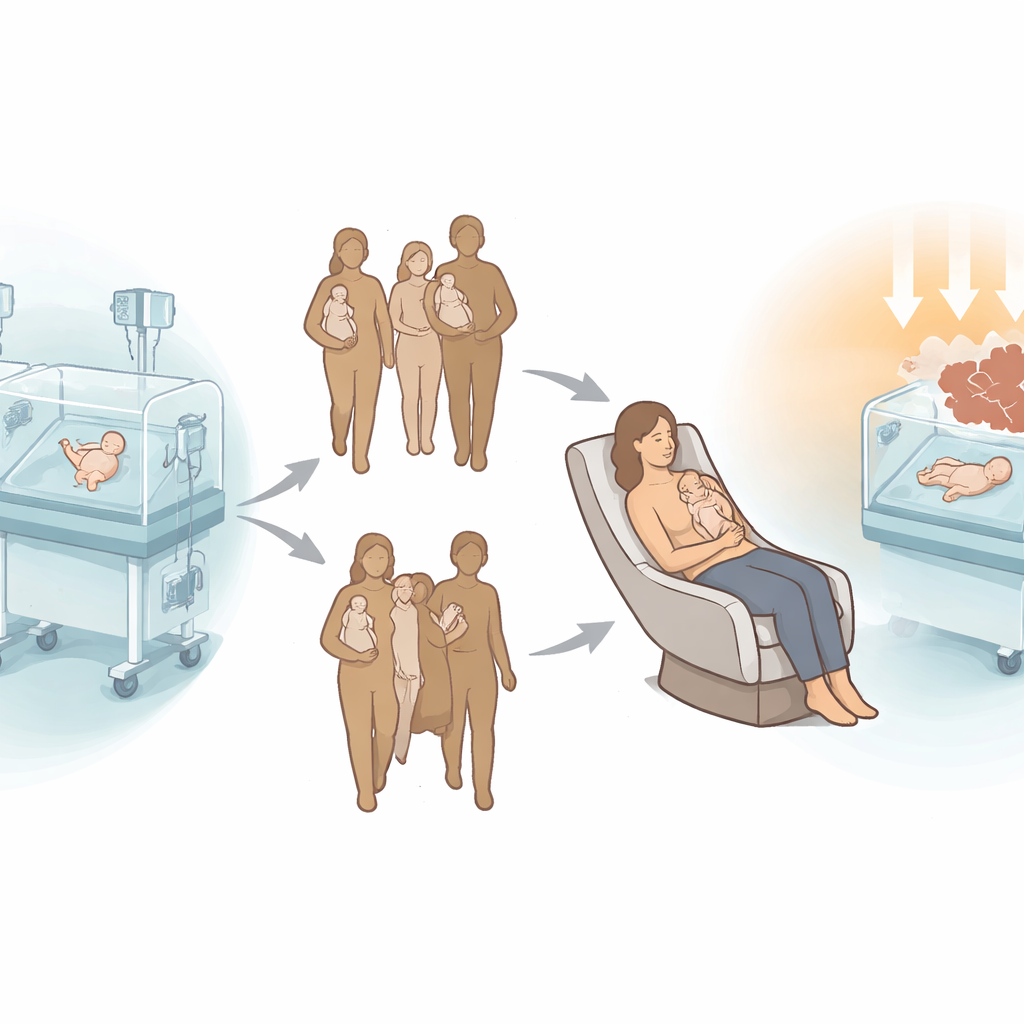
For many families, a baby born too early means weeks in a neonatal intensive care unit (NICU), where fragile infants lie in incubators surrounded by machines instead of in their parents’ arms. This study asks a simple but powerful question: can just one hour of chest-to-chest contact between a mother and her premature baby quickly calm the baby’s body and help the two feel more connected, even in this high‑tech setting? The answer, drawn from careful measurements in a Pakistani hospital, suggests that a single, brief session of “kangaroo mother care” may act like an instant reset button for both stress and bonding.
Premature birth and the strain of separation
Babies born weeks before their due date face an uphill battle. Their organs are still developing, and they are easily overwhelmed by bright lights, loud noises, and frequent medical procedures. To keep them safe, hospitals often place them in incubators and limit handling. While this protects the body, it can unintentionally pull mother and child apart at a time when emotional closeness is usually forming rapidly. Mothers may stand by helplessly, feeling guilt and worry, while babies miss the warmth, smell, and heartbeat that usually help them feel secure. In Pakistan and other low‑ and middle‑income countries—where premature birth is common and mental health support is scarce—finding simple ways to restore this closeness is especially urgent.
A simple touch-based approach
Kangaroo mother care is a low‑tech practice in which a diapered baby is held upright against a parent’s bare chest, usually under a light covering. Global health groups already recommend doing this for many hours a day to support growth and survival. But long daily sessions can be hard to implement in busy NICUs. The researchers behind this trial wanted to know whether even a single, one‑hour session could spark immediate benefits. They enrolled 40 pairs of mothers and moderately premature babies in a NICU in Lahore, Pakistan. Half of the babies continued with standard incubator care, while the other half spent one hour resting skin‑to‑skin on their mother’s chest on the third day after birth, in addition to usual care. Mothers and staff were guided carefully on positioning and safety, and babies’ breathing and temperature were closely watched.
Measuring stress inside tiny bodies
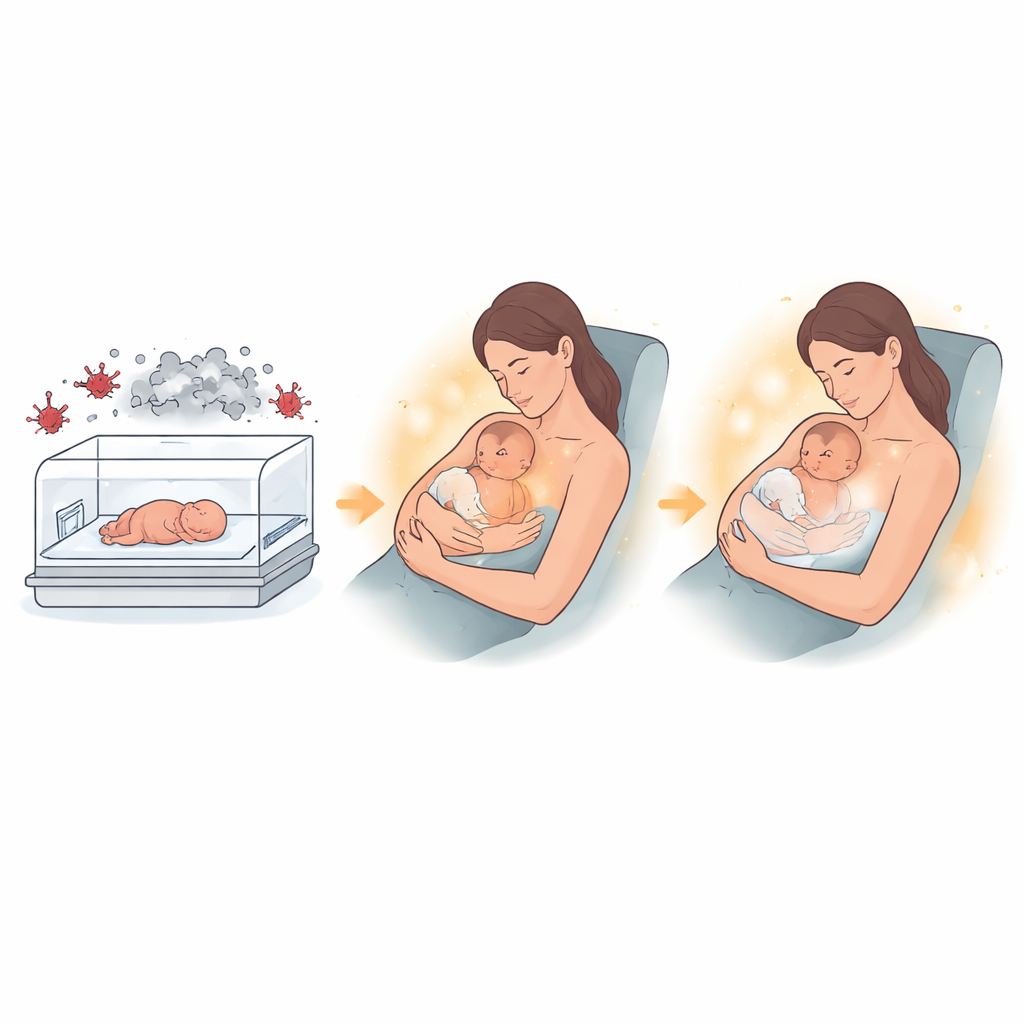
To move beyond impressions, the team looked for hard evidence inside the babies’ bodies. They used urine samples to measure allantoin, a substance that rises when the body is under “oxidative stress” — a kind of chemical wear and tear linked to unstable oxygen molecules. High oxidative stress has been tied to serious complications in premature infants. Because collecting urine is painless and simple, it offers a window into what the baby is experiencing without adding more procedures. The researchers also asked mothers to fill out a short questionnaire, before and after the hour, about how connected and affectionate they felt toward their baby. Higher scores meant more difficulty bonding.
Rapid shifts in body chemistry and feelings
Before the session, both groups of babies had similar levels of the stress‑linked urine marker, and mothers in both groups reported struggling with bonding—unsurprising in the intense NICU environment. One hour after the kangaroo care session, however, clear differences emerged. Babies who had been held skin‑to‑skin showed a marked drop in the stress marker, while those who stayed only in incubators showed no meaningful improvement. At the same time, mothers who practiced kangaroo care reported feeling far more connected and less emotionally distant from their babies than mothers in the standard‑care group. The size of these changes was striking, suggesting that even brief, focused contact can quickly calm fragile bodies and soften emotional barriers created by medical separation.
What this could mean for families and nurses
Because this was a small, single‑center study using a simple assignment method, the authors caution that the results should not be over‑interpreted as proof of long‑term benefit. Mothers also knew which group they were in, which may have influenced how positively they answered questions about bonding. Still, the work shows that nurses in a busy NICU can safely build short kangaroo care sessions into routine care and that these sessions may provide a fast, low‑cost way to ease both biological stress and emotional strain. For parents of premature babies, the message is hopeful and intuitive: even in the most technical of hospital settings, the warmth of a mother’s chest can act as powerful medicine—helping tiny bodies settle and hearts draw closer, one hour at a time.
Citation: Manzoor, S., Kausar, S., Hanif, A. et al. “Short-term effects of a single kangaroo mother care session on urinary allantoin and maternal–infant bonding in preterm neonates: a quasi-randomized controlled trial”. Sci Rep 16, 8636 (2026). https://doi.org/10.1038/s41598-026-41614-z
Keywords: kangaroo mother care, preterm infants, skin-to-skin contact, neonatal stress, mother–infant bonding