Clear Sky Science · en
Cholesterol–high-density lipoprotein–glucose index versus triglyceride–glucose-derived indices for predicting 10-year cardiovascular mortality in the MASHAD cohort
Why a Simple Blood Test May Reveal Hidden Heart Risk
Heart disease is still the world’s leading killer, and many people who seem only mildly unwell today may face serious trouble a decade from now. Doctors already measure cholesterol and blood sugar, but these numbers are often considered one by one. This study from Iran asked a practical question with big everyday implications: if we cleverly combine routine blood test results into a single score, can we better spot who is most likely to die from heart disease over the next 10 years?

Looking for Better Early Warning Signs
The researchers focused on insulin resistance, a condition in which the body’s cells stop responding properly to insulin and struggle to handle sugar and fats. Insulin resistance quietly drives many heart problems long before symptoms appear. Several shortcuts, or “surrogate indices,” have been created to estimate insulin resistance from common lab tests. One widely used shortcut is the triglyceride–glucose (TyG) index, and there are spin-off versions that also factor in body size and waist measurements. A newer contender, called the cholesterol–HDL–glucose (CHG) index, mixes total cholesterol, protective HDL cholesterol, and fasting blood sugar into a single number. Earlier work suggested CHG might be good at flagging type 2 diabetes and its complications. This study set out to see whether CHG can also predict who will die from heart disease more accurately than TyG-based scores.
Following Thousands of Adults for a Decade
The team drew on the Mashhad Stroke and Heart Atherosclerotic Disorder (MASHAD) cohort, a long-running study of adults aged 35 to 65 years in the city of Mashhad, Iran. From nearly 10,000 participants, they selected 7,467 people who had no history of heart disease at the start and had complete blood and follow-up data. Everyone had their height, weight, waist and hip size, blood pressure, and lifestyle habits recorded, and they fasted overnight before blood was drawn to measure fats and sugar. The researchers then tracked these individuals for at least 10 years, documenting deaths and classifying whether they were due to cardiovascular causes such as heart attack, stroke, or other vessel-related events, or due to any cause.
One Index Stands Out for Heart-Related Death
Over the follow-up period, 154 people died from cardiovascular causes and 359 from any cause. When the researchers grouped participants by CHG levels, those in the highest quarter of values were older, heavier, had higher blood pressure, worse blood fats, and higher blood sugar than those with the lowest values. They also experienced far more deaths. Using a range of statistical models that accounted for age, sex, smoking, kidney function, blood pressure, diabetes, cholesterol problems, and family history, the team found that each stepwise increase in CHG was linked to a substantial jump in the risk of dying from cardiovascular causes. When treated as a continuous score, CHG showed a roughly linear relationship with cardiovascular death: the higher the CHG, the higher the risk, with no sign of a safe plateau.
How CHG Compares with Older Blood-Based Scores
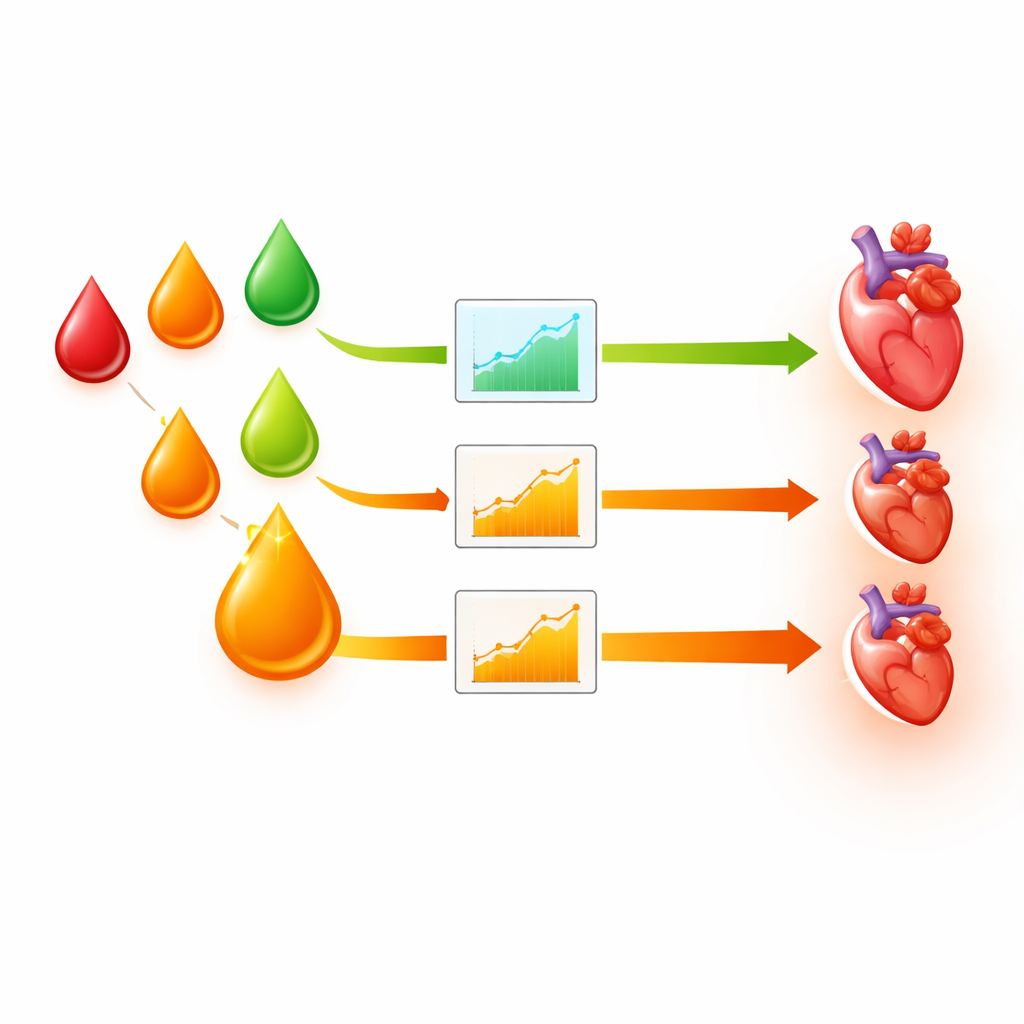
The investigators went further, directly pitting CHG against TyG and four TyG variants that blend in different obesity measures such as body mass index and waist-to-hip ratio. They evaluated how well each score separated those who would die from those who would not, how much extra information each added beyond traditional risk factors, and how useful each might be in real-world decision making. Across these tests, CHG consistently came out on top for predicting cardiovascular death: it had the highest ability to distinguish high- from low-risk individuals, improved risk reclassification more than competing scores, and contributed the largest share of the model’s explanatory power. Analyses that accounted for the competing risk of dying from non-heart causes, and checks for hidden biases, still pointed to CHG as the strongest cardiovascular mortality predictor among the indices tested.
Broader Mortality and Who Is Most at Risk
When the outcome was death from any cause, the picture was more mixed. While CHG levels were still linked to higher overall mortality, some TyG-based scores, especially those tied to waist and body size, performed slightly better for this broader outcome. Detailed curve-fitting suggested that for all-cause death, very low and very high CHG values might both carry risk, hinting at a more complex relationship. Subgroup analyses showed that CHG was a particularly strong warning sign among people with diabetes and those with reduced kidney function, but its link to cardiovascular death did not meaningfully differ by age, sex, smoking, or other major characteristics.
What This Means for Everyday Heart Health
In plain terms, this study suggests that a single number calculated from three routine blood tests—total cholesterol, HDL cholesterol, and fasting glucose—may offer a sharper early warning of fatal heart disease over the next decade than several older indices based on triglycerides and glucose. Because these tests are already part of standard checkups, calculating CHG would require no new procedures or expensive equipment. While more work is needed in diverse populations and to see how CHG responds to lifestyle and medical treatment, the findings support using this simple score as an additional tool to flag people whose “silent” metabolic problems put them on a collision course with deadly heart disease.
Citation: Tajik, A., Ghayour-Mobarhan, M., Darroudi, S. et al. Cholesterol–high-density lipoprotein–glucose index versus triglyceride–glucose-derived indices for predicting 10-year cardiovascular mortality in the MASHAD cohort. Sci Rep 16, 11193 (2026). https://doi.org/10.1038/s41598-026-41569-1
Keywords: insulin resistance, cardiovascular mortality, cholesterol and glucose index, risk prediction, cohort study