Clear Sky Science · en
Communication-free fault-tolerant control of distributed DC microgrid against sensor faults
Keeping the Lights On When Sensors Go Wrong
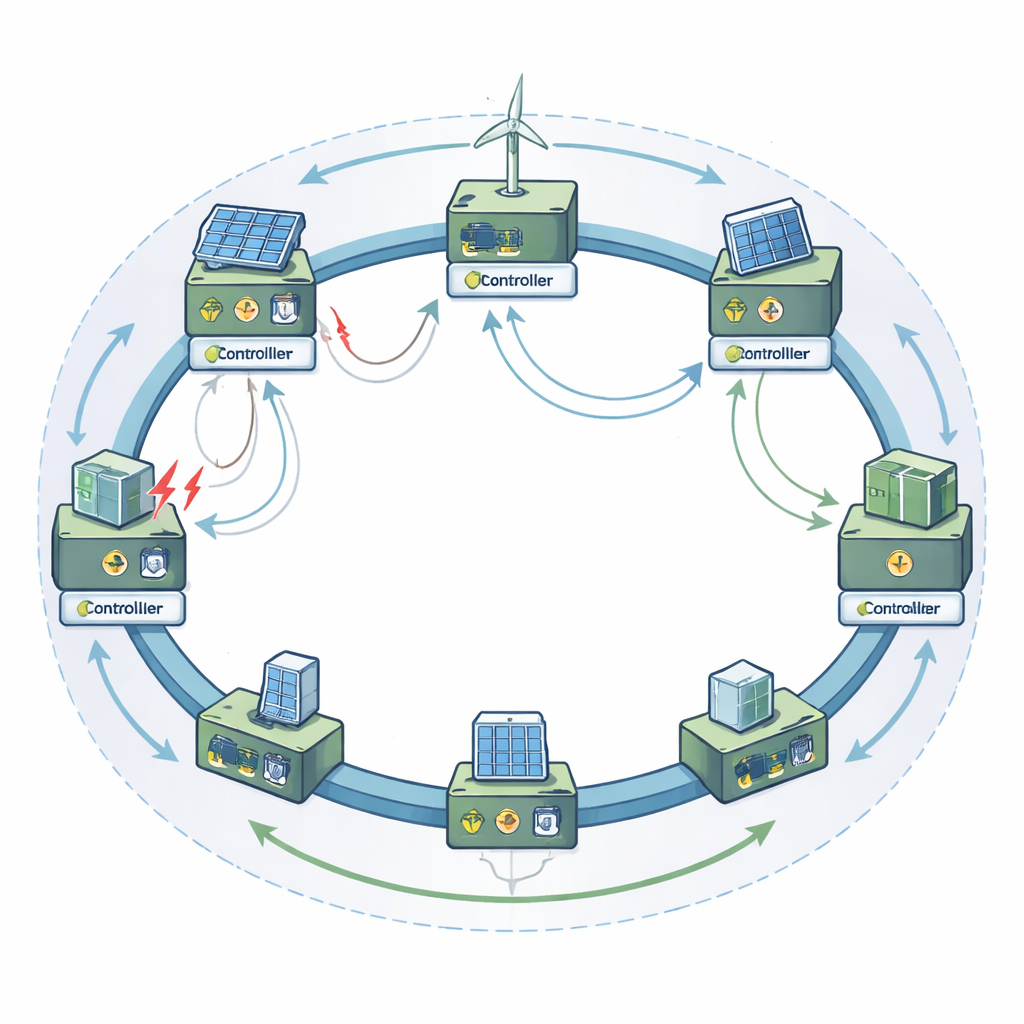
Modern ships, data centers, and even rural villages are increasingly powered by small, local direct-current (DC) grids that tie together solar panels, batteries, and electronic converters. These DC “microgrids” can be efficient and flexible, but they depend heavily on tiny devices—voltage and current sensors—to keep power levels safe and balanced. When those sensors misbehave, the entire system can wobble or even shut down. This paper introduces a way for DC microgrids to protect themselves from bad sensor readings in real time, without needing a central brain or constant communication between units.
Why Small DC Grids Matter
DC microgrids are gaining ground because they connect naturally to technologies like solar panels, batteries, and fast chargers, all of which already work with DC electricity. Compared with conventional alternating-current (AC) systems, DC setups can waste less energy and be easier to control. A typical DC microgrid links several local generation units—each with a source, a DC–DC converter, and nearby loads—through short cables. To operate safely, every unit must keep its local voltage within a narrow band and share the total demand fairly so that no single device is overloaded. That requires accurate measurements of voltage and current at each unit, fed to its controller and to the grid’s protection system.
When the “Eyes and Ears” Fail
In practice, sensors are imperfect. They age, drift, become noisy, or suddenly fail due to harsh environments or component wear. In DC microgrids, where protection devices can react within thousandths of a second, a biased or dead sensor can trigger unnecessary shutdowns, hide real faults, or cause one unit to take on far more load than it should. Earlier approaches tried to cope with such problems by adding extra hardware sensors, relying on multiple software observers, or using communication between units to cross-check data. These solutions tend to be costly, slower to respond, more complex, and vulnerable to cyberattacks or communication delays. Many also struggle when several sensors fail at once or when the fault pattern is irregular over time.
A Local “Sense-Correct-Act” Strategy
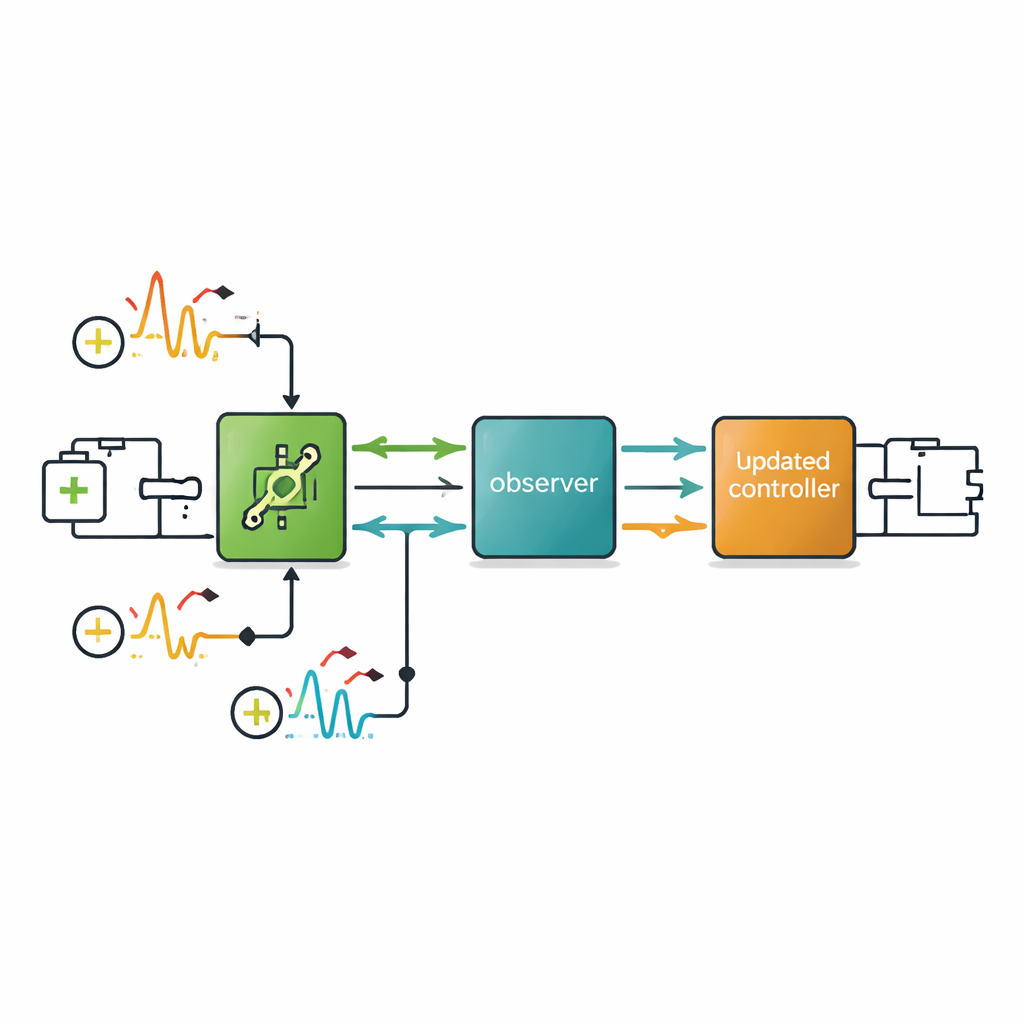
The authors propose a new control framework that lets each unit in a DC microgrid guard itself against faulty sensors using only its own measurements and parameters. At the heart of the method is a mathematical tool called a proportional–integral unknown input observer. In everyday terms, this is a smart filter that compares what a unit is measuring with what its internal model predicts should be happening. Any persistent mismatch is interpreted as a sensor fault rather than a real change on the grid. The observer estimates these fault signals for both voltage and current at the same time, even when several faults occur together or vary quickly. Crucially, it does this without asking neighbors for data, so it avoids communication bottlenecks and cyber risks.
Steering Power Safely Using Corrected Information
Once the observer has inferred how much each sensor is lying, the controller simply subtracts that error from the raw measurements. In effect, it reconstructs what a healthy sensor would have reported and feeds that into two layers of control: a passivity-based voltage controller that keeps the local voltage near its target, and a consensus-style algorithm that adjusts each unit’s output so that current sharing remains proportional to its rating. Because this design uses only local electrical values, each unit can be added or removed—so-called plug-and-play operation—without retuning the rest of the grid. The authors also refine the observer so that it ignores much of the random measurement noise that usually plagues power converters, making the fault estimates cleaner and more reliable.
Putting the Method to the Test
To see how well the scheme works, the researchers simulated a six-unit DC microgrid and subjected it to a series of challenging sensor problems: drifting readings, sudden jumps, time-varying distortions, and even complete loss of both voltage and current sensors at one unit. They also tested what happens when units are disconnected and reconnected while their sensors are faulty. Without fault compensation, these issues quickly spoiled voltage regulation, caused wild swings in current, and led to unfair power sharing. With the proposed framework active, the grid stayed stable, currents remained well balanced, and voltage stayed close to its targets. The system reacted on the order of millionths of a second to new faults and settled back to normal behavior within a few thousandths of a second. Real-time experiments using a hardware-in-the-loop setup confirmed that the method can run fast enough on practical platforms and outperforms a recent competing controller, especially for difficult, rapidly varying sensor faults.
What This Means for Future Power Systems
In everyday language, the authors have given DC microgrids a way to “see through” faulty instruments and keep operating smoothly, without needing extra hardware or a central overseer. Each unit carries its own lightweight fault-detection and correction layer, which cleans up bad readings on the fly and lets existing controllers continue doing their job as if nothing were wrong. This makes it easier to build modular, scalable, and cyber-resilient DC power systems that can tolerate the messy realities of real-world sensors. As DC microgrids spread into ships, buildings, charging stations, and remote communities, such self-protecting control schemes could play a key role in keeping power reliable even when some of the grid’s eyes and ears go bad.
Citation: Ouahabi, M.S., Benyounes, A., Barkat, S. et al. Communication-free fault-tolerant control of distributed DC microgrid against sensor faults. Sci Rep 16, 8591 (2026). https://doi.org/10.1038/s41598-026-41518-y
Keywords: DC microgrids, fault-tolerant control, sensor faults, distributed control, renewable energy systems