Clear Sky Science · en
Decrypting chaotic visual ciphers via quasi quantum neural networks (Q²NNs)
Breaking Hidden Pictures
Every day, our phones and computers silently scramble photos and messages to keep them safe from prying eyes. But as attackers gain access to more powerful tools, including future quantum computers, today’s protections may no longer be enough. This paper explores a new way to "read" extremely scrambled pictures using a blend of classical artificial intelligence and ideas borrowed from quantum physics, pointing toward smarter security systems—and smarter attacks—of tomorrow.
From Simple Digits to Wildly Scrambled Images
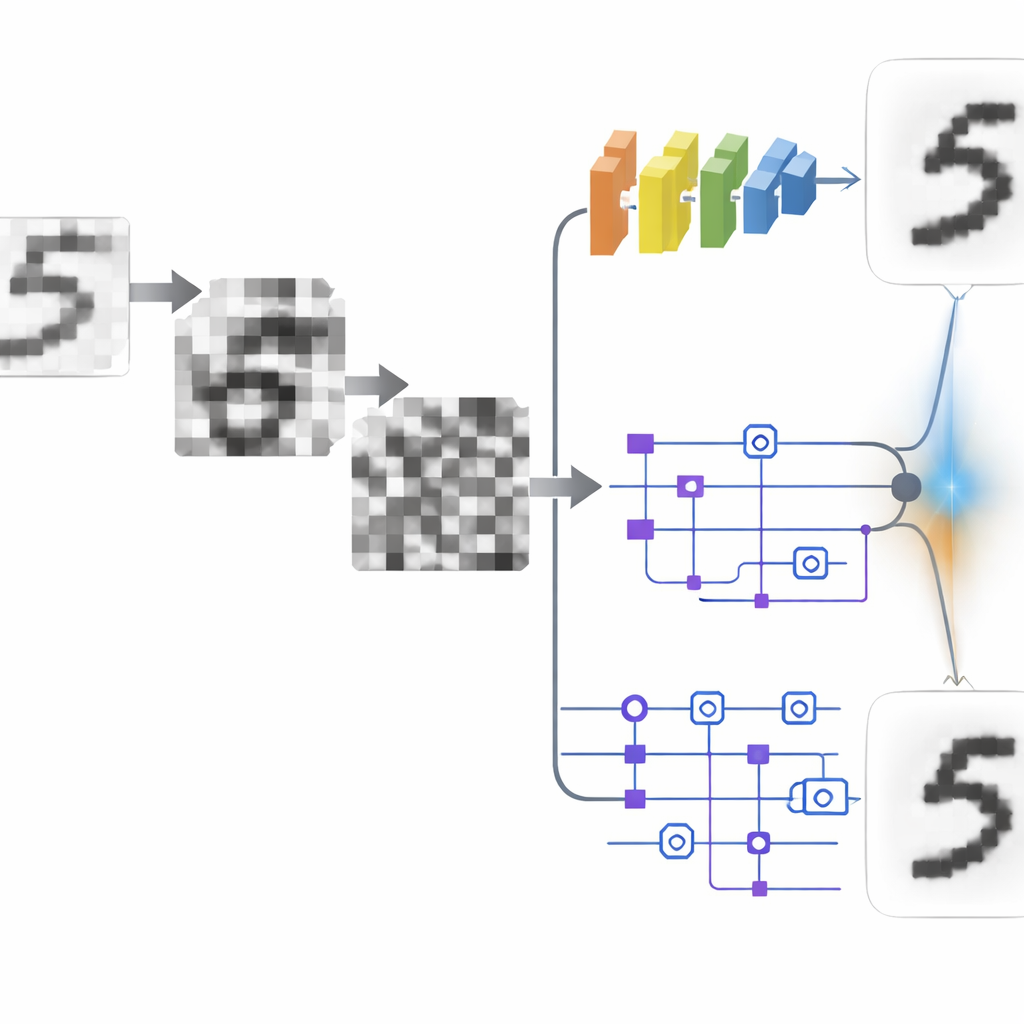
The researchers start with a familiar testbed: tiny, 28-by-28 pixel images of handwritten digits, similar to what’s used to train basic handwriting recognizers. Instead of classifying these digits, they first run them through a deliberately brutal scrambling process meant to mimic a strong visual cipher. Pixels are shuffled around the image using a map that behaves chaotically, their brightness values are altered using a sensitive mathematical sequence, and finally the resulting pixels are reordered again along a zigzag path. The outcome is a noisy square that looks like random static, with almost no trace of the original "1," "5," or "8" to the naked eye.
A Two-Track Brain: Classical and Quantum Together
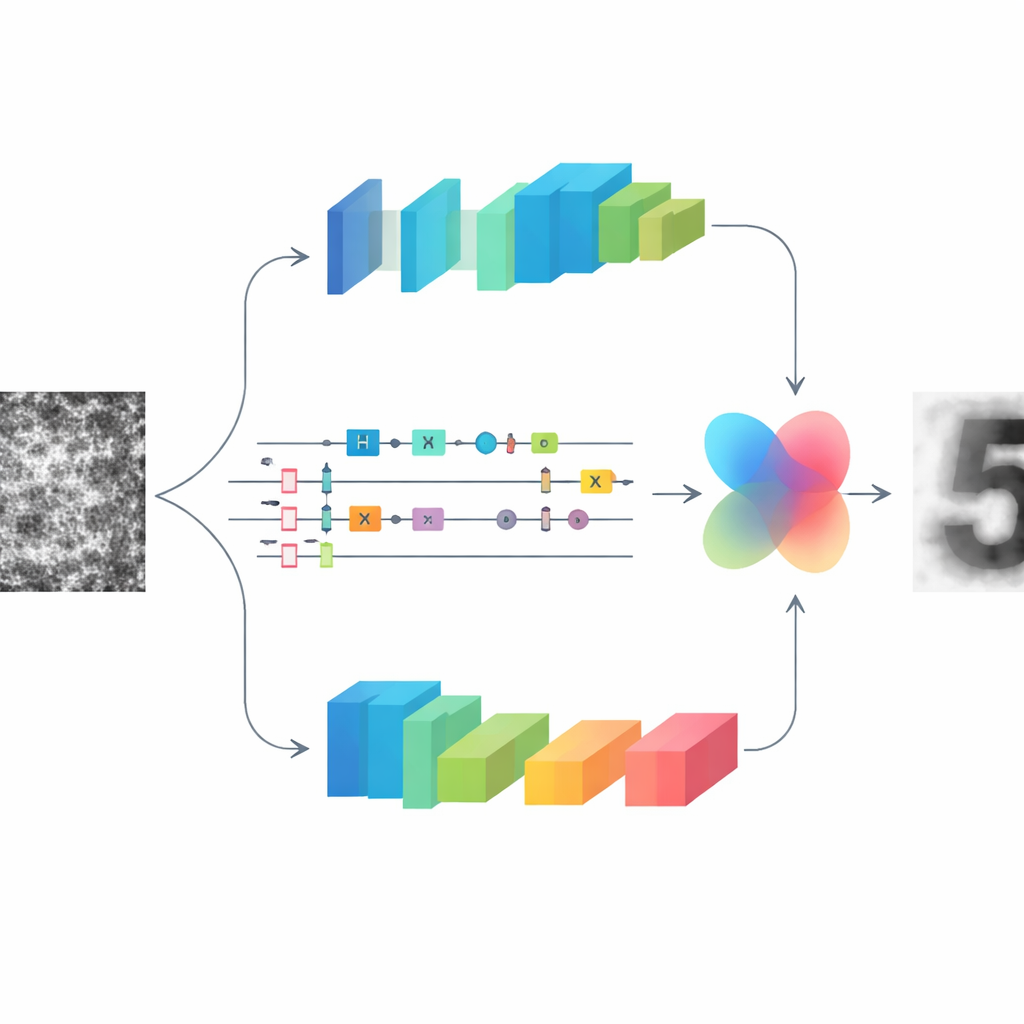
To recover the original image from this chaos, the team does not try to mathematically "undo" the cipher. Instead, they treat decryption as a learning problem. They build a hybrid model they call a quasi-quantum neural network, or Q²NN. Encrypted images are fed into two paths in parallel. One path is a conventional convolutional autoencoder, a type of deep network good at finding local shapes and textures. The other path mimics the behavior of a small quantum circuit: the image is compressed into a short numeric vector, encoded as rotations of virtual qubits, entangled through a trainable circuit, and then measured back into a new set of features. These two reconstructions are then blended by a learnable "fusion" unit that decides, during training, how much to trust each branch at every pixel.
Learning to See Through Chaos
The model is trained with many pairs of scrambled and original images, slowly adjusting its internal knobs so that its output matches the clean digit as closely as possible. To judge success, the authors look not only at raw pixel error but also at a measure of perceived structure, asking: does the reconstruction preserve shapes and contrasts that matter to human eyes? On all three tested digit classes, the hybrid network handily beats a purely classical network and a purely quantum-inspired one. It achieves extremely low reconstruction errors and high structural similarity scores, meaning the decrypted digits look almost indistinguishable from their originals, even though the inputs resemble pure noise.
Testing the Strength of the Cipher
Of course, a clever decryption model is impressive only if the cipher itself is genuinely hard to crack. The authors therefore stress-test their chaotic encryption pipeline using standard cryptographic statistics. The scrambled images have nearly maximum randomness according to Shannon’s entropy, neighboring pixels are essentially uncorrelated, and tiny changes in the original image cause large, widespread changes in the encrypted version. These numbers are on par with, or better than, other state-of-the-art chaos-based image ciphers, confirming that the task posed to the neural network is far from trivial.
Why This Matters for Future Security
Seen from a high level, the study shows that a carefully designed mix of classical deep learning and quantum-style processing can learn to reverse very complicated visual scrambling without ever being given the exact key or formula for the cipher. Today, this is demonstrated on small grayscale digits and simulated quantum circuits, but the same ideas could extend to medical images, satellite photos, or secure optical links—anywhere scrambled pictures must be reliably reconstructed. As quantum hardware matures, similar hybrid designs could underpin both stronger defenses and more capable analytical tools in the post-quantum era, where understanding and controlling what can be learned from encrypted data will be crucial.
Citation: Manavalan, G., Arnon, S. Decrypting chaotic visual ciphers via quasi quantum neural networks (Q²NNs). Sci Rep 16, 9937 (2026). https://doi.org/10.1038/s41598-026-41513-3
Keywords: image encryption, quantum neural networks, hybrid AI, chaotic cryptography, post-quantum security