Clear Sky Science · en
Risk assessment for type 2 diabetes mellitus and its association with knowledge and health beliefs among university students in three Arab countries
Why this matters for young adults
Type 2 diabetes is often seen as a disease of middle and older age, yet many of the habits that set it in motion begin much earlier. This study looks closely at university students in Egypt, Saudi Arabia, and Yemen to see how likely they are to develop type 2 diabetes, how much they know about it, and what they believe about preventing it. Understanding these patterns in young adults can show where early action might stop a lifelong illness before it starts. 
Young people at a crossroads
University life marks a turning point in how young people eat, move, sleep, and cope with stress. The researchers surveyed 2,787 students aged 18 and older from at least three universities in each of the three countries. About three-quarters of participants were women and a little over half were enrolled in medical faculties. Using structured interviews, the team collected information on students’ age, sex, body measurements, family background, and field of study. They then applied three established tools: a questionnaire on diabetes knowledge, a scale that captures beliefs about health and prevention, and a screening score that estimates a person’s chance of developing type 2 diabetes in the next few years.
What students know and believe
The study found that most students had at least a basic grasp of diabetes, but there were striking differences between countries and groups. Egyptian students showed the strongest knowledge, with nearly three out of four reaching the “good knowledge” range, compared with roughly two-thirds in Saudi Arabia and a little under 60% in Yemen. Students in higher academic years and those studying medicine scored better, as did those whose parents were more educated and whose families had more stable incomes. Women generally knew more about diabetes and expressed stronger beliefs in the value of healthy behaviors, such as regular exercise and balanced eating. These findings suggest that both education and economic stability help young people understand health risks and believe they can do something about them.
Who faces the greatest diabetes risk
When it came to actual risk of developing type 2 diabetes, the picture changed. Yemeni students were the most vulnerable: more than one in five fell into the severe-risk category, a higher share than in Egypt or Saudi Arabia. Across the whole sample, being male, older within the student age range, or having a higher body mass index all pushed risk upward. Students in non-medical faculties and those from families with lower income or less parental education were more likely to have elevated risk scores. The study also found that advancing through university years was linked not only to better knowledge and stronger health beliefs, but also to slightly lower diabetes risk, hinting that time in higher education can be protective—especially when it includes exposure to health information. 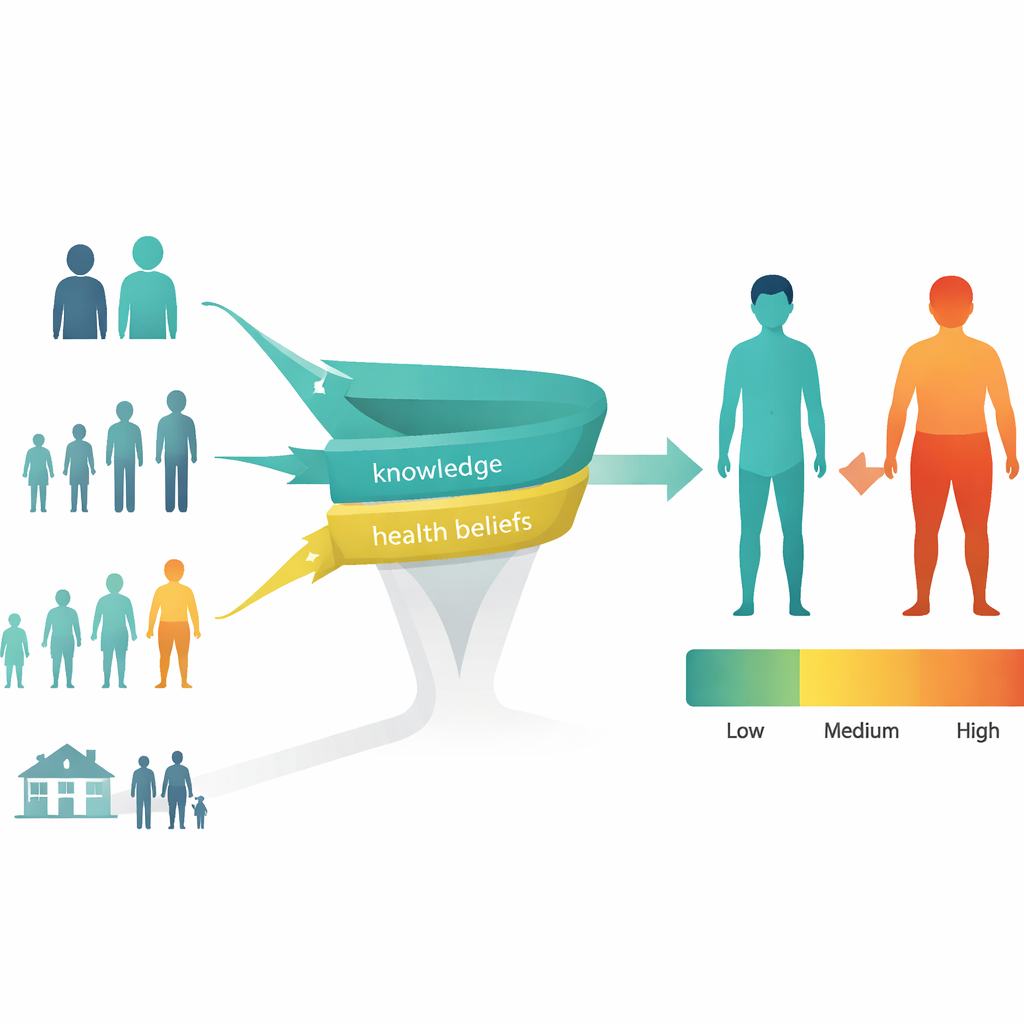
How knowledge and beliefs interact with risk
Interestingly, the link between what students knew and their estimated diabetes risk was weak. Knowledge and positive health beliefs were strongly connected to each other—students who understood diabetes better were also more likely to believe in prevention and to see themselves as potentially at risk. But these mental factors translated only modestly into a lower risk score, which is driven mainly by age, sex, weight, and family and lifestyle patterns. This suggests that simply knowing about diabetes is not enough: students also need supportive environments, affordable healthy food, safe spaces to be active, and campus cultures that make healthy choices easier than unhealthy ones.
What this means for prevention
Overall, the study shows that even “apparently healthy” university students can be on a path toward type 2 diabetes, especially young men, students outside medical fields, those with higher body weight, and those living in tougher economic conditions—particularly in Yemen. For a lay reader, the conclusion is straightforward: many future cases of diabetes could be avoided if universities and health systems act early. That means weaving practical diabetes education into courses, organizing campus health campaigns, and improving access to exercise opportunities and nutritious food. By focusing on high‑risk groups and tailoring efforts to each country’s resources, these Arab universities could help a generation of students build healthier habits now and greatly cut their chances of facing diabetes later in life.
Citation: Ahmed, H.A.A., Yousef, A., Abdelwahab, S.M. et al. Risk assessment for type 2 diabetes mellitus and its association with knowledge and health beliefs among university students in three Arab countries. Sci Rep 16, 10367 (2026). https://doi.org/10.1038/s41598-026-41511-5
Keywords: type 2 diabetes risk, university students, Arab countries, health beliefs, diabetes prevention