Clear Sky Science · en
Study on sound insulation performance of walls in traditional timber dwellings of the Miao ethnic group in Qiandongnan
Why quiet old wooden homes matter today
Imagine living in a centuries‑old wooden house perched on a misty hillside, rich in family stories and cultural meaning—but thin walls let in traffic, voices and music from every side. This study explores whether the traditional timber houses of the Miao ethnic group in Southwest China can still provide the peace and privacy people expect in modern life, and how to improve their sound insulation without losing their distinctive appearance.

Homes on the mountain
The research focuses on Jidao Village in Qiandongnan, a mountainous region where Miao families have built stilted timber houses for hundreds of years. These dwellings are raised on wooden columns to avoid damp ground and follow the slope in terraces, with three typical layouts: linear rows along the hillside, L‑shaped clusters around a corner courtyard, and U‑shaped courtyard houses that nearly enclose an inner yard. All are built mainly from locally grown Chinese fir planks only about 2 centimeters thick, a simple and economical method that has worked well for structure and climate, but whose acoustic performance had not been systematically tested.
How the sound tests were done
To understand how well these walls block noise, the team combined on‑site measurements with acoustic calculations. They selected six inhabited traditional houses in Jidao and two newly built timber houses that mimic local forms, one linear and one L‑shaped. For each dwelling they measured three wall types: exterior walls facing the outdoors, bedroom walls, and other internal partitions. A special loudspeaker outside or in a neighboring room produced broad‑band noise while precise meters recorded sound levels on both sides of each wall. By also measuring how long sound reverberated in the rooms, the researchers could calculate standard sound insulation ratings across frequencies from low rumbles (100 Hz) to higher‑pitched speech (3150 Hz).
What they found inside the walls
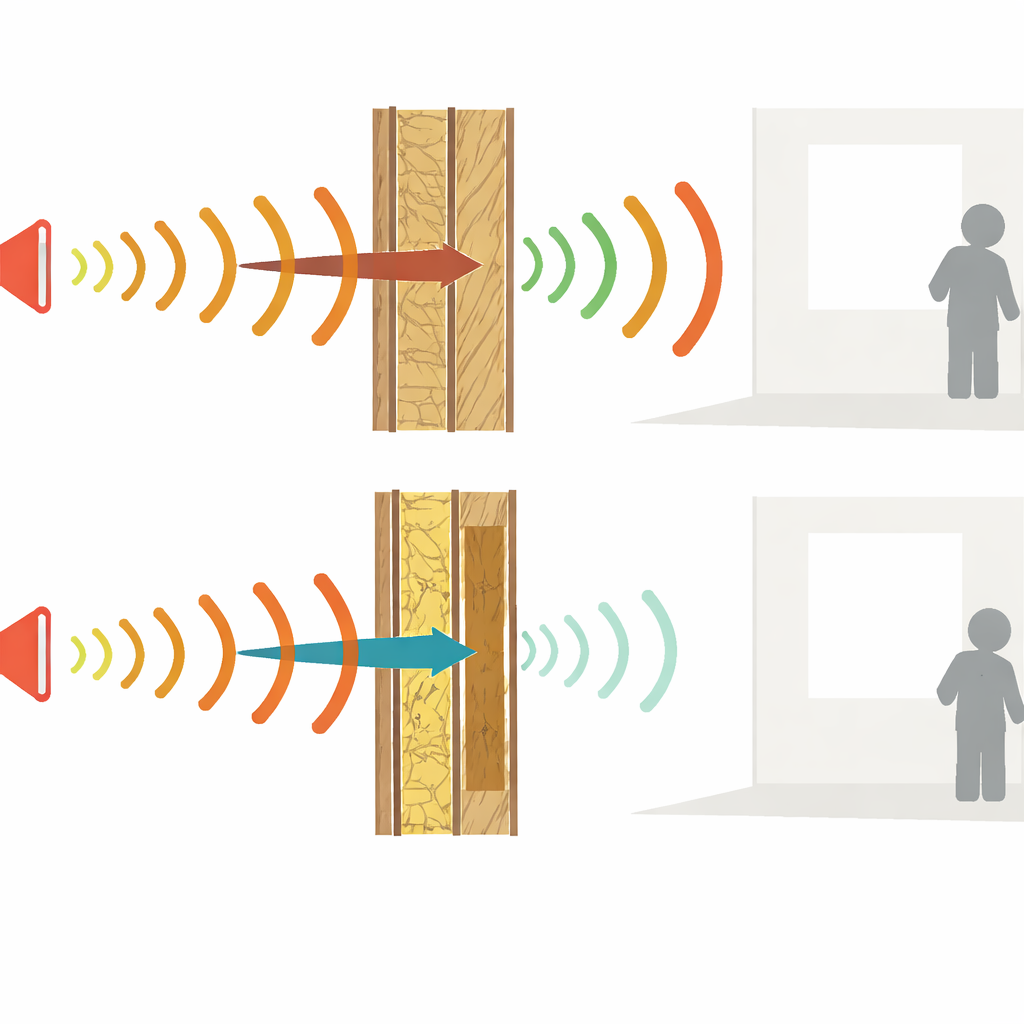
The results reveal a clear pattern. Traditional single‑plank walls, regardless of house layout, provide fairly weak sound insulation, with typical ratings around 21–26 decibels—well below the 35–45 decibels usually recommended for comfortable housing. These thin fir walls are especially poor at blocking low‑frequency noise, where vibration of the panels dominates and measured performance fluctuates strongly. In contrast, the new L‑shaped dwelling that uses a double layer of timber with a 3‑centimeter rock wool infill consistently outperforms all others: about 33.5 decibels for exterior and other internal walls and 37 decibels for bedroom walls, more than 30 percent better than traditional constructions.
Shape of the house versus build of the wall
House layout still matters, but less than one might think. Among the traditional dwellings, exterior walls in U‑shaped courtyard houses perform slightly better than those in L‑shaped and linear types, gaining roughly 2 decibels from the way enclosed courtyards scatter and weaken outdoor noise before it hits the walls. However, for interior walls, the overall shape of the building makes almost no difference; their performance is governed mainly by wall thickness, material condition, and how well joints are sealed. By comparing traditional and new houses, the authors estimate that only about 2 decibels of the roughly 11‑decibel improvement in the best new dwelling comes from changing the layout from linear to L‑shaped; the remaining 9 decibels stem from upgrading the wall into a composite system with a sound‑absorbing core.
Old timber, aging, and cultural wisdom
The study also shows that age and maintenance subtly change how walls behave. In older houses, the measured "weak spots" in sound insulation shift to lower frequencies than theory predicts, which the authors link to tiny cracks, insect damage, and moisture softening the wood over decades. At the same time, Miao builders historically compensated for thin walls using cultural and spatial strategies: accepting some domestic sounds as part of family life, and using more enclosed layouts to create quieter inner zones. Yet even with these adaptations, traditional walls usually reach only about 28–32 decibels—adequate in a quieter past, but insufficient amid modern traffic, machinery, and appliances.
Bringing peace and quiet to heritage homes
For readers, the key takeaway is that cherished timber villages need more than charm to remain livable in a noisy world. This research shows that carefully adding thickness and a hidden layer of sound‑absorbing material inside existing fir plank walls can greatly improve quietness, while small gains come from choosing more enclosed house forms. The authors argue for a "construction‑first, form‑assisted" strategy: keep the recognizable appearance of Miao dwellings, but discreetly retrofit walls, doors, and windows so that bedrooms and living spaces approach modern sound insulation standards. In doing so, communities can preserve the spirit of their wooden heritage while enjoying the privacy and acoustic comfort that contemporary life demands.
Citation: Huang, X., Zhao, W., Huang, Z. et al. Study on sound insulation performance of walls in traditional timber dwellings of the Miao ethnic group in Qiandongnan. Sci Rep 16, 8690 (2026). https://doi.org/10.1038/s41598-026-41450-1
Keywords: sound insulation, timber dwellings, Miao vernacular architecture, acoustic retrofitting, rock wool walls