Clear Sky Science · en
Exploring early-stage orienting behavior using an eye tracker for attention deficit hyperactivity disorder classification
Why where we look can reveal hidden attention problems
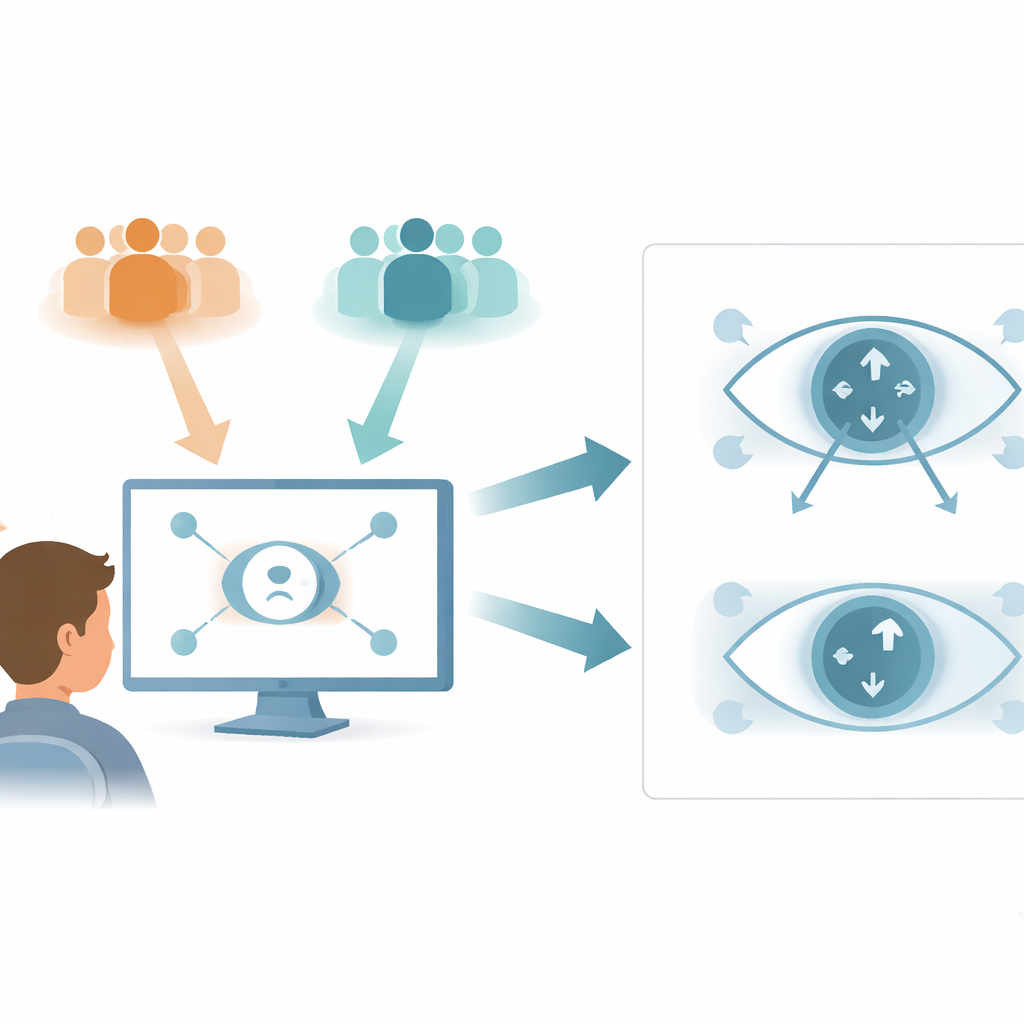
Parents and teachers often notice that some children seem mentally "elsewhere" even during simple tasks. Traditional attention tests look at how quickly or accurately a child presses a button, but these tests may miss subtle differences in how attention actually moves around a scene. This study asks a simple question with powerful implications: by watching exactly where children’s eyes move in an easy visual game, can we detect early signs of attention deficit hyperactivity disorder (ADHD) more clearly than with button‑press data alone?
A simple looking game with a hidden purpose
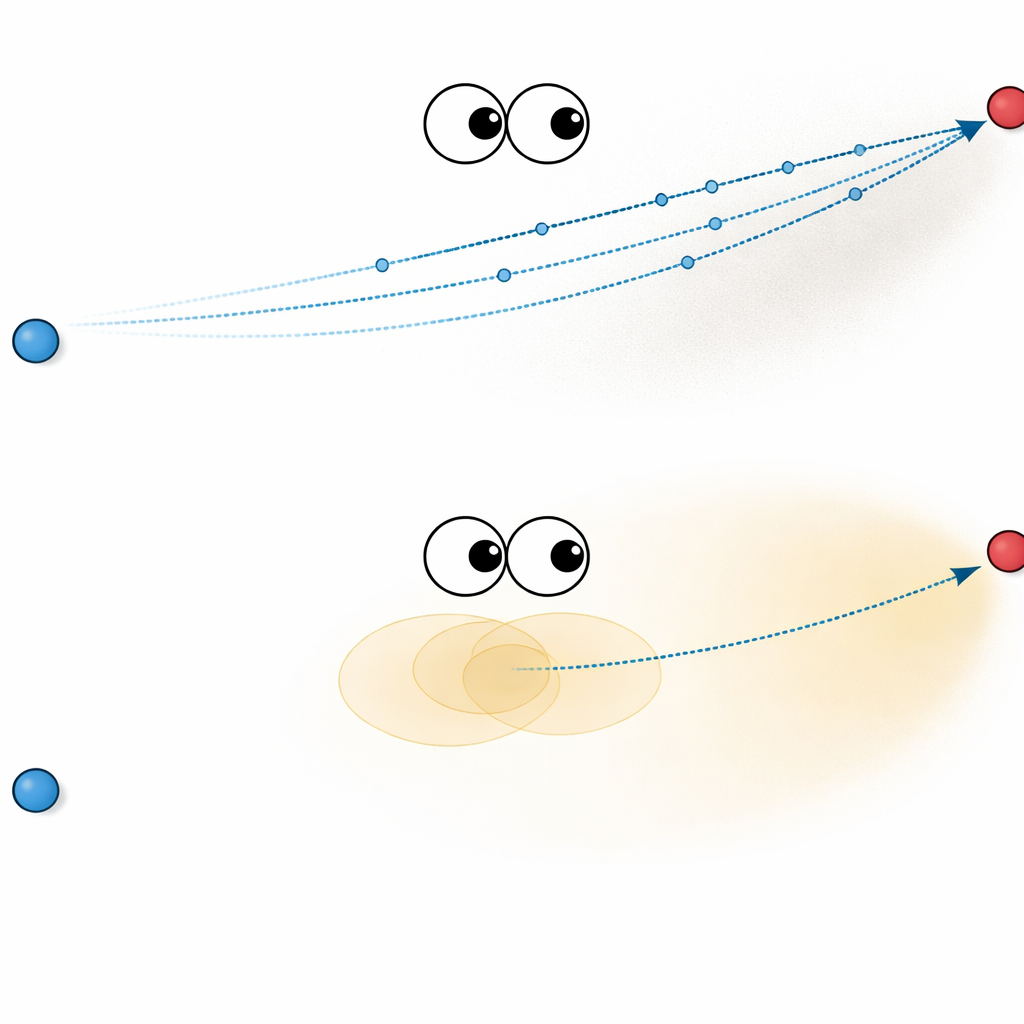
The researchers invited early elementary school children, some diagnosed with ADHD and others typically developing, to play what was described as a "red‑dot finding game." On each trial, a face or an arrow appeared in the center of a computer screen and pointed toward one of the four corners. After a brief delay, a red dot (the target) and a blue dot (a distractor) appeared in two corners. Children were told to look at the center, then shift their gaze to the red dot and press a key that matched its location. While the task seemed straightforward and low‑stress, a high‑speed eye tracker recorded every tiny eye movement, allowing the team to see not just whether the children were right or wrong, but how their eyes searched for the target from moment to moment.
Comparing attention in children with and without ADHD
When the researchers compared 19 children with ADHD to 27 typically developing peers, they saw only modest differences in traditional measures like button‑press accuracy and reaction time, especially given how easy the game was. In contrast, the eye‑movement data told a much richer story. Typically developing children tended to make more frequent and faster eye movements from the cue toward the target, with gaze positions spreading more widely across the screen. Children with ADHD, by comparison, showed fewer eye movements and spent more time holding their gaze in one place during the critical target‑detection window. They were also less likely to follow the cue’s direction in a smooth way, and more often seemed to detect the target without clearly looking directly at it.
What eye movements reveal about hidden effort
By feeding both behavioral and eye‑tracking features into statistical models, the authors tested how well different types of data could separate children with ADHD from their peers. Models based only on button‑press behavior did reasonably well, but models that used eye‑movement features—such as the number of saccades (quick jumps of the eyes), the spread of gaze, and how often children followed the cue—performed noticeably better. In fact, eye data alone predicted group membership almost as accurately as a combined model that used both eye and button‑press measures. One measure stood out: how long each fixation lasted during target detection. Children with ADHD had reliably longer fixations, even though their overall reaction times were similar. This prolonged "staring" away from the target strongly tracked clinical ratings of both inattention and hyperactivity.
Relying on side vision instead of direct looks
The study also examined how children used social cues (a pair of eyes) versus non‑social cues (arrows), and how they shifted their attention in these different settings. Typically developing children more often showed smooth "joint attention"—their gaze moved from the central face to the location it indicated. Children with ADHD showed fewer such responses and, instead, were more likely to keep fixating on the central face while still responding correctly, suggesting greater reliance on peripheral, or side, vision. This pattern was especially pronounced in low‑distraction conditions, implying that even when the environment is simple, children with ADHD may be less inclined to actively explore with their eyes and more likely to passively detect events around the edges of their vision.
What this means for understanding and screening ADHD
To a layperson, these findings suggest that ADHD is not just about being restless or easily bored; it also involves subtle differences in how the eyes and brain coordinate attention, even during very simple tasks. Longer pauses of the eyes in the wrong place and heavier reliance on peripheral vision point to a kind of "sticky" attention that is slower to move where it needs to go. Because these patterns can be picked up by an eye tracker in a brief game, they could serve as early behavioral markers that complement, rather than replace, clinical interviews and questionnaires. In the future, such gaze‑based tests might help identify children who struggle with attention earlier and more objectively, guiding more timely support at home and in the classroom.
Citation: Lee, S., Lee, S., Jeong, I. et al. Exploring early-stage orienting behavior using an eye tracker for attention deficit hyperactivity disorder classification. Sci Rep 16, 8671 (2026). https://doi.org/10.1038/s41598-026-41419-0
Keywords: ADHD, eye tracking, child attention, gaze behavior, early screening