Clear Sky Science · en
Quantum feedback-enhanced discord in T-shaped plasmonic waveguides with embedded cavity
Why tiny light circuits matter
Our everyday electronics are built from wires that guide electric currents. Now imagine circuits that guide single particles of light instead, and use them to store and process information in ways ordinary computers cannot. This paper explores how to keep fragile quantum links alive inside an ultra-small "T-shaped" light circuit made of metal nanowires and tiny artificial atoms. The authors show that by carefully shaping the structure and adding an active feedback loop—much like a thermostat for quantum effects—they can strengthen and protect subtle quantum connections called "discord," even at room temperature.
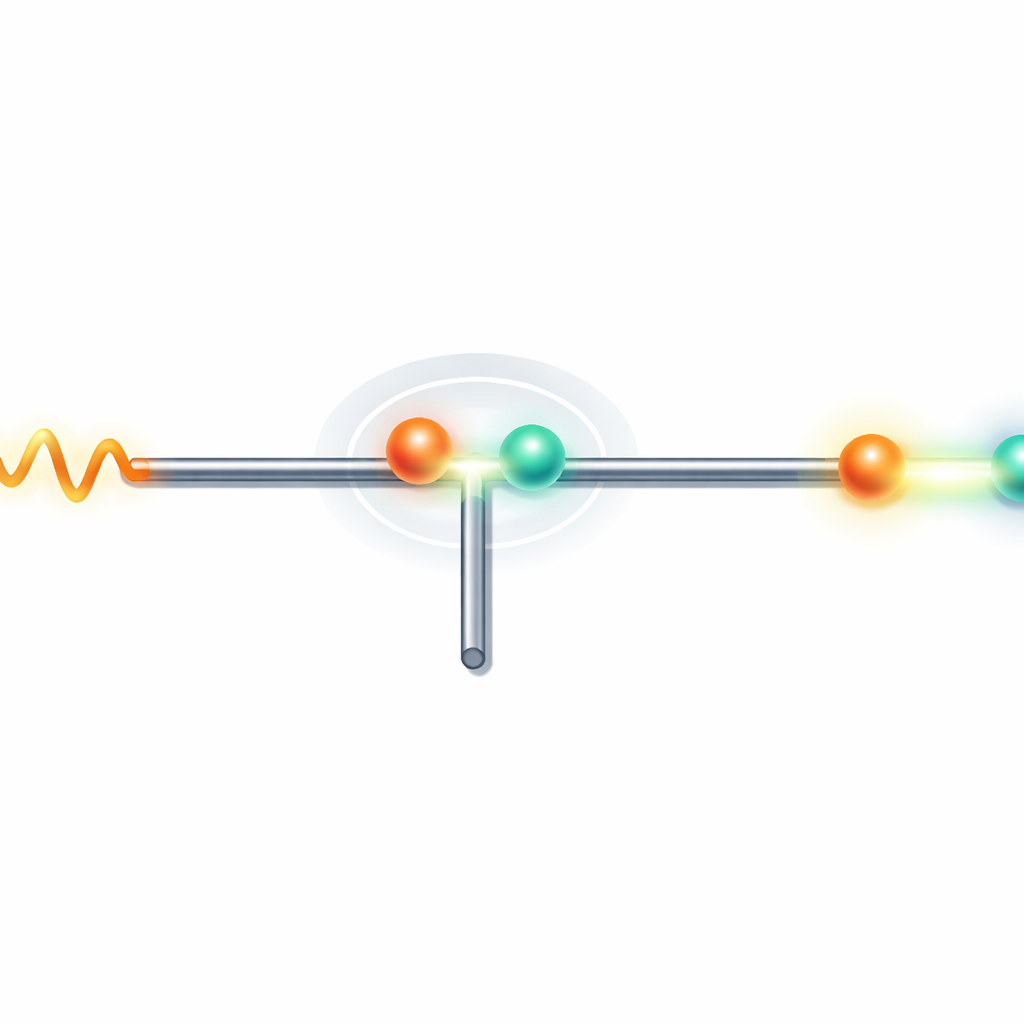
A tiny junction for guided light
At the heart of the study is a nanoscale T-junction made of a metallic waveguide that carries ripples of light called surface plasmons. One arm of the T extends indefinitely, while the other arm has a fixed length. Two semiconductor quantum dots—nanometer-sized objects that behave like artificial atoms—are placed at special locations: one where the two arms meet, and the other at the far tip of the short arm. Both sit inside the same optical cavity, a kind of light trap that boosts their interaction with the guided light. This specific layout is not just geometric decoration. Because one arm is finite, light reflecting from its end adds a controllable phase shift, turning the T-junction into a finely adjustable mixer for how the two quantum dots talk to each other.
Beyond entanglement: a tougher quantum link
Instead of focusing only on entanglement—the best-known type of quantum connection—the authors study quantum discord, a broader measure of how strongly two systems behave in ways that have no classical counterpart. Discord can survive even when entanglement has vanished, which makes it attractive for real devices that must cope with noise and loss. Using a detailed mathematical model of the T-shaped waveguide, its cavity, and the two dots, the team calculates how an incoming single plasmon excites the system and how the resulting quantum discord between the dots rises and falls over time. They find three distinct decay stages: a brief slow-down due to a quantum "Zeno" effect, a period of ordinary exponential decay, and finally a long-lived tail caused by the structured environment of the metal and cavity, which can partially feed information back into the dots.
Many knobs to tune the quantum link
The T-shaped layout with an embedded cavity offers several powerful control knobs. The length of the short arm sets a phase that can be tuned so that discord shows sharp peaks at particular values, effectively switching quantum correlations on and off. The strengths with which each dot couples to the cavity, and how far their natural colors are detuned from the incoming light, allow further fine-tuning. Even a weak direct interaction between the dots can help, by favoring a particular shared quantum state that carries high discord. Together, these parameters let designers shape how strongly the dots remain linked and how quickly those links fade, offering a richer menu of options than earlier V-shaped designs.
Closing the loop with quantum feedback
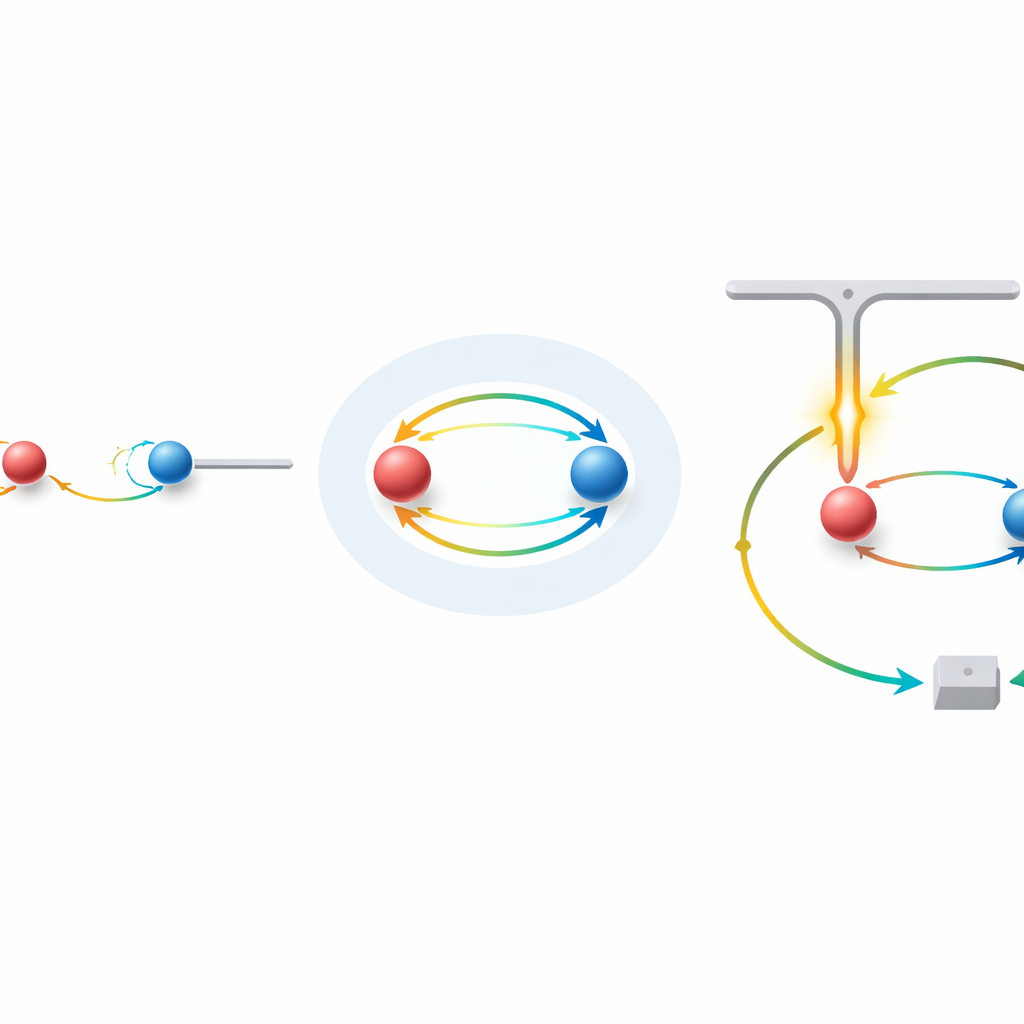
To go beyond passive tuning, the authors introduce an active feedback loop. Emitted light from the waveguide and cavity is continuously monitored, and every detection event triggers a carefully chosen operation back on the quantum dots. This feedback is designed to nudge the system into a protected pair of states that includes a well-known Bell state, where the dots are strongly and symmetrically connected. Numerical simulations show that a feedback scheme acting on both dots together significantly outperforms a purely local strategy. Under optimal conditions, the steady-state quantum discord reaches about 0.38 and remains high over a broad range of settings, meaning the protected quantum link is both strong and robust against imperfections.
What this means for future quantum chips
For a non-specialist, the key message is that the authors provide a practical recipe for building tiny optical circuits that not only generate useful quantum correlations, but actively maintain them. By combining a smart T-shaped nanostructure, a shared cavity, and real-time feedback, they show how to stabilize quantum discord—a resource that can power certain quantum computing and communication tasks even when conventional entanglement is gone. Because the proposed setup is compatible with existing metal nanowires and semiconductor quantum dots operating at room temperature, it points toward realistic quantum modules that could one day slot into integrated photonic chips, bringing quantum-enhanced technologies closer to everyday use.
Citation: Sadeghi, H., Mirzaee, M. & Zarei, R. Quantum feedback-enhanced discord in T-shaped plasmonic waveguides with embedded cavity. Sci Rep 16, 8891 (2026). https://doi.org/10.1038/s41598-026-41393-7
Keywords: quantum plasmonics, quantum discord, nanophotonics, quantum feedback, quantum dots