Turbulence is everywhere: in the air over airplane wings, in ocean currents, in the blood pulsing through your heart. Yet the way smooth flow suddenly turns into a tangle of whirls and eddies remains one of physics’ biggest puzzles. This paper proposes a new twist on that story. Instead of big swirls simply breaking into smaller ones, the authors uncover a process in which tiny vortices form first and then reorganize themselves in a striking zig-zag pattern, feeding energy back toward larger motions. Understanding this behavior could change how we model everything from aircraft drag to weather and medical flows.
How scientists usually picture turbulence
For nearly a century, the standard picture of turbulence has been an energy “cascade.” Big whirls transfer their energy to smaller whirls, which break down into even smaller ones, until the tiniest scales are smoothed out by friction in the fluid. This traditional view matches powerful statistical laws that describe how energy is distributed across different sizes of motion, notably a famous −5/3 power law. But while these laws capture the statistics of turbulence, they do not fully explain how the swirling structures in a real flow actually rearrange themselves to make those statistics appear.
A different starting point for chaos
In this study, the authors use large, high‑resolution computer simulations of an idealized flow containing a simple pair of counter‑rotating vortices. Instead of adding a turbulence model by hand, they rely on a very fine computational mesh and a carefully designed numerical method so that the smallest motions are limited only by the grid itself. As the simulation runs, the initial pair of large vortices splits into secondary vortices and the flow gradually becomes turbulent. When the researchers analyze how energy is spread across different motion sizes over time, they find that the characteristic −5/3 energy spectrum does not grow from large to small scales as the classic cascade picture suggests. Instead, it first appears at very small scales and then extends toward larger scales.
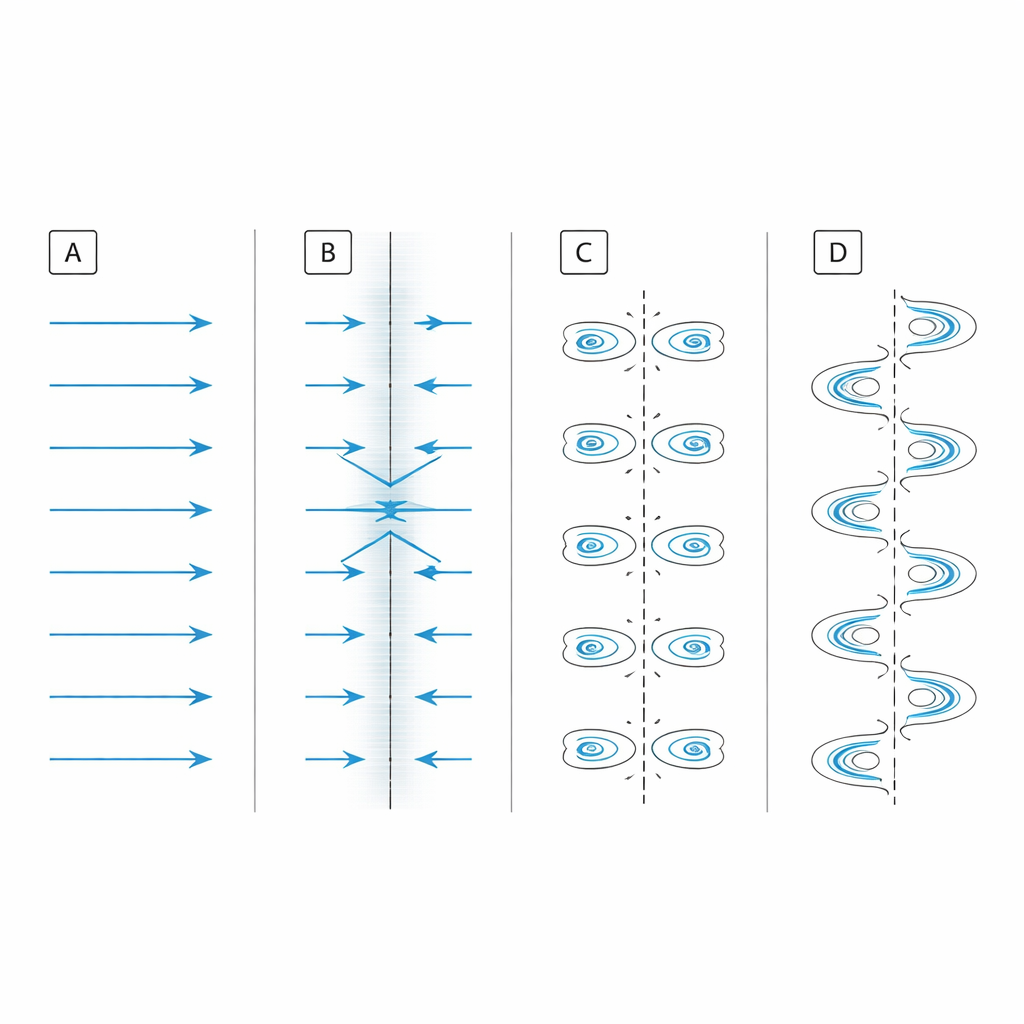
The surprising zig-zag of tiny vortices Figure 1.
To understand what structures are responsible for this upside‑down growth of the spectrum, the authors zoom in on a thin slice of the flow where activity first intensifies. Using a mathematical tool that splits the local flow into pure rotation, pure stretching, and shear, they spot the birth of an orderly row of tiny, paired vortices at the smallest resolvable scale. Once formed, these micro‑vortices do not simply merge into bigger ones. Instead, they slowly drift out of line and rearrange into a clear zig‑zag pattern. This reorganization changes the way the vortices push and pull on one another, effectively creating rotational motion on a slightly larger scale even though each individual vortex remains small.
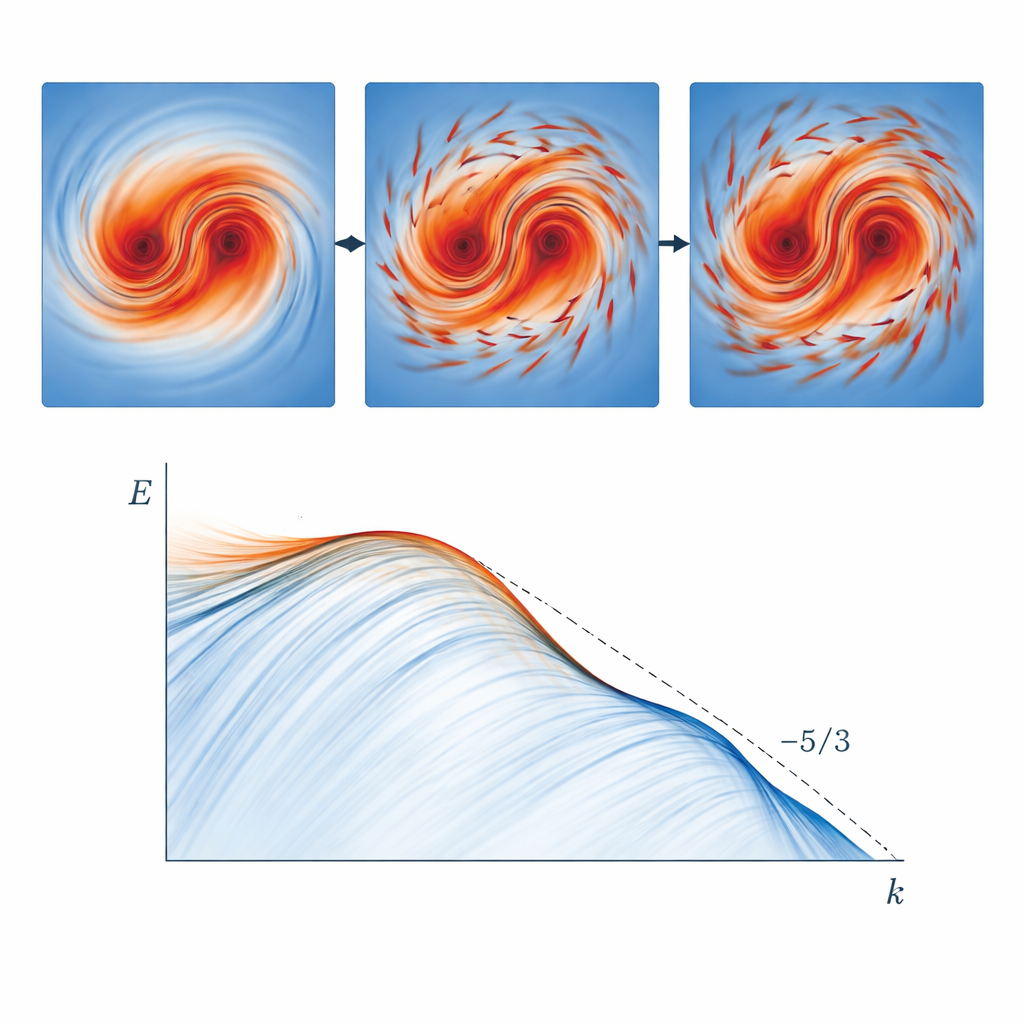
Energy running backward through the scales Figure 2.
As the zig‑zag pattern emerges, the energy spectrum reveals a rising level of energy at somewhat larger scales, while the characteristic slope spreads from high wavenumbers (small structures) toward lower wavenumbers (larger structures). The authors interpret this as an inverse transfer of energy: interactions among the smallest vortices are feeding energy back toward bigger motions, in contrast to the one‑way downhill transfer usually assumed. They show that this process can repeat itself as zig‑zag arrangements form in different regions and around larger vortices, gradually building up a full range of turbulent scales. Their stability analysis supports this picture by explaining why rotational structures can persist, while surrounding stretching and shear trigger growth and rearrangement.
A new angle on an old mystery
For non‑specialists, the key message is that turbulence may not always begin with large eddies crumbling into smaller ones. In the scenario explored here, the smallest whirls arise first, then organize themselves into a repeating zig‑zag pattern that pumps energy back up to larger structures. This offers a fresh, concrete mechanism for how the familiar turbulence spectrum can form and suggests that self‑organization among tiny vortices might play a larger role in real flows than previously thought. If confirmed in experiments and other simulations, this inverse pathway could reshape how engineers and scientists think about mixing, drag, and noise in complex flows across nature and technology.
Citation: Kronborg, J., Hoffman, J. Turbulence generation supported by an inverse energy transfer through a zig-zag pattern.
Sci Rep16, 7739 (2026). https://doi.org/10.1038/s41598-026-41372-y
Keywords: turbulence, vortices, energy cascade, inverse energy transfer, fluid dynamics