Clear Sky Science · en
Polydopamine-doped PEDOT interfaces improve cell-electrode interactions and neural signal transmission
Smarter Connections Between Brains and Machines
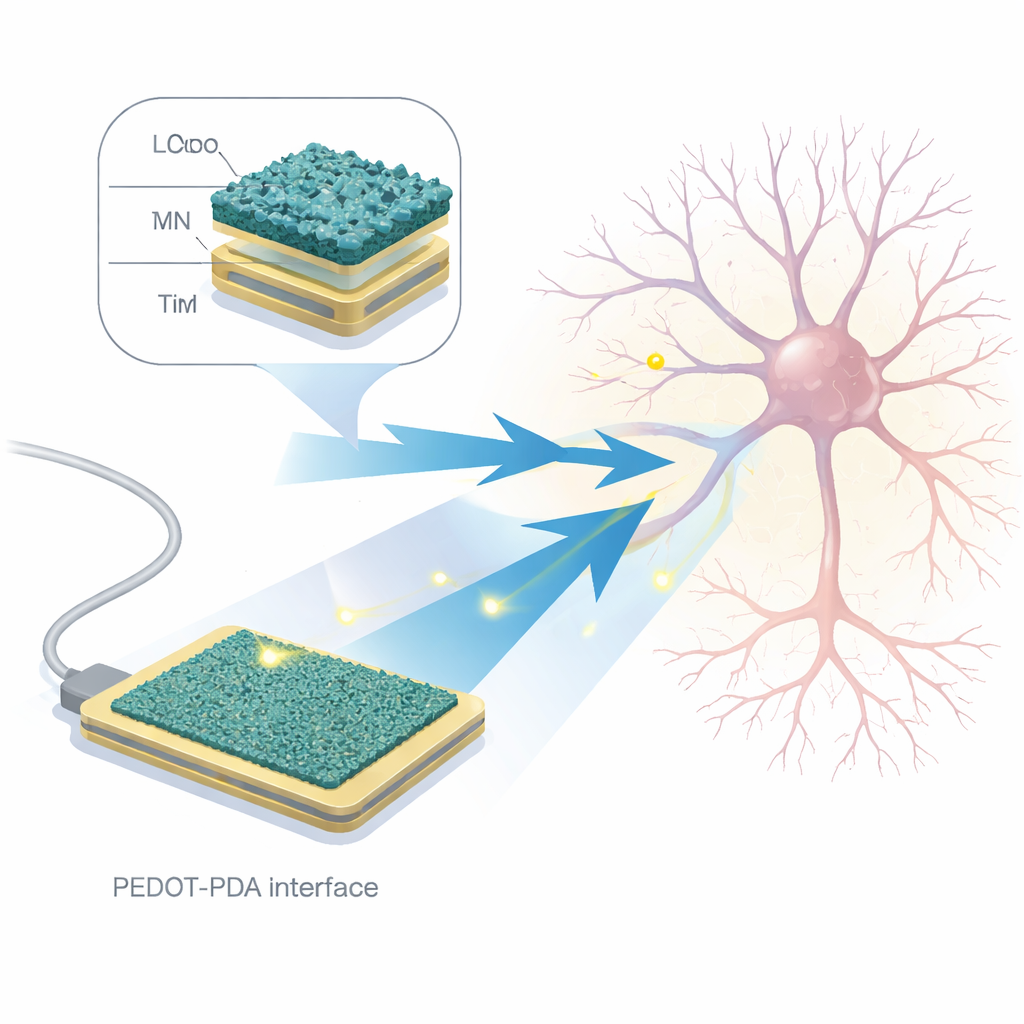
Modern brain–computer interfaces promise to restore movement, sense touch, and treat neurological disease, but they face a stubborn obstacle: our brains are soft and wet, while most electrodes are hard and dry. This mismatch leads to weak signals and irritated tissue over time. The study behind this article introduces a new electrode coating that behaves more like living tissue, helping nerve cells cling to electronics and send clearer signals across that delicate border.
Why Today’s Brain Electrodes Fall Short
For decades, doctors and engineers have relied on noble metals such as platinum, gold, and iridium to record brain activity. These metals conduct electricity well, but they do not communicate gracefully with living cells. Their stiff, smooth surfaces create high electrical resistance, which blurs tiny neural signals, and their rigidity can strain nearby brain tissue. To overcome these limitations, researchers have turned to soft, carbon-based conductors known as conductive polymers. Among them, a material called PEDOT has stood out for combining flexibility, good conductivity, and long-term stability. However, the most common way of formulating PEDOT uses an acidic additive that can swell, crack, and potentially irritate cells, motivating the search for gentler, more stable partners.
Blending a Brain Chemical into a Soft Electrode
The team behind this work combined PEDOT with polydopamine, a polymer formed from dopamine—the same molecule that helps brain cells talk to one another and also acts as a natural adhesive in mussels. They carefully tuned the electrochemical recipe so that PEDOT and polydopamine grew together as an interwoven film on top of a thin titanium nitride layer, itself deposited on glass. Electron microscopy showed that this hybrid coating, called PEDOT‑PDA, is compact and tightly packed, unlike looser, more granular pure PEDOT. At the same time, atomic force microscopy revealed that its outer surface is far rougher on the nanometer scale, resembling the fibrous mesh of proteins that surrounds cells in the body. This tissue-like landscape gives cells more footholds and room to explore.
Wetter Surfaces, Quieter Electrodes
One striking change brought by adding polydopamine is how the surface interacts with water. Bare titanium nitride and pure PEDOT beads up water droplets much like a waxed car hood, indicating a relatively water-fearing surface. In contrast, PEDOT‑PDA becomes almost super‑wetting: droplets spread out into a thin film. Such hydrophilic behavior is important in the body, where salts and proteins float in watery surroundings. A wetter surface helps the coating blend with bodily fluids and form a stable, low-resistance contact with tissue. Electrical tests in saline solution showed that PEDOT‑PDA electrodes have much lower impedance—a measure of opposition to signal flow—than both metal and PEDOT‑only electrodes, especially at the kilohertz frequencies typical of neural spikes. In fact, their impedance at this key frequency is roughly 94 percent lower than that of standard gold electrodes, allowing tiny voltage changes from neurons to be captured with less noise and distortion.
Helping Cells Settle In and Talk
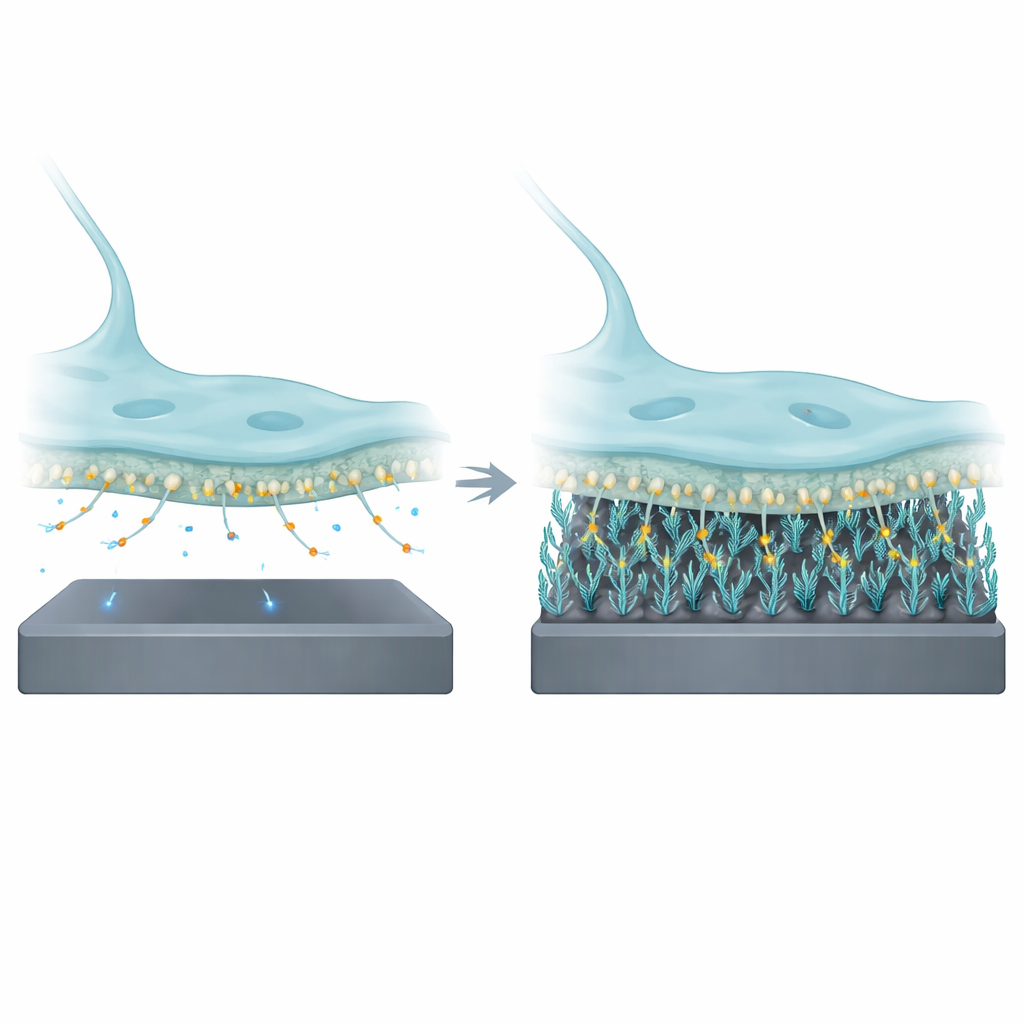
Of course, a better electrode must also be a better neighbor to living cells. The researchers cultured fibroblast cells on uncoated titanium nitride, pure PEDOT, and PEDOT‑PDA surfaces. All samples met basic safety benchmarks, but cells on PEDOT‑PDA spread more widely, extended numerous thin projections, and appeared firmly anchored into the rough coating. Live–dead staining confirmed high cell survival, and microscopy showed the cells’ filopodia—finger-like extensions—penetrating into the nanostructured layer. To peek beneath the microscope images, the team ran detailed computer simulations of how short segments of PEDOT and polydopamine interact with a model cell membrane. These virtual experiments found that adding polydopamine dramatically strengthens the attraction between the coating and the membrane, increases the number of molecular contact points, and even boosts the side‑to‑side motion of molecules along the interface, which can ease the flow of ions that carry neural information.
What This Means for Future Brain Technology
Put simply, the PEDOT‑PDA coating makes electrodes that are softer, wetter, and friendlier to cells, while also behaving as superior electrical antennas for brain signals. The material lowers the barrier between living tissue and electronics: cells hold on more tightly, electrical resistance drops, and the dance of ions and electrons across the interface becomes more efficient and dynamic. This combination of biological comfort and electrical performance is exactly what is needed for durable, high‑fidelity brain–computer interfaces, sensitive biosensors, and body‑worn electronics. While further testing in actual neural tissue and in living animals will be essential, this work points toward electrode coatings that can listen to the brain more clearly—without shouting back at it in the form of irritation and long‑term damage.
Citation: Ahmadi Seyedkhani, S., Kalhor, S., Iraji zad, A. et al. Polydopamine-doped PEDOT interfaces improve cell-electrode interactions and neural signal transmission. Sci Rep 16, 10443 (2026). https://doi.org/10.1038/s41598-026-41328-2
Keywords: neural interfaces, conductive polymers, brain-computer interfaces, electrode coatings, cell-electrode interactions