Clear Sky Science · en
Dynamic causal modeling of low-density resting-state EEG in long-term meditation practitioners
Why This Matters for Everyday Mind and Mood
Meditation is often praised for bringing calm, focus, and emotional balance—but what does long-term practice actually do inside the brain? This study looks at Tibetan Buddhist monks, many with decades of daily practice, to see how their brains work at rest. By carefully measuring tiny electrical signals on the scalp, the researchers show that lifelong meditation is linked to lasting changes in how key brain networks talk to each other, especially those tied to self-awareness and how we react to important events.
A Unique Window into Lifelong Practice
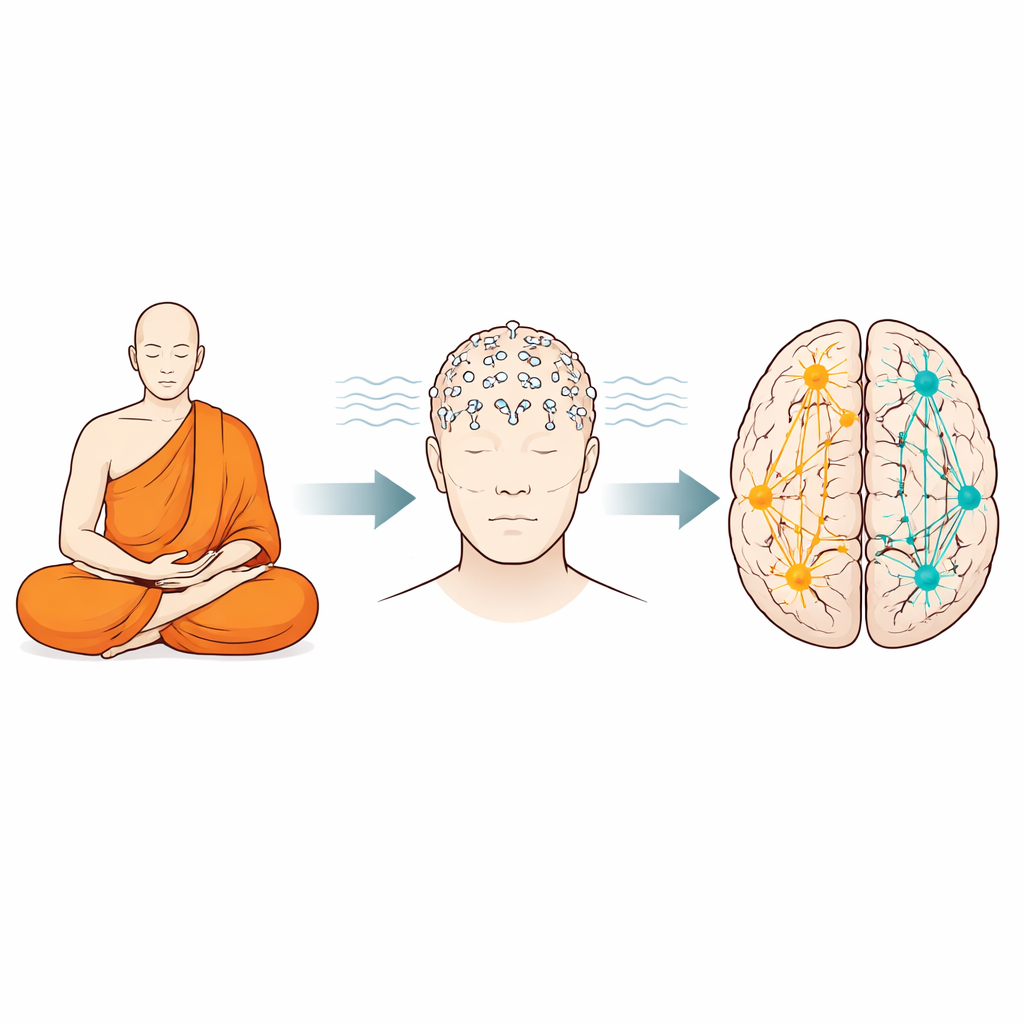
Most meditation studies follow people for a few weeks or months and rely on mixed groups of volunteers. Here, the team worked with a rare and highly consistent community: 23 male monks and scholars (Geshes) from Sera Jey Monastic University in India. These practitioners shared a common cultural background and Buddhist training but differed widely in meditation experience, from less than a year to full-time meditators with long retreat histories. This setting let researchers treat meditation as a long-term “training regime” and ask how more years of practice might reshape the resting brain, even when people are simply sitting quietly with eyes closed.
Listening to the Resting Brain with EEG
The scientists recorded brain activity using a 19-channel EEG cap, a portable system that tracks fast electrical rhythms from the scalp. After careful cleaning of the signals to remove blinks, muscle noise, and other artifacts, they focused on the central three minutes of a five-minute resting period, avoiding the brain’s transition into and out of formal meditation. Rather than just asking which areas were active, they used a sophisticated modeling approach to estimate how specific brain regions influence each other over time. This method, called dynamic causal modeling, allowed them to infer the direction and strength of communication within two major networks: the default mode network, linked to self-focused thought and mind-wandering, and the salience network, which helps the brain notice and prioritize important inner and outer events.
Two Key Networks: Self-Focus and Reactivity
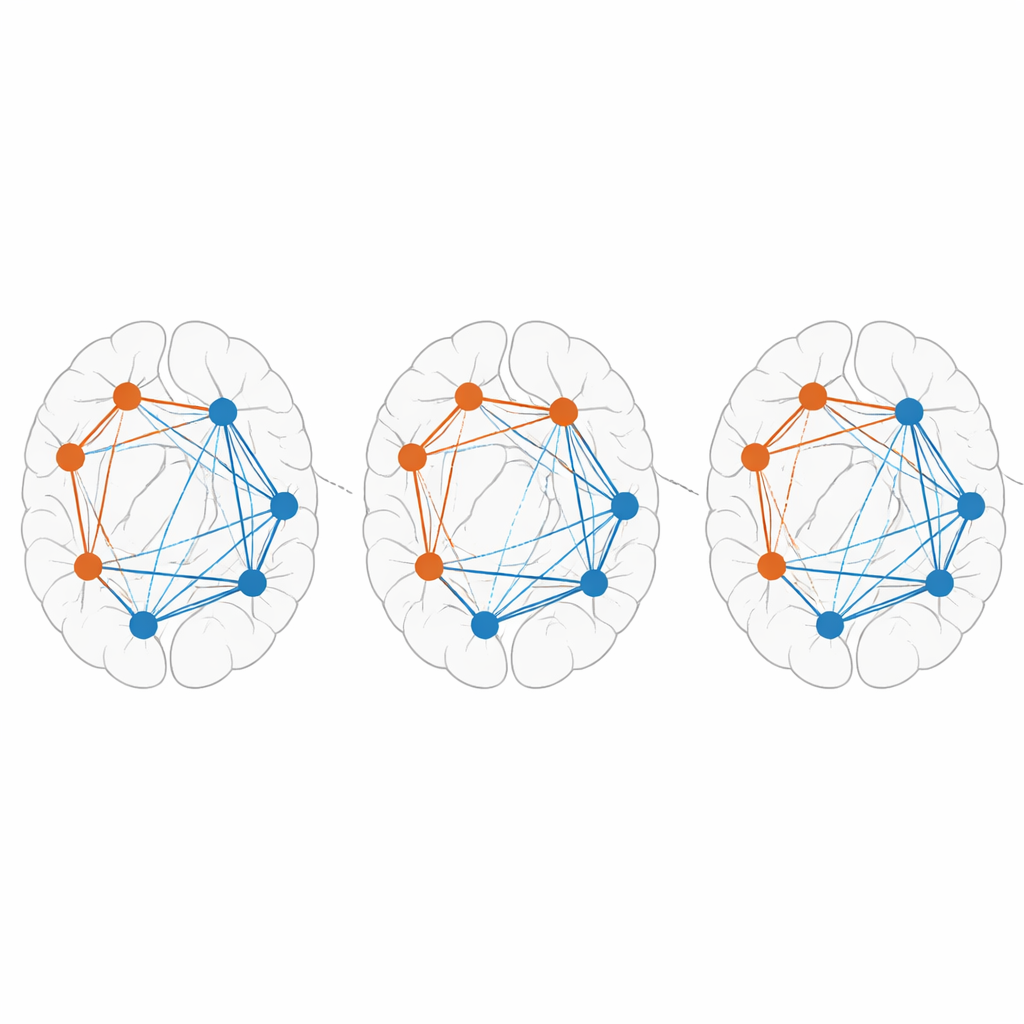
The default mode network includes midline regions involved in reflecting on oneself, recalling personal memories, and drifting into daydreams. The salience network, in contrast, helps detect what matters—emotionally charged events, bodily signals, or sudden changes in the environment—and shifts attention accordingly. The study found that, across all monks, connections that send information up and down the brain’s hierarchy tended to be weaker at rest than expected, while side-to-side links within the same level were stronger. More intriguingly, some connections in the self-focused network showed gentle, rhythmic changes in strength over time, suggesting that even at rest, the brain’s self-monitoring system subtly pulses rather than remaining fixed.
How Experience Shapes Self-Awareness and Reactivity
When the researchers compared beginners, intermediate practitioners, and advanced meditators, clear patterns emerged. In the default mode network, a key feedback connection from a region that integrates internal context (the precuneus) to a parietal area that links self-related information with external perspective showed larger oscillations in more experienced meditators. In plain terms, with more years of practice, the brain’s internal “self-monitoring loop” became more dynamically tuned, as if experienced meditators could more finely adjust the balance between inner awareness and outer context. In the salience network, the opposite trend appeared: a connection between left and right parietal regions—important for orienting to significant stimuli—grew weaker with higher experience. Another connection from a frontal control region back to parietal cortex also fluctuated less in seasoned practitioners. These changes suggest that, over time, the brain’s reactivity to potential distractions is dialed down, making attention less likely to be pulled away by every new signal.
What This Means for the Meditating Mind
Taken together, the findings point to a brain that, with long-term meditation, becomes both more inwardly stable and more selectively responsive. The network that supports self-reflection seems to gain a more refined, coordinated structure, while the network that flags salient events becomes less prone to automatic, reactive firing. Even though the study has limits—such as a modest sample size and no non-meditator control group—it offers rare evidence, from a culturally rich monastic setting, that years of contemplative practice leave a lasting imprint on the brain at rest. For the everyday meditator, this supports the idea that consistent practice may gradually cultivate a quieter, less easily distracted mind and a more grounded sense of self.
Citation: Rho, G., Bossi, F., Norbu, N. et al. Dynamic causal modeling of low-density resting-state EEG in long-term meditation practitioners. Sci Rep 16, 8691 (2026). https://doi.org/10.1038/s41598-026-41310-y
Keywords: meditation, EEG, brain networks, default mode network, salience network