Clear Sky Science · en
Effect of vest structure, airflow velocity, and humidity on evaporative cooling capacity using a thermal manikin
Staying Cool When the World Heats Up
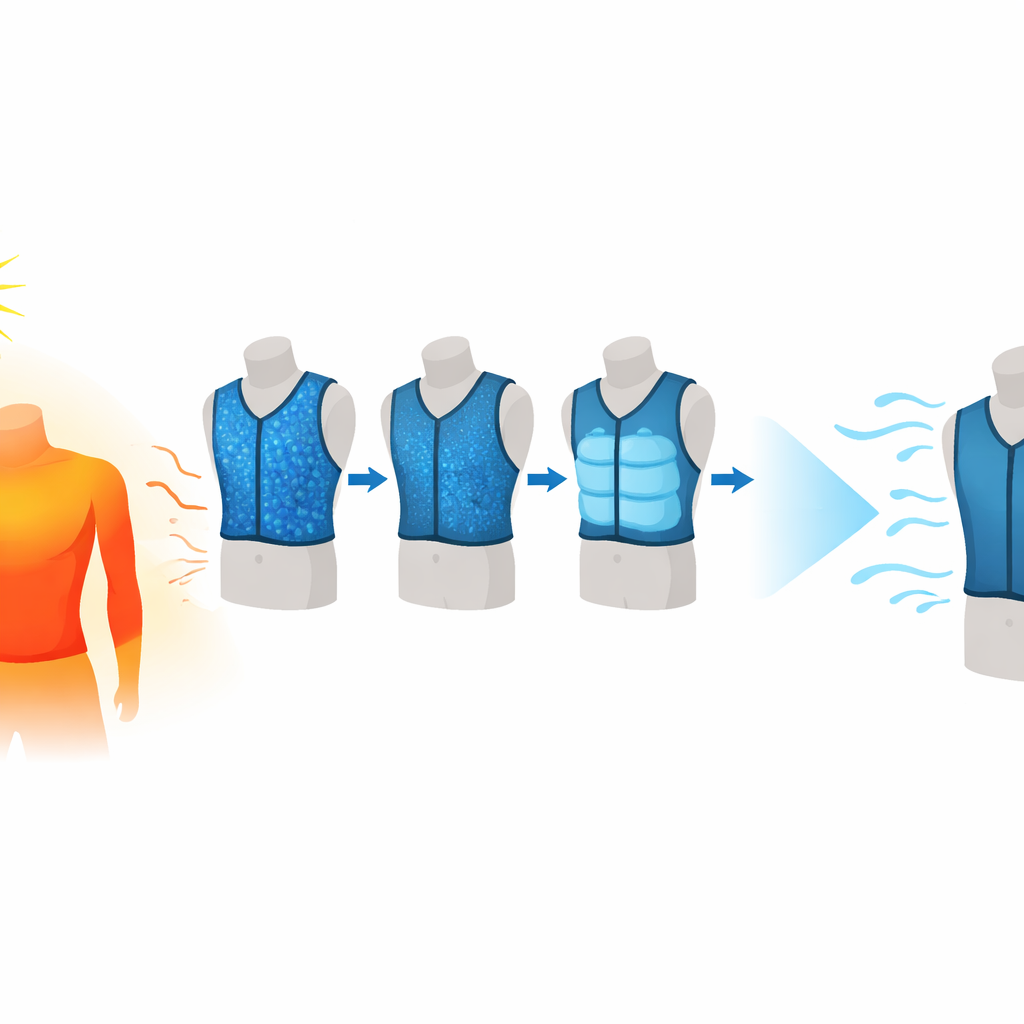
As summers grow hotter and heat waves more frequent, millions of people who work outdoors or in hot factories face rising risks of exhaustion, illness, and injury. One promising line of defense is the simple-looking cooling vest, which holds water and uses evaporation to draw heat away from the body. This study asks a practical question with real-world consequences: which types of evaporative cooling vests work best, and under what combinations of temperature, airflow, and humidity do they offer the greatest protection?
Why Cooling Vests Matter for Workers
Heat stress is not just uncomfortable; it can damage organs, slow thinking, and raise the chance of on-the-job accidents, especially in jobs like construction or agriculture where heavy gear and hard labor are the norm. Traditional cooling garments that circulate chilled water or use special wax-like materials can be effective but are often heavy, expensive, or dependent on external power. Evaporative cooling vests, by contrast, are light, inexpensive, and rely only on water and moving air. When water in the vest turns into vapor, it takes heat with it, helping to keep the wearer’s core temperature in check during long, hot shifts.
Putting Four Vest Designs to the Test
To compare designs fairly, the researchers used a heated copper torso known as a thermal manikin, kept at typical skin temperature and placed inside a climate-controlled chamber. They tested four vests: two based on polymer gels (one with extra punch holes, one without), one built around a cellulose-based core, and one widely sold commercial model. Each vest was soaked in water, then worn by the manikin in air temperatures of 35 or 40 degrees Celsius, under two humidity levels and three air speeds ranging from almost still air to a strong breeze. By measuring how much power the manikin needed to stay warm over two hours, and how much water each vest lost, the team could calculate cooling capacity and how efficiently each kilogram of water was turned into useful cooling.
What Makes One Vest Cooler Than Another
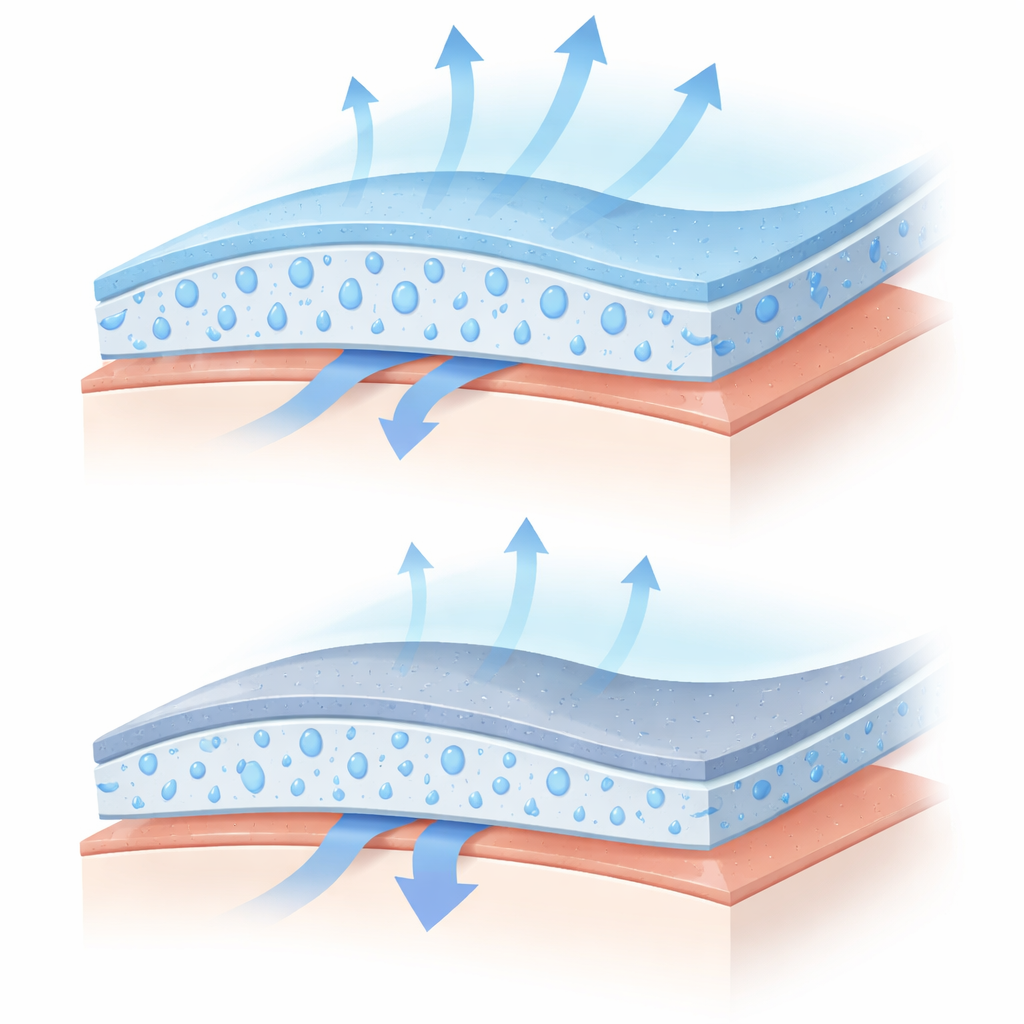
The standout performer across most hot, dry conditions was the cellulose-based vest. Its structure—a porous, absorbent layer combined with breathable outer fabrics—held more water while still allowing air to pass through, which encouraged steady evaporation rather than quick drying. Under the hottest, driest, fast-airflow setting, this vest delivered the highest average cooling power, while the commercial vest lagged behind in every test, largely because it stored less water and dried out faster. Among the polymer vests, the version without punch holes typically cooled better and for longer than the perforated one, whose holes encouraged rapid, uneven evaporation and a quicker drop-off in performance over time.
How Airflow and Humidity Tilt the Balance
Air movement turned out to be a double-edged sword. Moderate to strong airflow usually boosted the immediate cooling power of the vests, especially the cellulose and solid polymer designs, by speeding up evaporation. However, that same airflow drained water more quickly, which meant that efficiency—how much of the water’s cooling potential was actually used to cool the manikin—often fell as fans sped up. In contrast, higher humidity made everything worse: when the air was already moist, water in the vest evaporated more slowly, cutting cooling power by roughly a quarter or more. Thermal camera images of the vest surfaces confirmed these trends visually, showing cool, damp areas shrinking over time, particularly when the air was moving fast.
What This Means for Real-World Heat Protection
Viewed from a layperson’s perspective, the message is straightforward: in hot, dry climates, a well-designed, water-rich, breathable vest can significantly ease heat strain for workers and athletes, especially when some airflow is present. Cellulose-based cores and thoughtfully engineered fabric layers outperform simpler, low-capacity designs. Yet there is a trade-off between instant strong cooling and how long a vest stays effective before it needs to be re-soaked. In muggy conditions, any evaporative vest will struggle, and other cooling strategies may be needed. Overall, the study offers concrete guidance for designing and choosing cooling vests that make it safer to work hard in a warming world.
Citation: Soleimani, N., Dehghan, A. & Dehghan, H. Effect of vest structure, airflow velocity, and humidity on evaporative cooling capacity using a thermal manikin. Sci Rep 16, 8878 (2026). https://doi.org/10.1038/s41598-026-41309-5
Keywords: evaporative cooling vests, heat stress, occupational heat exposure, cooling garment design, airflow and humidity